Lifetime Citizen Portal Access — AI Briefings, Alerts & Unlimited Follows
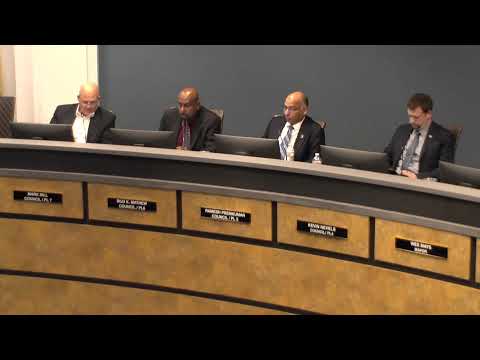
Coppell council keeps public hearing open on proposed shopping center after residents press for more study
Loading...
Summary
Residents urged preservation of mature trees, stricter trash and delivery times, and a formal traffic study for a proposed 14,480‑sq‑ft commercial development bordering Arbor Manors; council continued the public hearing to April 28 to allow more neighborhood‑developer discussion and staff follow‑up.
The Coppell City Council kept a public hearing open on a proposed commercial development (PD‑214 R10‑C) after more than two dozen residents urged conditions to protect adjacent homes.
City planner Mary Peron Boswell summarized the proposal and Planning & Zoning Commission recommendations, saying the developer will preserve 39 existing trees and plant about 38 overstory trees, add Nellie R. Stevens along the southern perimeter for screening, and that signage will have to meet city requirements. Boswell listed six staff conditions, including a detailed engineering review and a directive for staff to "take a detailed look at traffic." She told council the project did not meet ordinance thresholds for a traffic‑impact analysis (TIA).
Neighborhood leaders and homeowners told the council they accept that the land is zoned for commercial use but asked for stronger protections. "I'm not here to stop this development," said Artin Kulkarni, a homeowner behind the site, asking the council to require preservation of mature trees, a taller boundary wall, relocation or reconfiguration of the proposed second entrance, direction of restaurant ventilation away from homes, and a wildlife survey before clearing. Dan Robicheaux, president of the Arbor Manors HOA, asked that the east entrance be moved west and restricted to entrance‑only and that the number and density of replacement trees be increased.
Other speakers, including attorneys representing affected homeowners, pressed the council for specific conditions: prohibiting an outdoor patio or outdoor music, limiting operating hours (no operations after 9 p.m.), banning future drive‑throughs, and restricting trash pickup hours to between 7 a.m. and 9 p.m. Neighbors repeatedly called for a formal traffic study because they said existing crash data flags nearby intersections as high‑risk.
Several council members said the objections raised were substantial. Some members preferred denying the application to force a redesign; others favored more time for the developer and neighborhood to negotiate. After discussion and an executive‑session consultation with the city attorney, the council voted to continue the public hearing to April 28 so staff, the applicant and residents can pursue additional meetings and technical follow up.
The council’s continuation preserves neighbors’ ability to return with specific proposals and gives staff time to clarify the scope of a traffic review tied to the PNZ condition. No land‑use vote was taken; the public hearing remains open.