Get Full Government Meeting Transcripts, Videos, & Alerts Forever!
Get email alerts on the Water Rates topic
No spam. Unsubscribe anytime.
Lucas council accepts Raftelis water and wastewater rate study, sets February public hearing
Summary
Lucas City Council accepted a consultant’s five‑year water and wastewater rate study and directed staff to prepare an ordinance implementing a five‑tier rate structure; the council set a public hearing for the first meeting in February 2026 and was told the plan would include a prorated 6% increase in 2026.
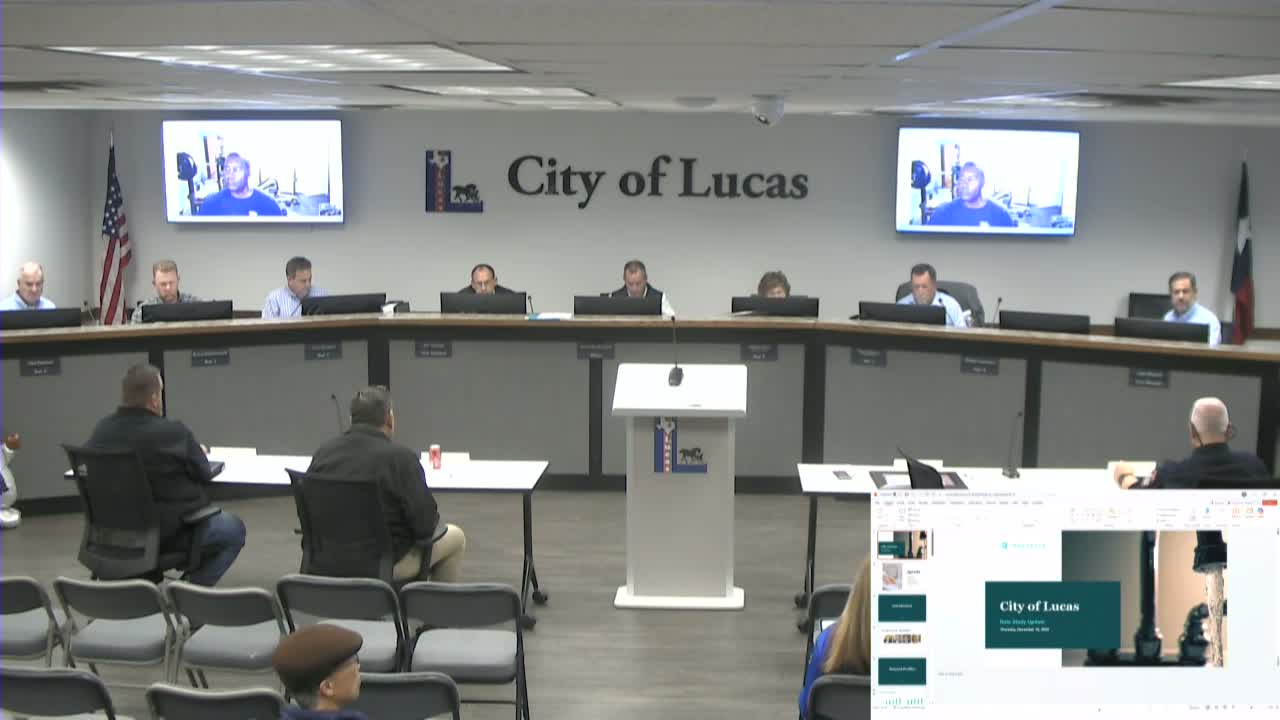
The Lucas City Council on Dec. 18 accepted a five‑year water and wastewater rate study by consultant Raftelis and directed staff to draft an ordinance to implement a five‑tier rate structure and schedule a public hearing at the council’s first meeting in February 2026.
The study, presented by Christopher Williams of Raftelis, forecasts about 2,850 residential meters in fiscal 2026, growing roughly 1% annually to about 2,965 by 2030, with residential demand of about 659 million gallons in 2026 and 684 million gallons by 2030. Major cost drivers Williams cited include $761,000 in 2026 building improvements, $946,000 in cash‑funded capital for 2026 and about $5.6 million over two years, purchase water costs of about $3.5 million in 2026 (roughly $24 million over five years) tied to North Texas Municipal Water District charges, and a proposed $9 million debt issuance in 2029.
Williams recommended a prorated 6% rate increase in 2026 (modeled to take effect in February for eight months) followed by a 6% increase in October 2027 and annually thereafter in the model. "I'm recommending a 6% increase in 2026, which technically we've prorated in the model," Williams told the council.
He explained the proposed five‑tier residential structure is intended to lower typical bills for average users while charging more for very high users. For a representative 1‑inch meter residential account (about 19,200 gallons annually), Williams showed the current 2025 bill at roughly $193.37; a simple 6% across‑the‑board increase (Option 1) would be about $204.98, while Raftelis’ recommended structure (Option 2) produced an example bill of about $176.37 for that average user.
Councilmembers questioned assumptions about demand variability, commercial growth, and how the plan treats very large users. Williams said the demand model uses a four‑year average and that the city’s reserves make it resilient to wet or dry years; he also offered to provide a bill‑frequency breakdown showing how many customer bills fall into each tier.
Councilmember Neil Peterson moved to accept the study and five‑year financial plan and directed staff to prepare an ordinance (including billing for the first gallon) consistent with the study and to schedule a required public hearing. Members amended the motion to set the public hearing for the first meeting in February 2026 to allow sufficient time for ordinance preparation and public notice. The motion carried by unanimous voice vote. The council did not record an individual roll‑call tally in the minutes.
Next steps: staff will prepare the ordinance amending the fee schedule, publish required public notice for the February meeting and provide additional bill‑frequency details to the council and public ahead of the hearing.