Lifetime Citizen Portal Access — AI Briefings, Alerts & Unlimited Follows
Charlottesville presenters propose 80‑bed low‑barrier shelter at 2000 Holiday Drive; council presses on costs and transit
Loading...
Summary
A regional working group proposed converting 2000 Holiday Drive into an 80‑bed low‑barrier shelter and service hub with day services, case management and a potential clinic; presenters said capital costs are about $8.6M but warned operating funding and transit will require regional contributions and further planning.
Charlottesville City Council on March 25 heard a detailed proposal to transform 2000 Holiday Drive into a low‑barrier, housing‑focused shelter and service hub that would house about 80 single adults and colocate multiple service providers.
The Blue Ridge Area Coalition for the Homeless and partner agencies presented a conceptual design, program model and cost estimate. "Our capital costs have reduced roughly 11% from 9,700,000 to 8,600,000," said Shayla Washington, executive director of the Blue Ridge Area Coalition for the Homeless, summarizing the current estimate and saying the project would support day shelter services, coordinated entry, case management and links to health care and workforce supports.
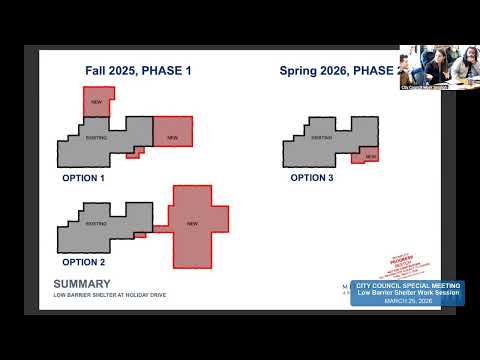
Architect Aaron Hannigan of Mitchell Matthews Architects and Planners described a test‑fit that places most overnight shelter areas on the second floor with pods and 8‑person bedrooms. "In conclusion, we currently have 80 beds, requested to be in the project now," Hannigan said, adding the design includes isolation rooms, gender‑neutral rooms and space for case management and support staff.
The proposal calls for renovating roughly 26,000 square feet with just under 4,000 square feet of new construction. Hannigan said the entitlements and site plan process could take about 12–18 months, with construction another roughly 12 months, and cautioned that the renovation scope means savings from reduced footprint are offset by heavier interior work.
Partners and operating model
The working group outlined which organizations would run which services: BRAC would remain the Continuum of Care lead agency, The Haven would manage day shelter operations and PACHA (Pacham/PACHA) would run overnight shelter operations. Sunshine Nathan, executive director of Piedmont Housing Alliance, praised the regional cooperation that produced the plan.
Owen Brennan, executive director of The Haven, said the Haven’s board voted March 17 to endorse participation. "Last night, the Haven's board has approved a resolution that endorses the Haven's participation in and commitment to the housing‑oriented low barrier overnight shelter at 2000 Holiday Drive," Brennan said.
Transit, staffing and operating costs
Presenters said transportation is a critical requirement. The working group proposed a dedicated shuttle loop connecting Holiday Drive with UVA Medical Center, downtown and service locations; initial rough pricing was estimated at about $411,000 per year. "It would cost them $411,000 to run that shuttle service annually," a presenter said during the transportation discussion.
Agencies also outlined staffing and operating needs. Cameron Moore, interim executive director for PACHA, said the operating scale required to staff the expanded facility represents a significant increase over current budgets: "This is a 293% increase in terms of our current operating budget this fiscal year to what we would need to be able to do that." Moore said the figure is an approximation and that the organizations expect to pursue philanthropic and regional government support.
Council questions and concerns
Council members pressed presenters on comparative options, cost per bed, long‑term operating funding and how the move would affect downtown services. One councilor noted that 80 beds at the $8.6 million capital estimate implies "roughly a $110,000 per bed" and asked whether earlier options that would have yielded ~108–113 beds could be more cost‑effective.
Councilors repeatedly asked where annual operating funds (discussed in the millions) would come from; presenters said they expect a regional funding approach and increased philanthropic support rather than Charlottesville bearing the full annual cost alone. Presenters also said The Haven does not own its current building at 112 West Market Street, so selling that site to fund Holiday Drive is not an immediate option.
Questions also focused on accessibility and code compliance; the architect said the existing building does not meet current accessibility requirements and that ramps, curb cuts and egress work would be addressed in the permitting process. Presenters said the proposed clinic fit‑out is priced separately and that clinical partners such as UVA Health have been consulted about spatial needs but not yet engaged at executive/funding levels.
Next steps and schedule
Presenters described a phase‑3 scope that includes aligning policies and MOUs among colocated agencies, fundraising, community engagement with nearby businesses and neighbors, procurement and AE (architecture/engineering) design. The group recommended further technical review by city staff for zoning and site plan compliance. The typical schedule presented would put entitlements and site plan approvals at 12–18 months, construction at about 12 months, and additional time for procurement and fundraising.
Council took no formal action on the proposal at the meeting. The special meeting was adjourned by unanimous voice vote after questions and discussion. City staff and the working group said they will return with additional technical and financial details as they pursue phase‑3 work and engage regional partners for operating support.
Ending
City Manager closing remarks emphasized that Holiday Drive is a significant, expensive step but not a standalone solution to homelessness and that regional coordination and further technical work will be required before implementation.