Get Full Government Meeting Transcripts, Videos, & Alerts Forever!
Get email alerts on the Border Wall topic
No spam. Unsubscribe anytime.
Laredo council hears staff update on Border Patrol "smart wall," residents press for independent flood study and data sharing
Summary
At a special April 16 meeting, City of Laredo staff briefed council on Border Patrol 'smart wall' plans and the city's evaluation strategy; residents and landowner groups urged independent hydraulic studies, warned of flood risks, and pressed for enforceable data-sharing before granting federal access.
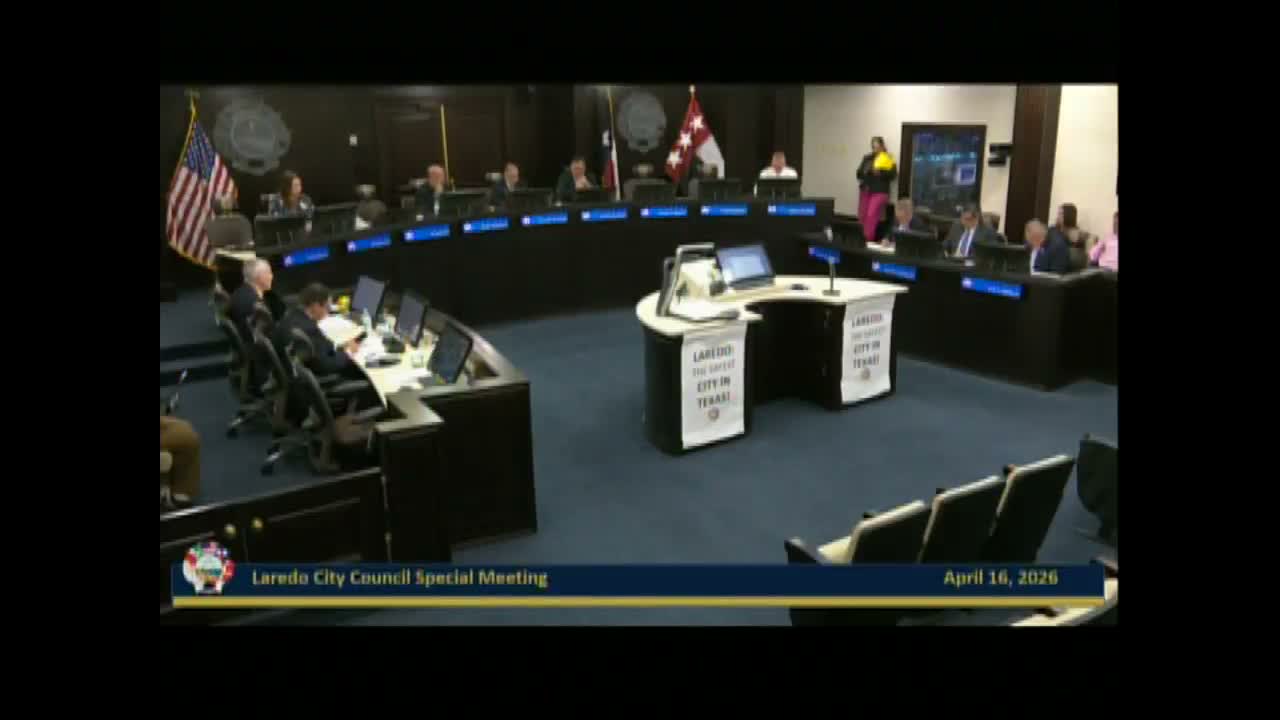
Laredo’s City Council held a special meeting April 16 to review federal Border Patrol plans for a "smart wall" along stretches of the Rio Grande and to hear dozens of residents and landowners who warned the project could worsen flooding.
Staff summarized the city’s long-running coordination with Border Patrol and consultants, outlined design elements the agency has described (a 28–30 foot physical barrier with buoys and technology), and said the federal government has provided partial maps and has agreed to supply additional design and modeling data. The presenter (staff member) said the city is asking for that data and is preparing to "trust but verify" with independent technical reviews: "Right of entry is not project approval," the staff member said, adding that the requested access primarily supports surveys, borings and data collection rather than immediate construction.
Why it matters: Residents, landowners and advisory-committee members repeatedly told the council that the only detailed analysis available (the Tompkins report, commissioned by local stakeholders) suggests the wall and buoy system could accelerate flows and increase flood risk near Laredo. Ricardo Deanda, representing the Rio Grande Landowners Association and the Riverfront Advisory Committee, said his group paid $15,000 for an independent study and urged the council to commission its own hydrology or hydraulic analysis before endorsing broad federal access or accepting project specifications: "Hire someone," Deanda said. "A professional will tell you what it costs and how long it takes; don't decide that administratively."
What staff told the council: City staff said the federal side has committed to providing what data it can, but that some critical information (such as geotechnical borings and final engineering) requires access to property before definitive modeling is possible. Staff recommended an independent audit of federal models when available, and proposed a broader city flood-plain study (staff gave a high-level estimate of roughly $1,000,000 for ~20 river miles, with a possible Webb County cost-share) to update FEMA-era mapping and provide a defensible technical baseline.
Public response and demands: Speakers during public comment framed the choice as urgent and existential. Public commenter Jesse Guillermo said, "They took our water. They took our land," and urged the council to resist measures that could harm the river and community. Multiple commenters asked council to require legally binding assurances that any federal surveys or studies would share full data with the city and to delay approvals until the city’s own hydraulic experts can independently test federal models. Sayedida Chathamontalgo (resident) asked council to "hold the line" and not cooperate with federal construction without trust and transparency.
Council reactions and next steps: Several council members pressed staff about interlocal options and whether a formal city resolution or interlocal agreement with Webb County and Laredo College would strengthen the city’s negotiating position; staff agreed to prepare recommended documents and to continue daily coordination with Border Patrol and legal counsel (Jackson Walker) and consultants (Bowman Consulting). Council did not take final action on project approvals at this meeting; instead members passed motions directing staff to pursue coordination documents and prepare a path for independent review and for using federal data when available. Staff noted federal timelines could move quickly, and that the Border Patrol has indicated intent to build to a 100-year base flood elevation and a federal project timeline that includes completion milestones into 2028.
What remains unresolved: The council and speakers repeatedly emphasized two open facts: (1) several important engineering data sets are not yet available to the city, and (2) any city study will take months and might not prevent the federal agency from proceeding. Council members and staff said they will continue negotiations and pursue independent technical review of federal modeling when the data are delivered.
The council then moved to the next agenda items; no further votes on construction or ROE approvals were taken at this session.