Get Full Government Meeting Transcripts, Videos, & Alerts Forever!
Get email alerts on the Communications topic
No spam. Unsubscribe anytime.
Duval officials unveil communications overhaul and new Data Triangle survey with strong participation
Summary
New cabinet communications member Arwen Fitzgerald outlined a six-part restructuring to boost trust and reach; Natasha Barnes, director of strategic planning, reported high participation in the district’s new Data Triangle survey and described plans for town halls and KPI alignment.
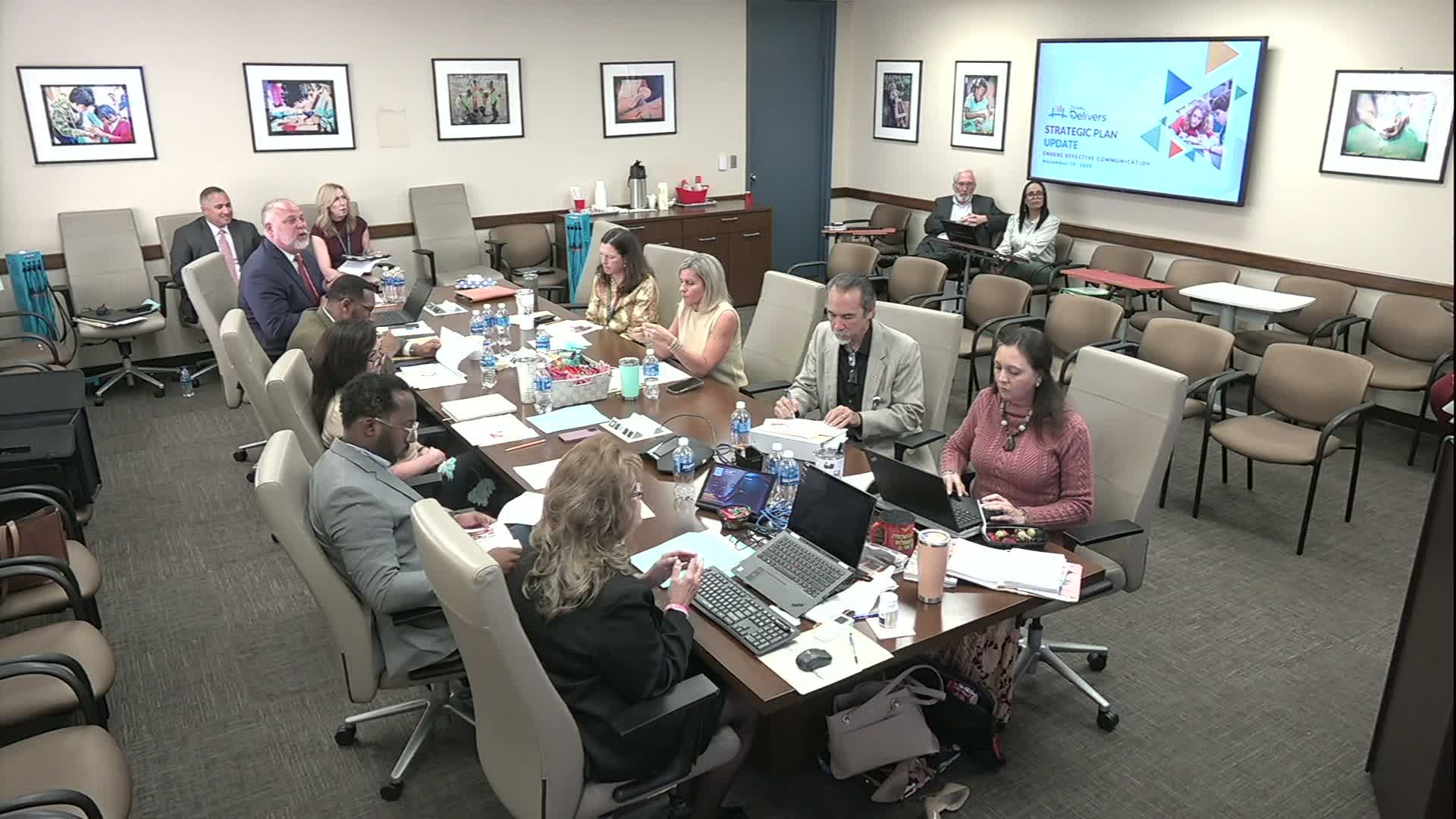
Arwen Fitzgerald, a new member of the district’s communications cabinet, told the Duval County School Board that the district is reorganizing its communications team to focus on six areas — content creation, social media, family engagement, community relations, media relations and reputation management — to improve trust and more effectively promote the district brand “Duval delivers.” Fitzgerald said the smaller team will coordinate with parent leaders, community partners and enrollment staff to amplify school successes and to respond quickly to crises.
Natasha Barnes, director of strategic planning, said the district replaced its prior five-essentials survey with the Data Triangle suite to gather broader input from students (grades 4–12), all staff, families and community members. The survey ran Oct. 6–20, Barnes said, and the district set participation goals of 50% of students, 50% of staff and 20% of parents at each school. She reported that 93.7% of schools met the student threshold, 97.4% met staff targets and about 65% met the parent target; district-wide staff participation was about 68%, and staff collected 521 responses from community members.
Barnes said 27 of 48 strategic-plan KPIs align directly to items in the Data Triangle instrument. She described two avenues for richer feedback: qualitative open-ended questions built into the survey and a series of planned follow-up activities, including 10 focus groups and later town halls and school-level meetings. Those deeper conversations, she said, will allow principals and region superintendents to see school-level reports and build targeted improvement plans tied to the district’s KPIs.
Board members questioned whether broad perception items — for example, a parent’s answer to “my child feels safe at school” — yield actionable data. Board member Boldy said parents may interpret “safety” differently depending on classroom, bus loop or bathroom conditions and asked how the district will use the responses. Barnes and other staff said the open-ended follow-ups and planned in-person focus groups are intended to surface context and that the survey is a point-in-time “conversation starter,” not a stand-alone decision tool.
Fitzgerald said the communications team intends to amplify community voices so district messaging is perceived as more authentic, and to separate content-production and crisis-response roles so staff can both create forward-looking content and handle urgent reputation issues promptly. Barnes said staff will align Data Triangle baselines to KPIs in mid-December and continue analysis in spring, with the survey becoming an annual instrument embedded in school improvement planning.
The board did not take a vote on any action related to communications or the survey. The district plans further analysis and community engagement as staff translate survey findings into KPI-aligned work plans.