Get Full Government Meeting Transcripts, Videos, & Alerts Forever!
Get email alerts on the Social Welfare Direct Cash topic
No spam. Unsubscribe anytime.
Task force hears Rx Kids evidence, staff recommends a Washington pilot with $2,000 prenatal payment and 5,000‑family evaluation minimum
Summary
Dr. Mona Hanna presented evidence from Michigan’s Rx Kids direct‑cash program (lower preterm births, fewer NICU admissions, large reductions in evictions); Washington staff described a feasibility study and recommended a pilot design of $2,000 prenatal plus $675/month postnatal, with a minimum sample of 5,000 moms and babies and priority sites in Yakima, southwest Washington, and northeastern clusters.
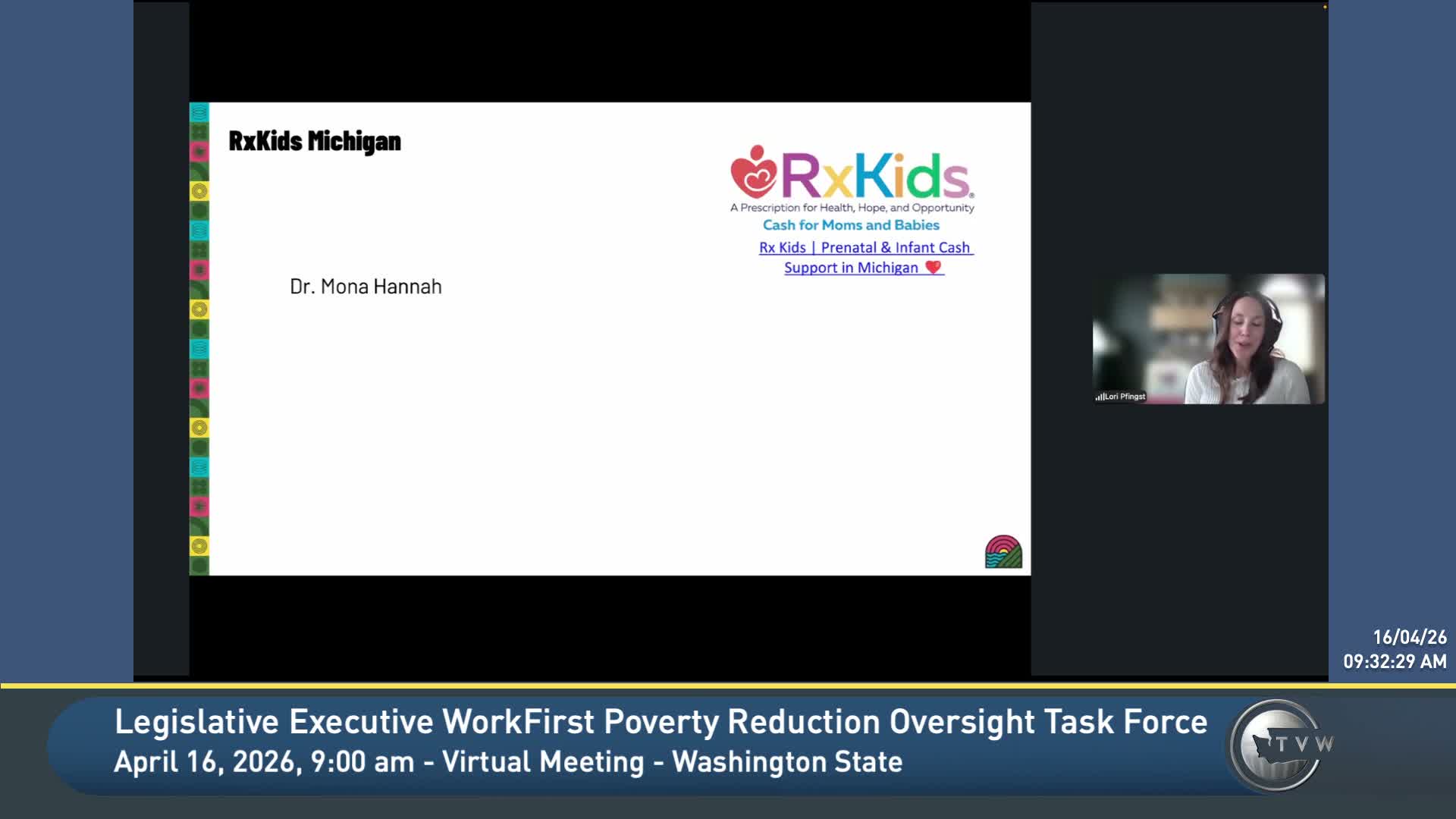
Dr. Mona Hanna, a pediatrician and founder of the Rx Kids program, told the Legislative Executive Workforce Poverty Reduction Oversight Task Force that Rx Kids delivers place‑based cash supports to pregnant people and infants and has generated measurable improvements in health and housing stability.
At the virtual meeting, Dr. Hanna said Rx Kids began in Flint and has scaled to dozens of Michigan communities. “We are now the largest anti‑poverty program of its kind in the country,” she said, reporting that the program has prescribed more than $33 million to over 9,000 families and shown near‑universal take‑up. She described published and pending results: increased prenatal‑care utilization (reported in JAMA Open Network), reductions in low birth weight and preterm births, an approximately 30 percent drop in NICU admissions, and large reductions in eviction filings. She emphasized that the intervention pairs a prenatal lump sum with predictable monthly postnatal transfers and local community outreach.
The evidence matters because Rx Kids is explicit about scale and evaluation: Dr. Hanna said the program uses vital‑records and administrative data to measure outcomes and has peer‑reviewed publications and preprints. On program safeguards, Emma Kelsey of GiveDirectly — the partner that manages payments — described a mom‑tested online application, document verification, automated fraud checks, a safeguarding team that connects participants to services, and an audit unit that reviews enrollments.
Babs Roberts, facilitator of the task force’s Economic Justice Alliance work, presented the Washington feasibility study funded by Perigee Fund. Roberts said staff and core partners (including Health Care Authority, Department of Health, and Department of Children, Youth, and Families) recommended disbursement amounts adjusted for Washington’s cost of living: a prenatal payment of $2,000 and monthly postnatal payments of $675 (totaling about $10,000 per family across the year). Roberts said the research team recommends a minimum pilot that reaches 5,000 mothers and babies to detect population‑level effects, with a recommended (larger) option of about 9,000 births and an optimal expansion to ~12,000 births if funding allows.
Staff proposed initial pilot geographies that balance need and diversity: a Yakima/central‑Washington cluster (high rates of preterm births and Medicaid coverage), a northeastern cluster to capture rural and tribal communities, and a southwestern cluster (including Cowlitz/Pacific counties); adding Tacoma/Pierce County and Joint Base Lewis‑McChord was recommended to increase urban representation. Roberts emphasized community engagement and said the team will conduct focus groups, partner with local champions, and use WSIPP (Washington State Institute for Public Policy) to model return on investment.
Task force members asked for more detail on the fiscal case. One member noted the importance of showing dollar‑for‑dollar savings in other line items; Roberts said a comprehensive ROI and cost‑effectiveness analysis is forthcoming and that WSIPP will help quantify savings to state budgets, federal programs, and local economies. Members also pushed for careful site selection to ensure inclusion of communities with high need (e.g., areas with recent birthing‑center closures, tribal lands, border communities) and for using public‑private partnerships to protect public benefits for undocumented participants where TANF cannot be used.
The presenters asked LUPRO members to help socialize the pilot, connect staff to philanthropic and local partners, host focus groups, and support outreach to legislative colleagues. The study team will finalize the pilot design, ROI modeling, and an evaluation plan before returning recommendations to the task force.