Get Full Government Meeting Transcripts, Videos, & Alerts Forever!
Get email alerts on the Noise Ordinance topic
No spam. Unsubscribe anytime.
Highlands board debates shift toward decibel-based noise rules as residents warn of unintended effects
Summary
The Highlands board continued work on a revised noise ordinance that adds objective decibel limits; residents and commissioners debated amplified outdoor sound, construction-site radios and whether low decibel thresholds could curb protests. The board agreed to refine the draft and consider a committee before voting.
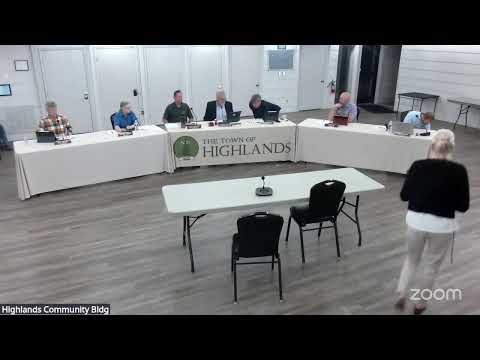
The Highlands Town Board of Commissioners spent much of its April 16 meeting discussing a recently released rewrite of the town's noise ordinance that would add decibel-based limits and narrow some subjective enforcement criteria.
Nick Tosko, who presented the draft language, said the update was prepared with input from the police chief and example provisions from other jurisdictions to make enforcement clearer. "We tried to tailor it to be more objective as opposed to subjective," Tosko told the board during the discussion.
Police Chief (identified in the meeting as the chief) and staff described three broad approaches used across North Carolina: purely subjective disturbance standards, a hybrid subjective-plus-decibel approach and a primarily objective decibel regime. Chief said officers favor clearer numeric guidelines because they make enforcement more consistent for newer staff.
Several commissioners and residents urged caution. Bergen Hayes, a Highlands resident, said the newly posted draft—released the day of the meeting—moves too far toward a purely objective standard. "This draft is a solely objective noise ordinance based on the decibel level of the sound involved," Hayes said, warning that the language could leave residents with "no legal relief" from measured noise from dishwashers, hair dryers or other common home devices.
Other public commenters and commissioners raised narrower concerns about amplified music at businesses on Main Street. Cherry Biddick urged an outright ban on outdoor amplified sound at places of business, arguing enforcement is ineffective when sound is simply turned down while officers are present and turned back up afterward. Mizelle Sutton asked how the ordinance would handle multiple businesses each playing different radio stations along the same block.
Commissioners discussed whether the town should prohibit some commercial uses of amplified radios or add more fine‑grained exemptions by time, zoning and context. One commissioner noted that live music used by hospitality venues can be amplified but often serves patrons in a confined space, while other outdoor speakers may be aimed at passing pedestrians as an attention device.
Several speakers highlighted enforcement and equity questions. An Indivisible member described a recent rally that triggered a decibel reading, saying the limit was low enough to interrupt chants led by a high‑school‑age participant and that the council should consider whether decibel thresholds unduly constrain public speech.
After extended discussion, the board did not adopt the draft. Mayor said the consensus was to continue working on the ordinance, seek public feedback, and consider forming a committee to refine definitions and exemptions before taking final action.
The board invited residents to submit suggested language and indicated it will return the ordinance to a future agenda once staff and the chief refine it.