Lifetime Citizen Portal Access — AI Briefings, Alerts & Unlimited Follows
Historic review board approves demolition and repairs at 109 North Orange but denies proposed large accessory building
Loading...
Summary
The Fredericksburg Historic Review Board approved rerating and demolition of two ancillary structures, siding repairs, front‑door repainting and a 4‑ft fence for 109 North Orange, but refused permission for a proposed oversized accessory building, citing ordinance limits on accessory footprint and massing.
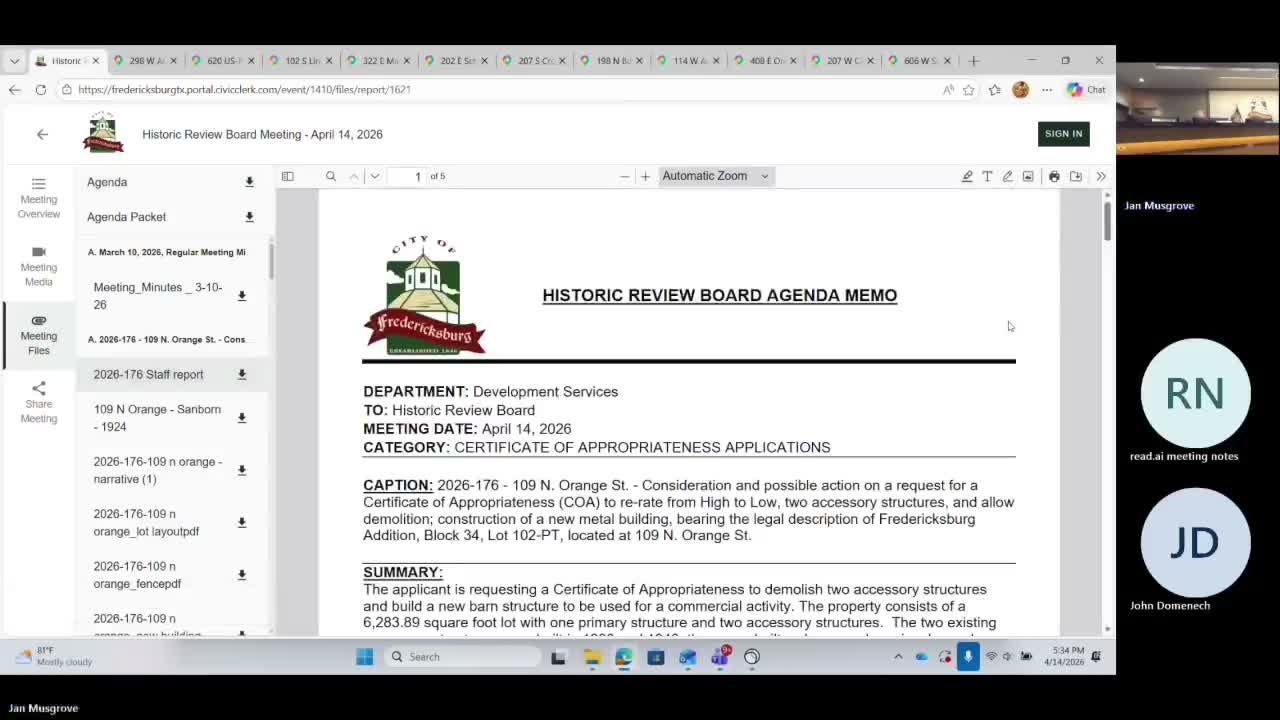
The Fredericksburg City Historic Review Board on April 14 approved most elements of an application for 109 North Orange Street but declined to permit a large new accessory building that applicants said would support a commercial use.
Applicant representative Kiana Savage (speaker 7) told the board the two rear accessory structures lack historic integrity and asked that they be rerated as low and demolished, and that the main house receive incidental siding replacement and a repaint of the front door. The applicant also proposed a new metal accessory building at the rear; the proposal was initially described as 36 by 60 feet and later as 55 by 30 feet.
“The existing ancillary structures are not historically significant and lack the integrity to maintain a high rating,” the applicant said, arguing the site’s commercial zoning and surrounding development justify an infill accessory building. The applicant also said the proposed lot coverage, setbacks and general design were intended to avoid overshadowing the main resource.
Board members agreed to the rerating, demolition of the two accessory structures, replacement of rotted siding and painting of the front door, and to permit a 4‑foot perimeter fence. Several members warned, however, that the proposed accessory building exceeded the board’s design guideline limits. One member cited section 3.4.0.1 and related guidance that accessory buildings should be either a maximum of 50 percent of the primary footprint or 800 square feet, and said the proposed building “far exceeds anything in our ordinance.”
The board held the new building component out of the approval. A motion to approve the rerating, demolition, siding repair, door paint and fence — excluding approval of the larger new accessory building — carried.
Chair David Bullion (speaker 1) told the applicants to work with their consultant and staff on revised layouts that meet the ordinance, or to return with multiple smaller accessory buildings so the total square footage complies with the 800‑square‑foot guidance.
The board’s action clears the way for demolition of the two ancillary buildings and for the owner to pursue permitted repairs; permission to rebuild an accessory structure remains unresolved pending a compliant redesign or a request for formal dispensation.