Lifetime Citizen Portal Access — AI Briefings, Alerts & Unlimited Follows
Fredericksburg council adopts zoning changes to regulate vape shops, tattoo studios and sexually oriented businesses
Loading...
Summary
The Fredericksburg City Council approved text amendments to the zoning code that add definitions and conditional-use permitting for vape shops, tattoo studios, game/skill parlors and sexually oriented businesses, set distance buffers from schools and align operational rules with Chapter 26. Staff said existing shops are grandfathered; opponents raised consistency and property-rights concerns.
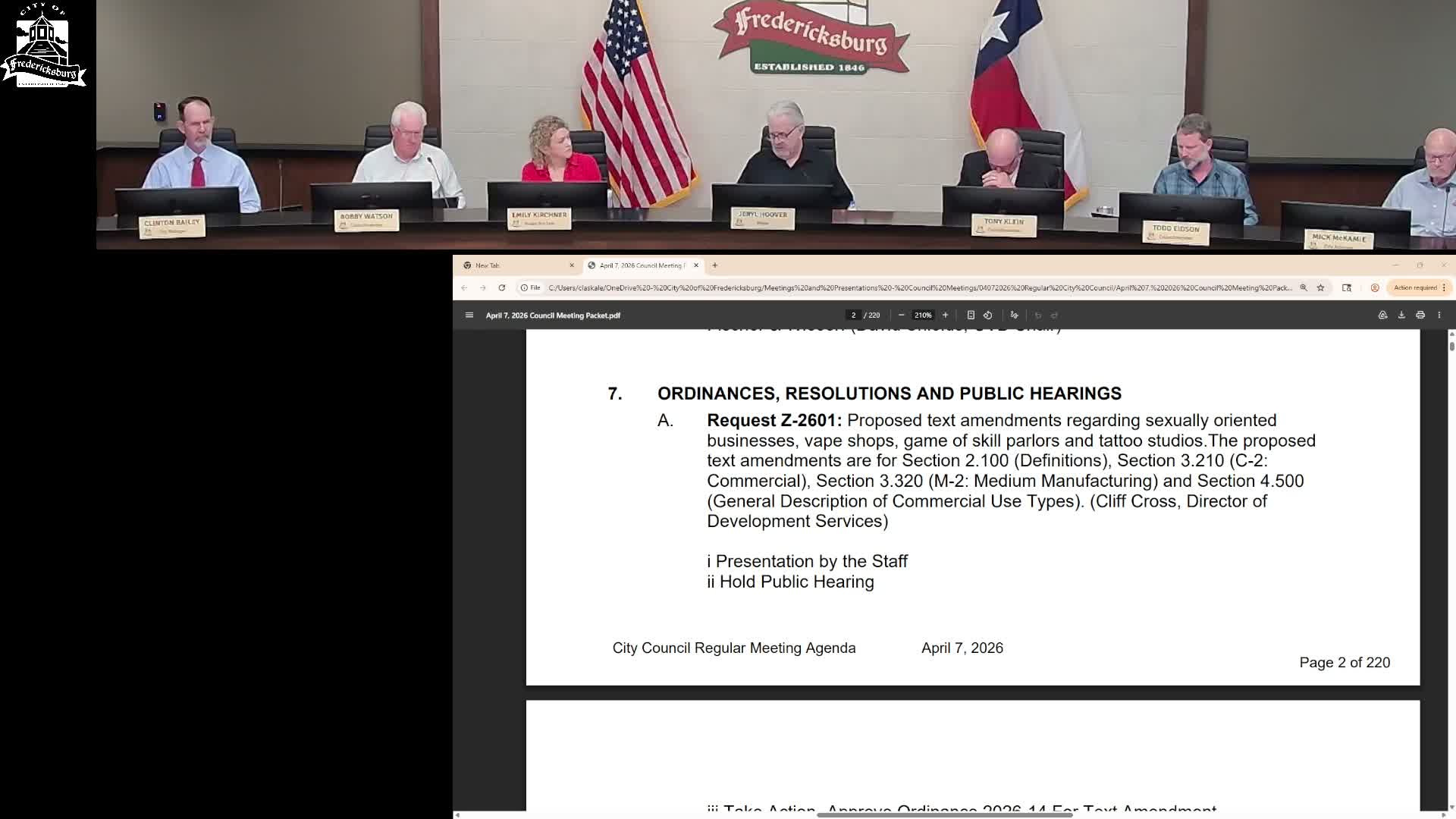
Fredericksburg City Council on April 7 approved a package of zoning text amendments that add explicit definitions and siting rules for vape shops, tattoo studios, game/skill parlors and sexually oriented businesses and require many of those uses to obtain conditional-use permits.
Cliff, the city planning staff member who presented the package, told the council the amendments update sections of the zoning code (definitions, the C2 and M2 districts, and the general commercial use section) to clarify how staff and Planning & Zoning should handle applications. Cliff said the changes would require vape shops, tattoo studios and game/skill parlors to seek conditional-use permits and would impose supplementary regulations — including a 500-foot buffer from schools, child-care facilities and youth centers and a 1,500-foot separation between vape shops. He noted existing vape shops will remain legal nonconforming (grandfathered) unless they voluntarily discontinue operations.
“Short answer is this is the zoning component associated with the siting and the permitting of those individual uses,” Cliff said, summarizing the staff report.
The city attorney-level commenter Mick, who has represented municipalities in related litigation, told the council the proposals follow common practice and case-law guidance. Mick said the so-called “10%” idea commonly cited in courtroom decisions is a guideline used when courts evaluate whether a city has left a sufficient amount of area available for such protected uses, not a statute.
Residents and business owners raised questions during the public hearing. Dan McCoy, who identified himself as CEO of Hill Country Software, argued the amendment could conflict with Fredericksburg’s recently adopted 2024 comprehensive plan and said the change might create an avenue for uses in manufacturing zones that previously lacked explicit allowance. Several speakers asked whether bookstores or other retailers could be swept into the ordinance’s definition and whether the city had adequate case-law support for distance restrictions.
Council members pressed staff on how the amendment would be applied in specific zones — for example, whether Industrial Loop M2 parcels would actually be eligible for conditional-use permits if proximity to residential areas or parks made them ineligible. Cliff said staff’s approach was to identify the most intense zones (M2) and then add supplementary regulations so many M2 parcels would still be ineligible for CUPs because of separation standards or proximity to protected uses.
Council member motioned to adopt the amendments and the ordinance passed following a voice vote. Staff told the council the amendments are designed to align the zoning text with Chapter 26 operational rules the council will consider in parallel and to provide consistent, enforceable standards when applications arrive.
The council recorded neither a detailed roll-call tally in the room nor any change to the grandfathering language; staff clarified existing businesses remain legal nonconforming unless they voluntarily discontinue the use. The ordinance now directs future applications for the listed uses into the conditional-use-permit process and ties siting restrictions to the city’s operational standards in Chapter 26.
The council’s action is procedural; site-specific applications that seek to locate a regulated use will still come before Planning & Zoning and the council for separate decisions.