Get Full Government Meeting Transcripts, Videos, & Alerts Forever!
Get email alerts on the LNG‑project‑fiscal‑framework topic
No spam. Unsubscribe anytime.
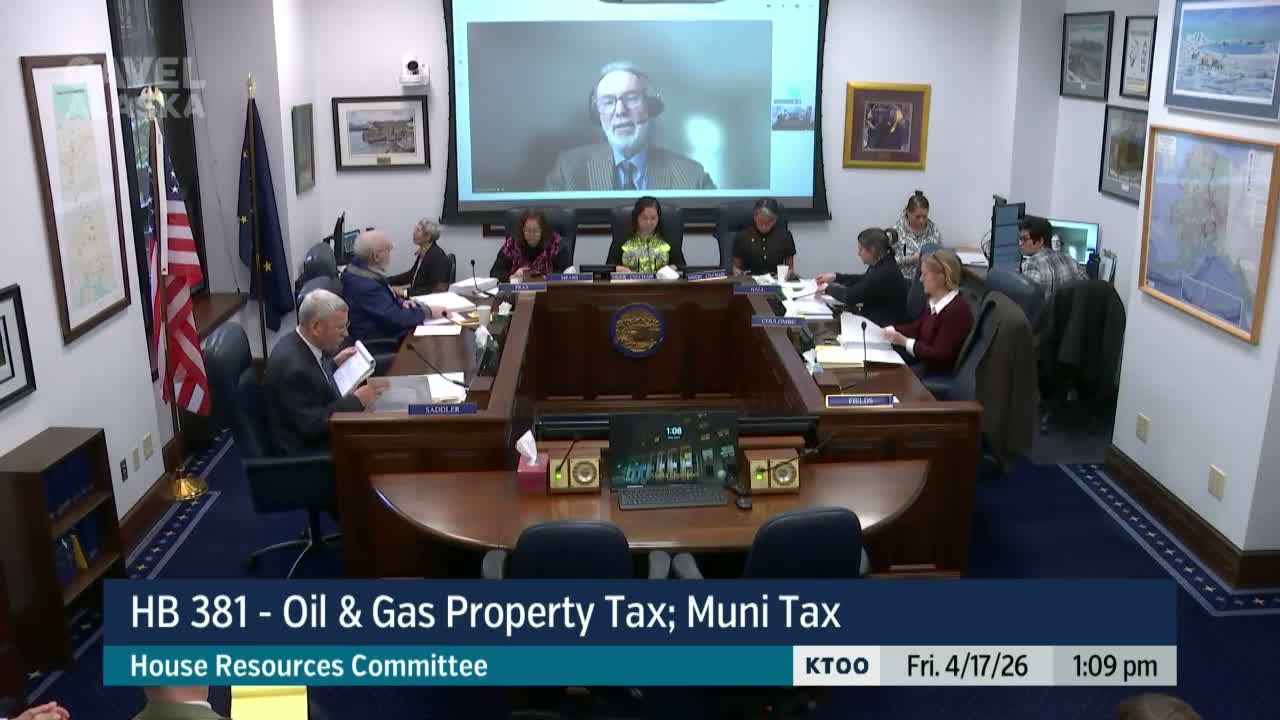
Expert tells House committee governments commonly take equity stakes in LNG projects, warns of risks
Summary
Nicholas Fulford of Gaffney Klein told the House Resources Committee on April 17 that government equity stakes and royalty packages are common in large LNG projects and can generate steady long‑term value—but they transfer commercial risk to the state and require careful negotiation and indexation to protect revenue streams.
Nicholas Fulford, senior director of gas and LNG at Gaffney Klein, told the Alaska House Resources Committee on April 17 that governments commonly take equity stakes in large liquefied natural gas projects as part of a negotiated fiscal package.
"By taking equity in the project, you're to some extent also sharing the commercial risks that are part and parcel of an energy project like this," Fulford said. He described a commonly used "carry" arrangement in which project sponsors hold equity up front and the government’s share is paid out of future revenues, and he urged the committee to consider how such structures shift both upside and downside to the host state.
Fulford used the Papua New Guinea LNG project as an analogy: the state stake there was about 19.4% and local affected communities ultimately held roughly 4–4.5% of equity; a 2% wellhead royalty in that example was allocated about 40% to direct cash payments to communities, 30% to a community infrastructure fund and 30% to a future‑generations fund. "That 2% royalty was split 40, 30, 30 in that manner," he said.
On taxation and indexing, Fulford walked committee members through the effects of a fixed low escalation rate and recommended indexation tied to inflation or a consumer price index. Using an example he described to the committee, a nominal $65 million per year stream would fall to roughly $60 million in real terms after 10 years under a 1% fixed escalation while a 2% inflation assumption was used for the counterfactual; after 35 years the same stream would be about $47 million in real terms, with cumulative nominal receipts of roughly $2.23 billion (about $1.96 billion in real terms), he said.
Members asked whether major LNG projects routinely receive tax relief or bespoke fiscal packages. "Pretty well without exception, all major LNG projects have a tailor‑made, negotiated fiscal package around them," Fulford replied, noting the packages can include tax holidays or abatements in some jurisdictions and different measures in others.
Dan Stickel, chief economist at the Department of Revenue, told the committee DOR has supported and modeled fiscal negotiations for months. "We've been supporting the state team every step of the way," Stickel said, and offered to continue modeling state investment scenarios and government‑take outcomes for legislative decision‑makers.
Committee members pressed for examples, templates and documentation to help craft Alaska’s approach, and Fulford agreed to provide charts and modeling details from the firm. The committee closed the Fulford exchange by inviting written follow‑ups and indicating it may call Gaffney Klein back as amendments to related legislation are finalized.
What’s next: Members were instructed to submit additional questions in writing to house.resources@akledge.gov; the committee set House Bill 381 aside and moved on to consider amendments to House Bill 321 later in the session.