Get Full Government Meeting Transcripts, Videos, & Alerts Forever!
Get email alerts on the Udc Amendment Detention Centers topic
No spam. Unsubscribe anytime.
Zoning commission recommends denying proposed UDC amendment on detention centers after questions about exemptions and process
Summary
After an extended staff presentation and commissioner questioning, the Zoning Commission voted to recommend denial of a proposed Unified Development Code amendment that would define and restrict local "detention centers," citing unclear exemption procedures for state/federal facilities and missing impact studies.
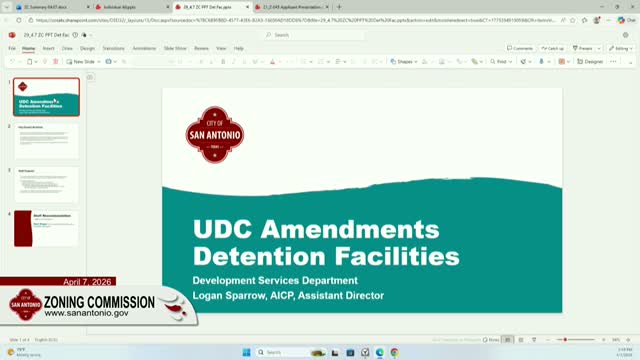
Staff presented a proposed Unified Development Code (UDC) amendment intended to define "detention centers," require notification for conversions or operations and establish a 1,000-foot buffer from schools and other protected uses. Assistant director Logan Speron explained the amendment is intended to protect public safety responders and clarify when local regulations apply; he said state and federal facilities would be treated as exempt if they demonstrated the applicable jurisdictional nexus.
Commissioners extensively questioned staff about scope, legal basis, precedent and implementation. Commissioners asked whether any existing facilities in San Antonio would be affected (staff said none required rezoning at present), how exemptions would be proven, whether purchase/ownership triggers notification and whether the Mayors requested timeline (an accelerated 45-day path mentioned in presentations) had resulted in missing analyses. Staff repeatedly said the code would apply "unless" a facility proved an exemption based on state or federal jurisdiction and that the city attorney would be consulted for specific determinations.
Several commissioners said the package lacked required supporting materials: maps of parcels that would be affected, an economic-impact statement and environmental or public-safety analyses. Commissioner discussion split over whether the commission should postpone to obtain that information or recommend denial as drafted. Some members said the changes were a policy priority requested by City Council and praised staff for responding quickly; others said the commission should not be used to rubber-stamp a politically driven amendment without adequate public notice.
After votes on postponement and reconsideration failed to pass, the commission adopted a motion to recommend denial of the proposed UDC amendment as drafted. Commissioners recorded that staff had done substantial work in a short window but said Council-level urgency did not replace the need for maps, impact studies and clearer language about how exemptions would be demonstrated for state or federal facilities.
Next steps: The commission's recommendation is advisory; the City Council may nevertheless take up revised language or direct staff to return with additional analyses. Staff was asked to prepare maps of potentially affected parcels and to provide an economic/environmental impact assessment if the Council requests reintroduction.