Get Full Government Meeting Transcripts, Videos, & Alerts Forever!
Get email alerts on the Campaign Finance topic
No spam. Unsubscribe anytime.
Conference committees adopt amendment to HB 2874 to limit late-filing penalties and add emergency clause
Summary
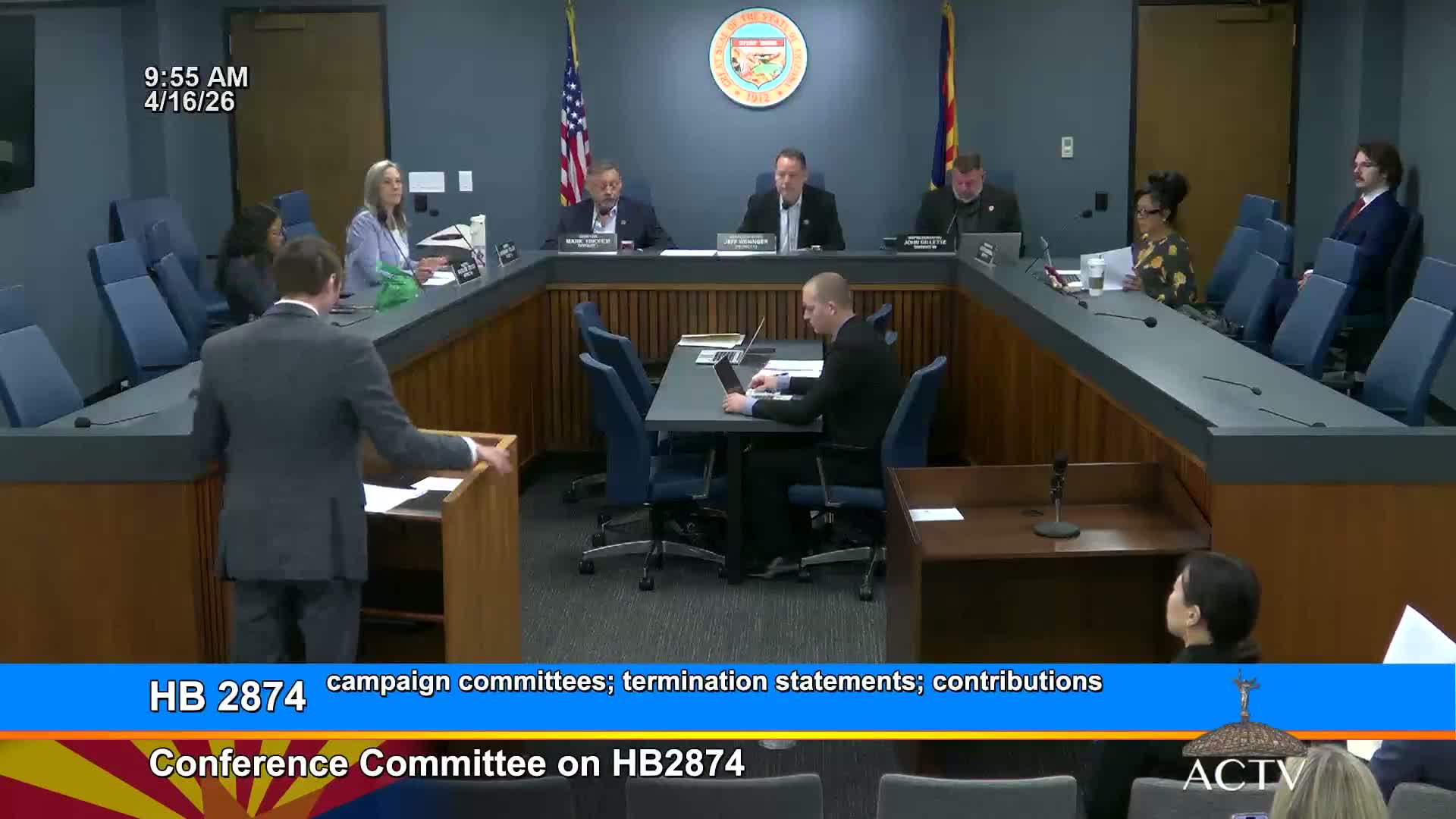
On April 16, 2026, House and Senate conference committees on House Bill 2874 adopted a five-page amendment that caps late-filing penalties, requires a termination statement for inactive committees, directs public posting of delinquent committees and makes parts of the law retroactive, with an added emergency clause.
On April 16, 2026, the House and Senate conference committees on House Bill 2874 met in a joint series of proceedings and adopted a five-page conference committee amendment that narrows late-filing penalties for certain campaign committees, adds a termination-statement requirement for inactive committees, and includes an emergency clause.
The amendment, explained to committee members by a staff member, clarifies that a candidate committee, political action committee or political party may be exempt from penalties if it certifies that it received no contributions and made no expenditures during the reporting period. The staff member said the Senate amendments "prohibit[] and deem[] void retroactively penalties against the committee for failure to file a campaign finance report" where that certification applies and that the amendment moves the retroactivity clause to take effect from and after July 5, 2016.
Why it matters: committee members said the changes are designed to reduce compliance burdens on small or informal campaigns and to clear longstanding, low-value delinquencies from government records. The amendment also sets a maximum penalty that a committee may accrue for any single reporting period at $5,000 and requires filing officers to publish, via the Secretary of State filing system or on the internet, a listing of committees that owe late-filing fees within five days of a filing deadline so the public and filers can more quickly identify missing reports.
Committee discussion focused on scope and implementation. A committee member asked whether accounts that had been suspended or closed for inactivity would qualify for the amendment’s relief; the House chair deferred to staff, and the staff member said the bill does not explicitly name "suspended accounts" but that if a closed account meets the criteria of having received no contributions and made no expenditures in the reporting period, it would likely be included under the amendment’s provisions. The staff member also summarized a safe-harbor provision discussed by members that would allow accounts closed by year-end to qualify under certain circumstances.
Supporters framed the amendment as a "cleanup" measure to remove stale liabilities dating back several years. A Senate committee member said the measure would help "everyday citizens to run for office" without facing disproportionate administrative burdens, and referenced interactions with the attorney general’s office indicating enforcement against closed campaigns may be impractical.
Formal action: a committee member moved that the conference committee adopt the five-page amendment dated April 16, 2026, at 09:03 a.m., to the Senate-engrossed version of HB 2874 and authorize staff to make technical conforming changes as recommended by the rules attorney. The motion was taken by voice vote; both committees recorded "ayes," and the chairs declared the motion adopted.
The House and Senate conference committees then adjourned.
What’s next: The committees approved the conference committee amendment and authorized staff to make technical conforming changes; the transcript does not record any further scheduling or a formal roll-call vote in committee.