Get Full Government Meeting Transcripts, Videos, & Alerts Forever!
Get email alerts on the Domestic Violence Protection Order topic
No spam. Unsubscribe anytime.
Petitioner’s counsel asks court to review termination of one-year domestic violence protection order
Summary
In a motion for discretionary review, petitioner’s attorney argued the trial court improperly ended a one-year domestic violence protection order and replaced it with mutual restraints without required motions, findings or evidence of changed circumstances; the court took the matter under advisement.
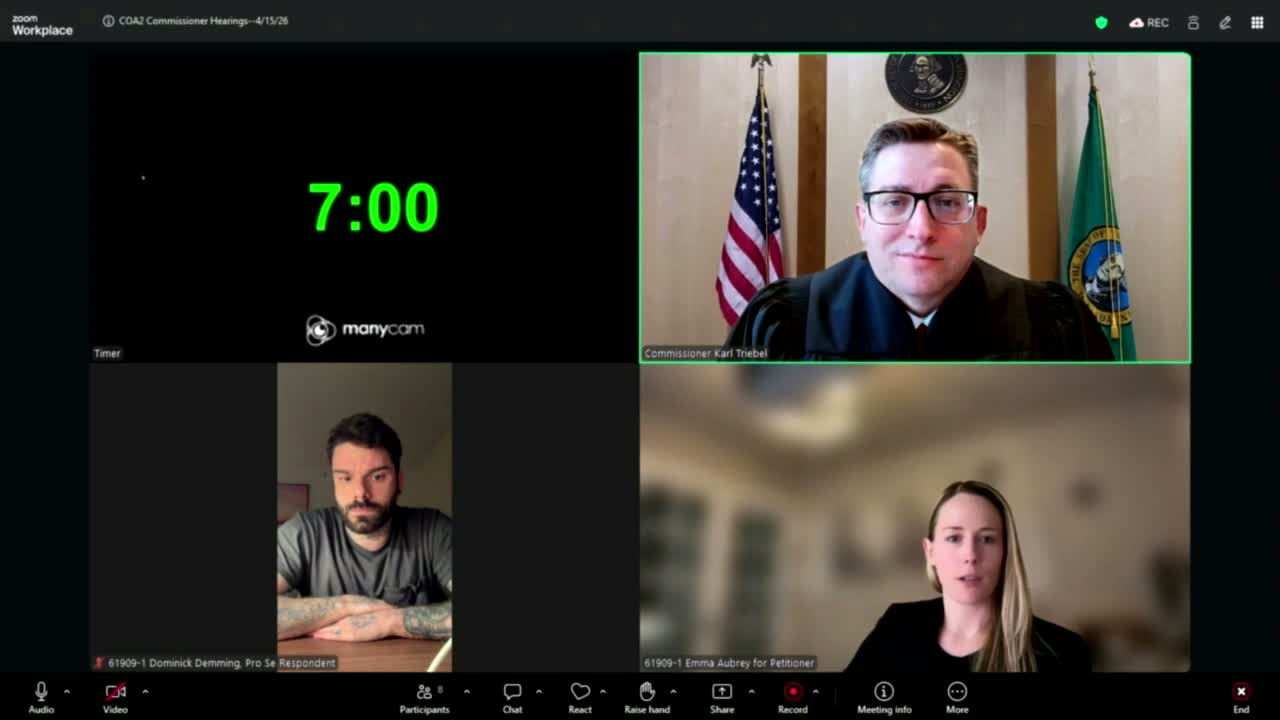
Emma Aubrey, counsel for the petitioner, asked the court to grant a motion for discretionary review, arguing the trial court committed legal error by terminating a valid one-year domestic violence protection order and replacing it with mutual restraints in a separate family law proceeding.
"Can a trial court terminate a valid 1 year domestic violence protection order without a proper motion, without required findings, and without evidence of changed circumstances simply by entering mutual restraints in a separate family law proceeding?" Aubrey asked, arguing the answer should be no and that the error warrants review.
Aubrey told the court that, under the statutory text cited in the record, termination of a protection order requires specific procedural steps including a motion to terminate, a respondent declaration, a finding of adequate cause, and a preponderance showing of a substantial change in circumstances. She said none of those steps occurred here and that the protection order appears to have been terminated as a byproduct of entering mutual restraints in the family law case.
"The statutory enforcement mechanisms that were tied to the domestic violence protection order were erased," Aubrey said, arguing that the petitioner lost unilateral legal protections and that the change affects an ongoing criminal case and the child named in the proceedings.
The presiding judge questioned where in the record the termination order appears and whether language in the appendix indicating that "family court may modify this order" referred to the protection order or only to a temporary parenting plan. Aubrey responded that the appendix language referred to the parenting plan authorized in the protection-order case, not to termination of the protection order.
Dominic Deming, the respondent who represented himself at the hearing, opposed discretionary review. "I do not believe that the trial court made a legal error," he said, adding that any issues can be addressed through the normal appeal process once the case concludes and that there is no immediate or irreversible harm that, in his view, requires immediate intervention.
The court reserved Aubrey’s remaining rebuttal time, heard that the parties may seek consolidation of the protection-order appeal with the family law matter if review is granted, and took the motion under advisement. The judge said a ruling will be issued as soon as possible.