Get Full Government Meeting Transcripts, Videos, & Alerts Forever!
Get email alerts on the Budget Legislation topic
No spam. Unsubscribe anytime.
Fish and Wildlife staff warn of deep shortfalls, outline legislative calendar and funding priorities
Summary
CFO Morgan Stinson told the Big Tent Committee that the agency faces multi‑million‑dollar reductions across programs, a projected roughly $1 billion statewide gap in the next biennium under current assumptions, and limited capacity for new agency requests; commissioners discussed outreach, hatchery closures and federal Mitchell Act funding.
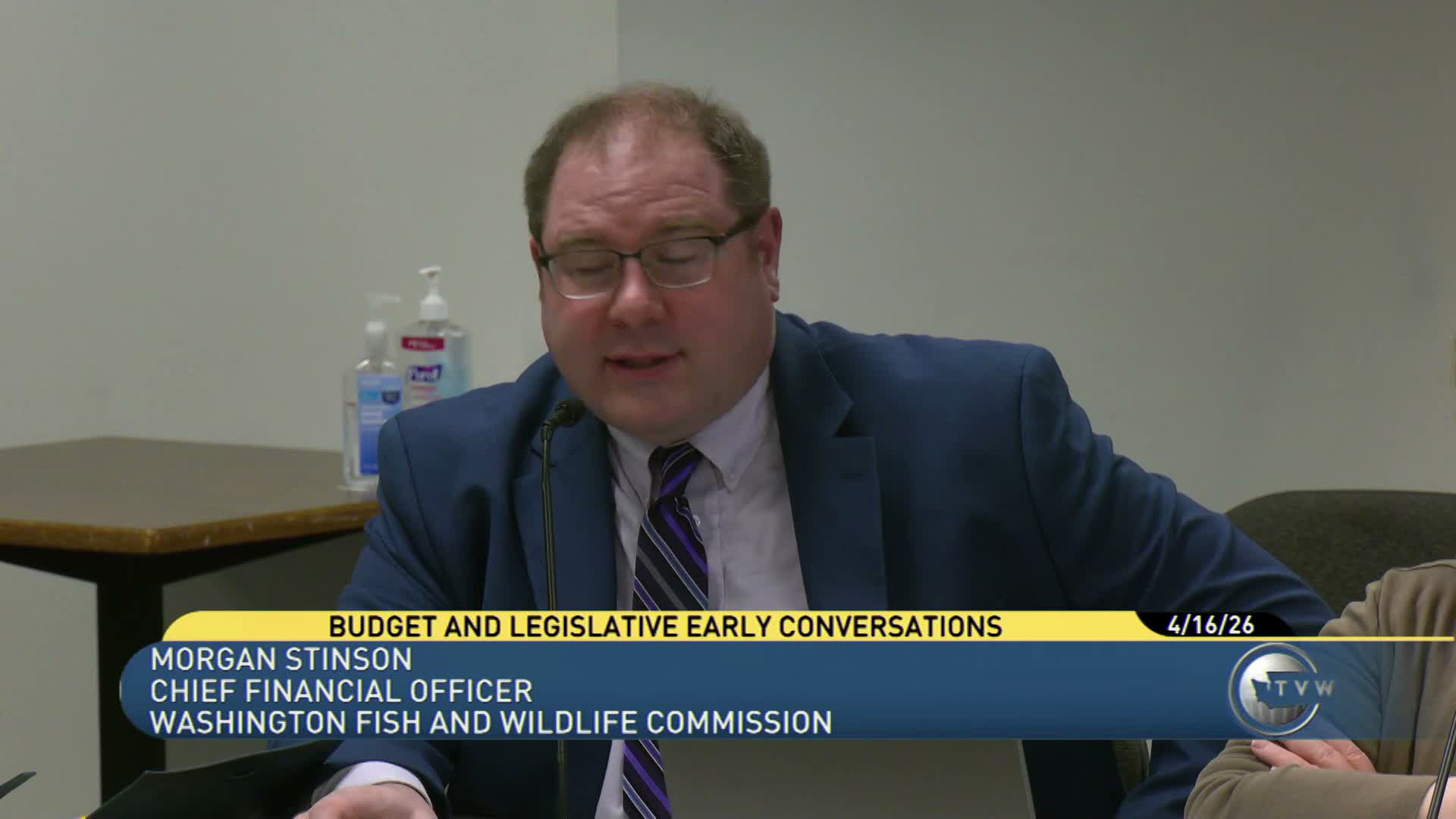
CFO Morgan Stinson told the Department of Fish and Wildlife’s Big Tent Committee on April 16 that the agency is facing sustained budget pressure and limited bandwidth for new legislative proposals.
Stinson presented slides showing reductions across the agency’s program areas — roughly $10 million to $14 million per year in many divisions — and described a statewide fiscal outlook that, even counting projected revenues, still shows about a $1 billion budget gap in the upcoming biennium under current appropriation levels. "Even when all of that revenue comes into place and is projected to be there, the expenditures on the state budget basically create ... a $1,000,000,000 problem," Stinson said.
Stinson and Legislative Director Melina Thompson outlined the calendar the agency follows: agency requests are due to the governor’s office in September, the governor’s proposal appears in December and the legislative session begins in January. Thompson said the department is already socializing three agency concepts for future sessions: removing duplicative required reports, a geoduck safety bill to adjust shoreline requirements for diver safety, and a fish and wildlife accounts modernization bill to improve fund tracking.
Commissioners pressed presenters for detail. Commissioner Barbara Baker asked for the spreadsheets and a clearer breakdown of hatchery and wildlife program impacts; Stinson agreed to circulate the presentation and provide a separate spreadsheet link. On hatcheries, Stinson said operating costs across the department’s roughly 80 hatcheries exceed $100 million on a biennial basis and that individual hatchery capital replacements commonly cost well over $10 million. "Running, you know, 80-ish hatcheries ... is over a $100,000,000 on a biennial basis," Stinson said.
Stinson described funding pressures that threaten specific facilities: reductions in state backfill and frozen federal Mitchell Act allocations led staff to a decision point on the Skamania hatchery. "We had to pick between those two hatcheries, and so that's why Skamania is closing in particular," Stinson said, explaining that a recent federal increase of about $4,000,000 will be split among recipients and produces only a little more than $1,000,000 for the agency — not enough to sustain both facilities.
Commissioners debated response strategy at length. Several members, led by Commissioner Baker, urged a proactive, large‑scale outreach and advocacy strategy to "rebuild trust" with legislators and broaden constituency engagement. Baker urged work to identify values and champions in the Legislature and suggested using advisory groups such as BPEG and CAPE to mobilize support. "We need to know what [the public] care about," Baker said, arguing constituency turnout and clear messaging will be critical in hard fiscal years.
Commissioner Steve Parker proposed focused media and stakeholder campaigns tied to specific local examples (he cited Skamania) to illustrate what cuts mean for communities and to encourage constituents to contact legislators. Director Kelly Sussman and other commissioners agreed the strategy should include clear framing that connects healthy fish and wildlife to the state economy and rural livelihoods.
On operating costs, Stinson acknowledged the agency spends more than $1,000,000 on fuel per biennium and will model increased costs into maintenance‑level requests; she also outlined the capital budget process, including a forthcoming prioritized $100 million capital request to continue projects started in prior biennia.
No formal votes were taken. Staff agreed to circulate the slide deck and spreadsheets, to continue socializing the three agency concepts with legislators, and to work with commissioners on drafting a strategy to build legislative champions and broaden public support ahead of the next budget cycle.
Next steps: staff to circulate data files, return with prioritized options for capital and operating requests, and the committee to consider a strategic outreach plan ahead of the September agency‑request deadline.