Get Full Government Meeting Transcripts, Videos, & Alerts Forever!
Get email alerts on the Embodied Carbon Policy topic
No spam. Unsubscribe anytime.
Expert urges Eugene working group to use road bond, procurement pilots to cut embodied carbon in city projects
Summary
Guest presenter Webley outlined policy tools — from Buy Clean-style procurement to deconstruction incentives and DEQ grants — and the commission recommended focusing early pilots where the city spends most (roads/concrete) and compiling case studies for a council briefing.
Webley, an architect and member of the Oregon State Sustainability Board, told the Eugene Sustainability Commission’s Sustainable Building Tech working group that the city can make immediate embodied-carbon reductions by targeting where it spends money and piloting low-carbon materials in upcoming capital projects.
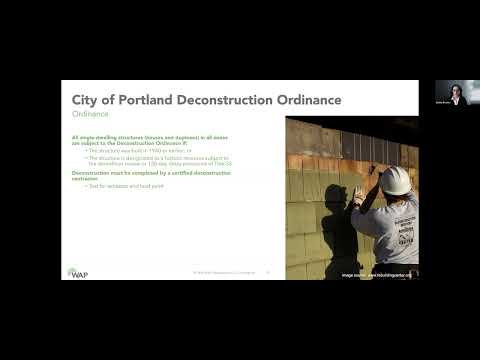
“Look at where the city is spending money,” Webley said during a 45-minute presentation on options for embodied-carbon policy. He described five policy buckets — government and infrastructure procurement, local codes and zoning, deconstruction and reuse, incentives and disclosure, and education — and urged the group to consider pilot projects tied to the recently passed roads and parks bond, where large amounts of asphalt and concrete will be procured.
The recommendation to focus on procurement followed examples Webley cited from other jurisdictions, including California’s Buy Clean program and Minnesota Department of Transportation test sites where different mixes are evaluated under real-world conditions. Webley also pointed to Oregon programs: the Oregon DEQ Low Embodied Carbon Housing Program, which offers pathways that require a 10% embodied-carbon reduction and includes funding of roughly $40,000–$45,000 per unit for reuse conversions and about $20,000 per unit for space-efficient new housing.
“I am a licensed architect,” Webley said, describing both building and infrastructure opportunities and urging a performance-based approach that relies on Environmental Product Declarations (EPDs) and demonstrated performance rather than mandating particular materials.
Ian (city staff) confirmed Eugene’s existing involvement with the DEQ program. “Eugene is actually a partner in this. We signed a contract with DEQ to help administer … the space-efficient low embodied carbon housing program,” he said, noting the city’s housing staff are pursuing applications and support.
Committee members pressed on specific levers: whether the MUFTI downtown multifamily tax/credit program could align with DEQ incentives, whether commercial PACE (CPACE) has been explored in Oregon, and whether EWEB or other utilities might play a role. Webley said zoning overlays and municipal procurement policies can be creative ways to act where state building code authority is limited, and that utilities can provide education or incentives if they have GHG targets.
Participants discussed materials questions — fly ash, slag, biochar and other supplementary cementitious materials — and the need to be performance- and EPD-driven to reduce contractor risk. Ian described the city’s approach of setting performance standards and allowing vendors to demonstrate compliance via EPDs rather than prescribing specific materials.
Before adjourning, the group assigned follow-up tasks: outreach to Oregon communities with CPACE experience, compiling relevant case studies (including local projects and national Carbon Leadership Forum studies), and building a short memo for City Council that recommends pilot locations and policy options. The group also scheduled sessions on policies from other communities, voluntary programs/reach codes, and a May review of their draft report.
The working group concluded that immediate, achievable impact may come from piloting low-carbon concrete and asphalt on a subset of bond-funded street and path projects, combined with performance-based procurement language and case studies to reduce perceived risk for contractors and owners.