Get Full Government Meeting Transcripts, Videos, & Alerts Forever!
Get email alerts on the Economic Development topic
No spam. Unsubscribe anytime.
Berkeley's economic dashboards show rising tourism, big startup deals and falling storefront vacancies
Summary
City economic staff told the City Council that Berkeley's unemployment ticked to 4.7% in 2025, hotel demand and transient-occupancy tax revenue rose, startups raised roughly $1.5 billion (more than half in three deals), and ground-floor vacancy fell to about 6.3%; public commenters urged more OED funding and attention to downtown safety and construction impacts.
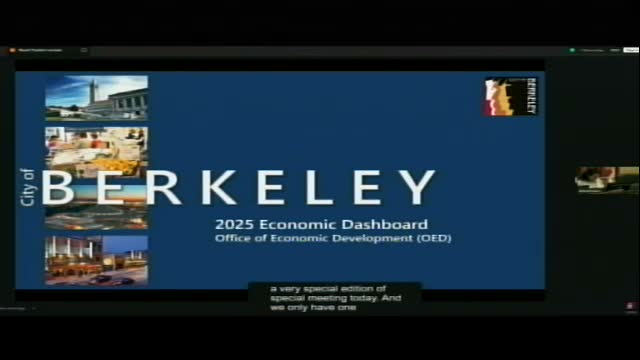
Eleanor Hollander, manager of the City of Berkeley's Office of Economic Development, presented the city's 2025 economic dashboards at a special City Council meeting on March 10, summarizing employment, visitation, real estate and business-support metrics.
The presentation reported that Berkeley's unemployment rose modestly to 4.7% from 4.4% a year earlier, in line with county figures and lower than the statewide rate. Hospitality and visitation were bright spots: the city recorded about 1.6 million overnight visitors in 2025, the average daily room rate rose to $190, and transient-occupancy-tax proceeds totaled roughly $8.3 million.
City staff highlighted the innovation sector as a major economic driver. OED said about 370 innovation-sector businesses operate in Berkeley and that 88 startups raised venture capital in 2025 totaling about $1.5 billion; more than half of that sum was concentrated in three large deals, including a $350 million offering by quantum-computing firm Rigetti in West Berkeley. Staff noted that life-science and health-care companies grew to parity with software firms as a share of the local innovation economy.
Real-estate indicators showed mixed conditions. Ground-floor vacancy citywide fell to about 6.3% (from roughly 7—7.5% the prior year), retail occupies about 31% of ground-floor space citywide (about 46% in West Berkeley), and office availability in Berkeley remained lower than nearby Oakland and Emeryville. The presentation also noted approximately 1,600— 1,700 housing units approved in 2025, concentrated downtown and adjacent to campus, and a December 2025 median single-family home price of about $1,265,000.
OED described several programs and partnerships that support commercial vitality: the Discover in Berkeley marketing campaign (which the office reported has produced more than 4.6 million impressions since 2019), two revolving loan funds with 25 active loans totaling about $1,000,000 in outstanding volume, collaboration with Visit Berkeley and UC Berkeley on business attraction and grant outreach, and a green-business certification effort that now counts 81 certified local firms. The office said one loan program has been transitioned to Working Solutions, a community development financial institution, to improve borrower servicing.
Council members asked detailed questions about measurement and policy. Council member Taplin asked whether Berkeley can learn from Emeryville's lower vacancy; staff said single-property transactions and perceptions of permit streamlining can skew vacancy rates and that Berkeley is working to improve permitting reputation and processes. Council members also pressed staff on vacancy-policy tools, data about why startups or businesses leave (exit interviews and spatial fit were cited), and ideas for a branded fast-track permitting or business-attraction program; OED said broader business-attraction advertising would require new funding.
Public comment reflected both praise and criticism. John Kaner, representing a local business association, thanked OED for work on vacancy and downtown renewal, urged continued enforcement and outreach around street safety, and said "OED needs a discretionary budget." Online commenter Kelly Hammergren said construction and current vacancies have reduced downtown's appeal and urged more attention to small property tenants; former council member Cheryl Davila sharply criticized city leadership and services for people experiencing homelessness, urging more direct action.
There were no formal votes on policy items. After council comments thanking staff and offering to help with outreach and business-attraction efforts, the meeting was adjourned by unanimous consent.
The Office of Economic Development said it will return with further detail on vacancy-policy work and a proposed toolkit; council members suggested exploring a legacy-business program, fast-track permitting branding, and targeted outreach to retain startups as next steps.