Get Full Government Meeting Transcripts, Videos, & Alerts Forever!
Get email alerts on the Land Use topic
No spam. Unsubscribe anytime.
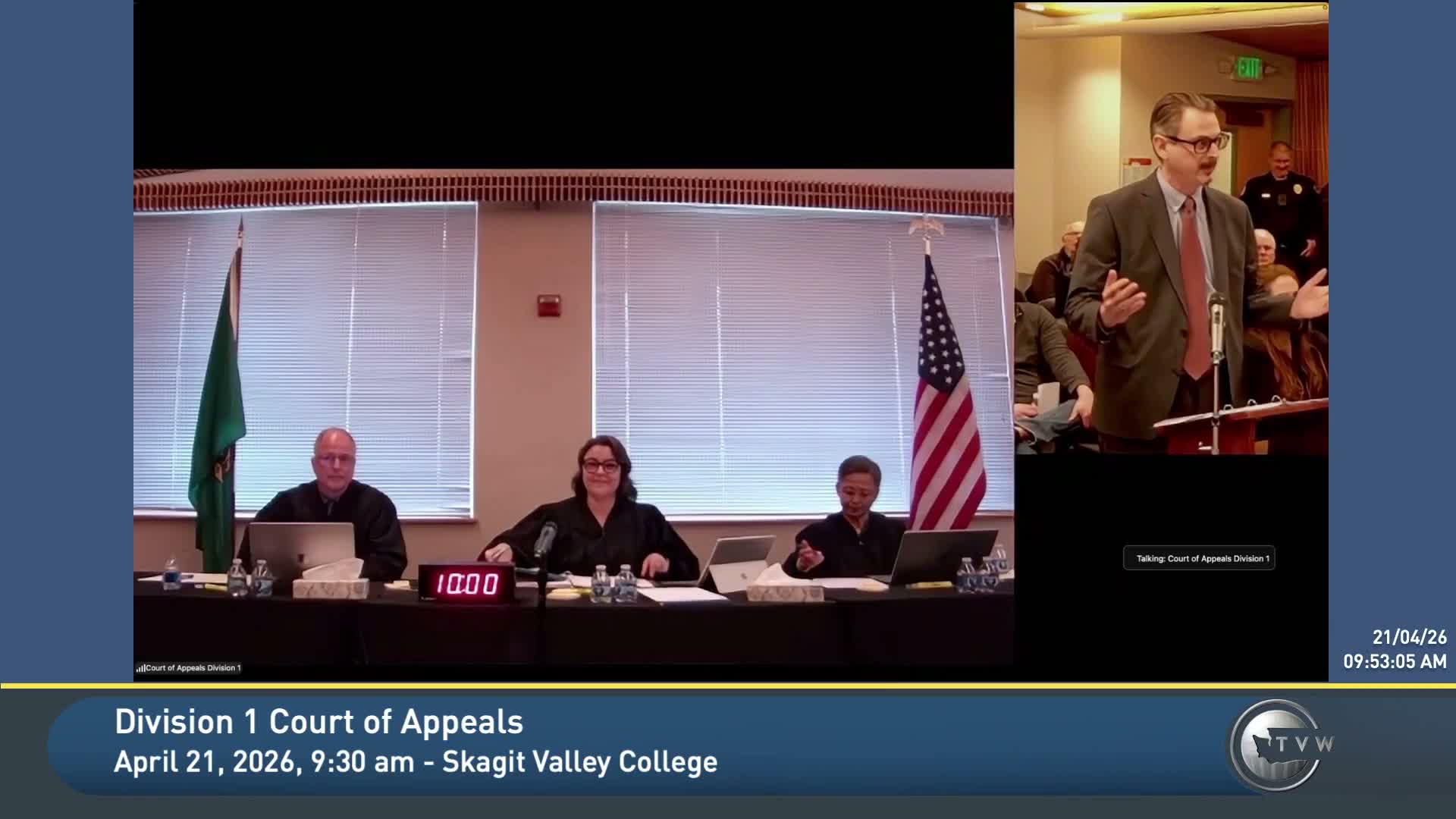
Appellate panel weighs whether Oak Harbor ordinance allowing parkland swaps without a public vote required SEPA review
Summary
In Action Network v. City of Oak Harbor, counsel for Whidbey Environmental Action Network told an intermediate appellate court that Ordinance 19‑99, which prescribes the contents of development agreements for parkland exchanges, amounts to a non‑project action under SEPA and should have been reviewed before adoption; the city’s attorney argued the ordinance is a procedural change and SEPA review is properly phased later.
An intermediate appellate panel on the record heard competing arguments over whether Oak Harbor’s Ordinance 19‑99 triggered environmental review under the State Environmental Policy Act.
Brian Telligen, counsel for the plaintiff Whidbey Environmental Action Network, told the court that the 2024 ordinance “is about private land development in city parks,” pointing to Hal Remaley Memorial Park and a proposed hotel parking lot as the factual origin for the measure. Telligen said the ordinance prescribes what must go into development agreements—an exchange of private land for public land, a finding that the exchange benefits the city, parity of market value and attention to environmental standards and accessibility—and argued those are standards that control use or modification of the environment and therefore qualify the ordinance as a non‑project action subject to SEPA review.
“The ordinance sets out what must go into the development agreement,” Telligen said. “That is the subject of the ordinance: development agreements, what must go into them.” He urged the court to reverse the superior court’s decision and set aside the ordinance.
Hillary Evans, counsel for the City of Oak Harbor, told the panel the city adopted the ordinance in 2024 to amend the process for transferring park property and eliminate a separate voter‑approval requirement in some circumstances. Evans said there has been no application, permit or transfer tied to the ordinance in the record before the court and argued SEPA review is appropriately conducted at the later project‑review stages.
“The city did not have to review the ordinance under SEPA because it merely amends the process for transferring parkland, eliminating the requirement of a citizen vote,” Evans said. She stressed that the ordinance provides alternative pathways for transfers—including voter approval—and does not foreclose options that existed previously.
The panel pressed both sides on textual and doctrinal lines: whether subsection 1’s plain language (does the ordinance contain standards controlling use or modification of the environment?) or subsection 2’s procedural description (timing and content of development agreements) governs the analysis; whether the ordinance, even if facially procedural, has the practical effect of facilitating a specific project (Telligen emphasized a Hilton hotel discussed in the record); and how WAC definitions and precedent—cited by both sides, including the International Longshore matter—should be applied when a law both changes procedure and contemplates foreseeable development.
Judicial questioning focused on whether enactment of the ordinance itself is a governmental action likely to have an adverse environmental impact that would require at least a threshold SEPA checklist, or whether the appropriate time for environmental review is later when a concrete project or transfer is proposed. Counsel also debated remedies: if the court were to find SEPA review required at adoption, whether the available relief would be invalidation and remand for a checklist or whether more limited remedies exist.
Telligen anchored his argument in the ordinance text and related statutory and municipal code provisions governing development agreements, citing RCW and Oak Harbor code sections that define development standards and dedications. Evans countered that the ordinance is a change in process that leaves developers able to pursue voter approval or alternate paths and that SEPA is built in at later stages of approval.
The court did not announce a decision at the hearing. The parties’ briefs and argument focused the panel on two central questions: (1) does the language of Ordinance 19‑99 itself contain standards controlling land‑use modification that trigger SEPA review at adoption, and (2) if the ordinance is procedural on its face, does the factual genesis tied to a foreseeable hotel project change the timing or necessity of review. The panel asked for further briefing and cited caselaw the parties had referenced as it weighed the proper interpretive frame.
The appeal remains pending; the panel’s ultimate ruling will determine whether Oak Harbor must conduct environmental review of Ordinance 19‑99 before the law can be fully implemented or whether SEPA obligations can be satisfied later in the project review process.