Get Full Government Meeting Transcripts, Videos, & Alerts Forever!
Get email alerts on the House Bill 3045 topic
No spam. Unsubscribe anytime.
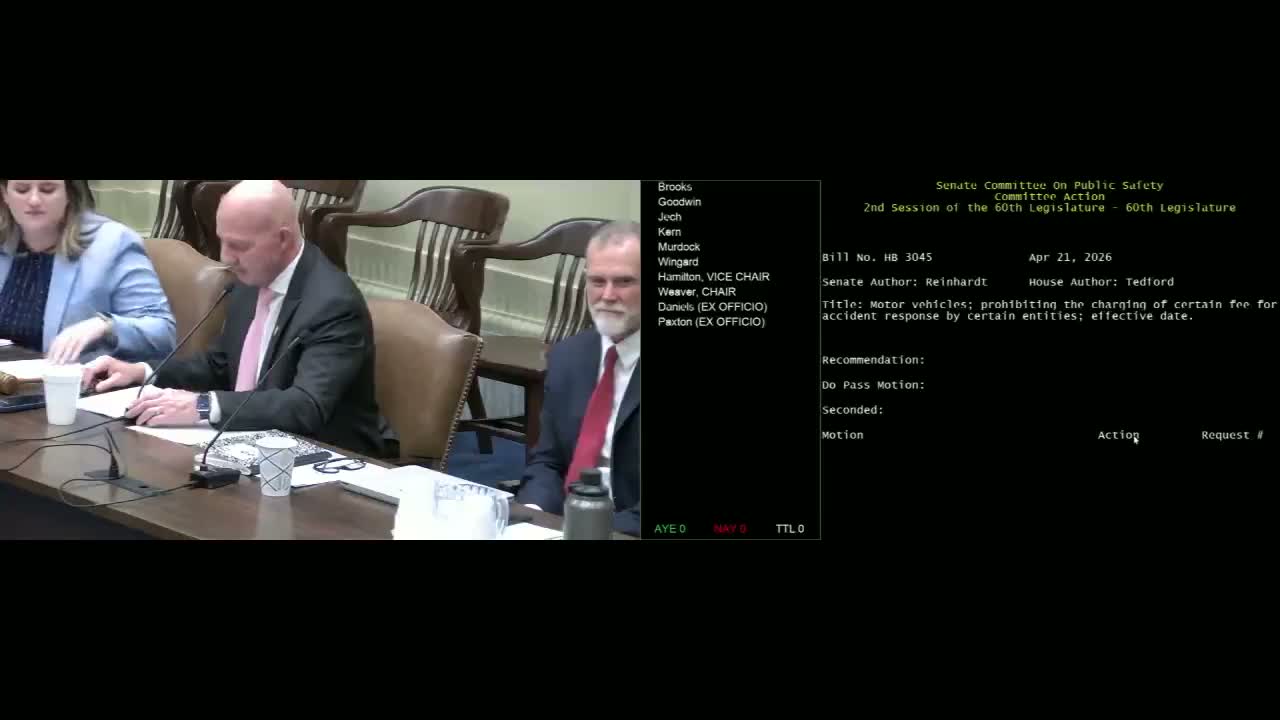
Senators debate amendment to HB 3045 to allow some fire departments to charge accident-response fees; bill laid over for fiscal review
Summary
Senator Reinhardt offered an amendment to House Bill 3045 to allow certain fire departments and rural fire districts to collect accident-response fees, with an exemption for municipalities under 200,000 population; the committee laid the bill over after a lawmaker raised municipal fiscal-impact concerns.
Senator Cindy Reinhardt presented an amendment to House Bill 3045 that would add municipal fire departments, rural fire protection districts, and rural fire districts to a statute (originally enacted in 2009 for law enforcement) concerning accident-response fees.
Reinhardt said the amendment was intended to allow smaller, non-municipal fire districts and rural departments a mechanism to recover fees in situations where they lack municipal tax revenue. He told the committee the exemption for municipalities with populations under 200,000 was a compromise reached after conversations with rural fire chiefs and in response to an ordinance passed earlier this year in Tulsa.
"This bill is adding fire departments to a statute that became law back in 2009 that prevents law enforcement agencies from charging accident response fees for auto accidents," Reinhardt said. He argued the change was aimed at protecting small rural districts that lack other revenue sources while recognizing the larger budgets of Tulsa and Oklahoma City.
Committee members pressed for details on impacts. Senator Brooks said she was troubled that the amendment would effectively exclude only the two largest municipalities and asked why the exemption would not apply uniformly. Reinhardt replied that Tulsa and Oklahoma City have significantly larger operating budgets (he cited a Tulsa estimate of $1,200,000 in fee revenue and said Oklahoma City's figure could be double that) and that rural departments warned the amendment otherwise could damage their ability to respond.
Reinhardt also described how the fee system would work as he understood it: fees would generally be charged to insured drivers, billed to insurers by third-party contractors, and could range (as he stated) from about $7.10 up to $1,800 per accident. He warned that such practices could lead to collections activity and upward pressure on insurance costs for drivers who follow the law.
Senator Murdoch raised a procedural objection under the Municipal Fiscal Impact Act, arguing the bill imposes an unescorted municipal fiscal impact and should not proceed until municipalities' fiscal effects are documented. The chair acknowledged the point and the committee laid HB 3045 over pending a formal municipal fiscal-impact analysis.
No final action on the amendment or the bill was taken at the meeting; the committee requested fiscal-impact information before further consideration.