Get Full Government Meeting Transcripts, Videos, & Alerts Forever!
Get email alerts on the Housing Policy topic
No spam. Unsubscribe anytime.
San Luis Obispo supervisors narrow Phase 2 housing study, direct staff to coordinate with REACH
Summary
After a daylong study session, the board asked staff to refine Phase 2 housing-element work to focus community-level feasibility, coordinate with REACH’s economic analysis, and add Santa Margarita Ranch and Paso Basin lot-split policy to the scope; staff will return with a revised work plan and community engagement schedule.
San Luis Obispo County supervisors on April 21 directed staff to narrow and reframe the second phase of the county’s housing-element implementation, pairing community-specific feasibility work with a regional economic baseline study. Planning staff will work with REACH (the county’s contracted economic-development partner) to assess infrastructure constraints, land availability and local opportunities before developing objective design standards and ministerial permitting pathways for selected communities.
The board’s study session followed a comprehensive presentation from senior planner Claire Momberger and Long Range Planning Division Manager Corey Hahn outlining three placemaking topics: (1) where to study rezonings and opportunity areas, (2) how to develop community-driven objective design standards, and (3) what project scales could be eligible for straightforward (ministerial) permitting. Momberger said the work will explore both a “key service-area” buffer approach (500-foot study buffers around community service hubs) and a broader approach that adds outer “opportunity areas” when appropriate.
Corey Hahn told the board the county’s next phase should identify communities that are realistic candidates for higher residential potential and surface the constraints—particularly water and sewer capacity—that would block development. “We can come back with a high-level, community-by-community look at whether there’s a nonstarter because of infrastructure constraints so we don’t spend time on places that simply lack capacity,” Hahn said.
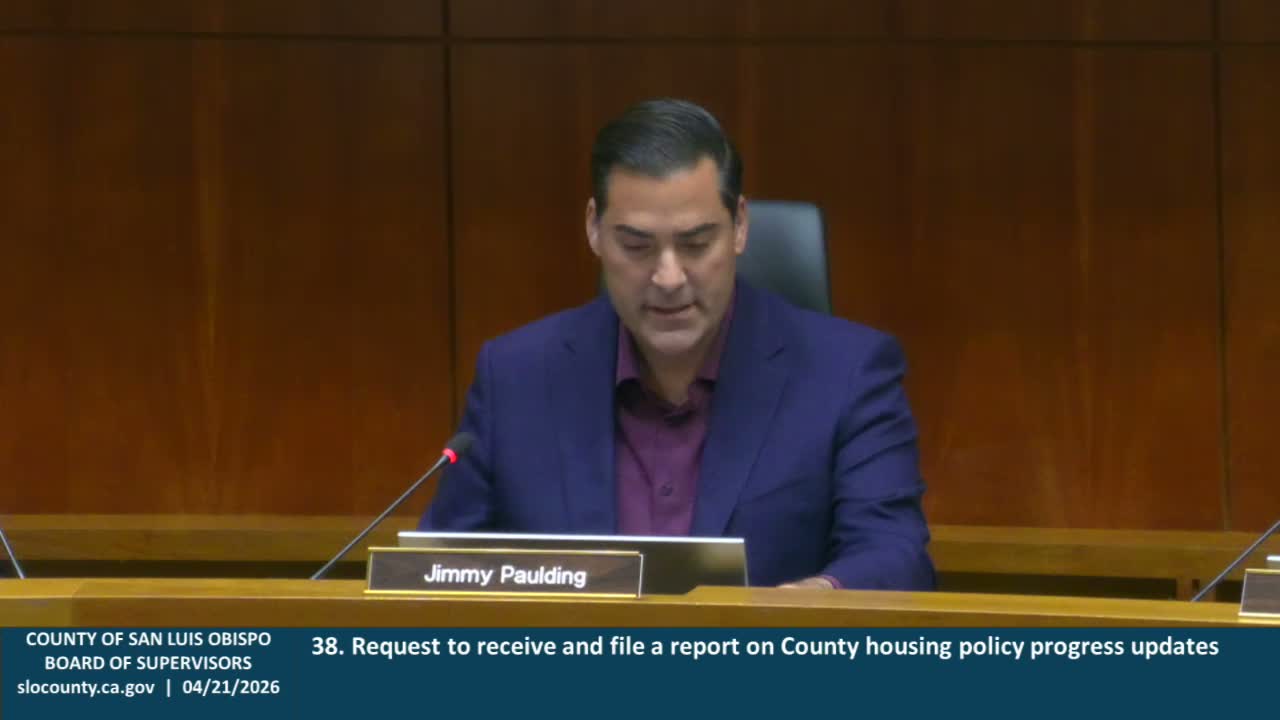
Board members and community speakers emphasized that housing production must be matched to public facilities. Supervisor Paulding said he wants “guardrails and policy guidelines” that align capital investment and service levels with where growth occurs; Supervisor Ortiz-Legg urged exploring modular and micro-unit options and county-owned land as leverage for housing partnerships.
Multiple supervisors and community representatives also asked staff to incorporate the recently created regional housing incentive program and to analyze how ADU counting rules from the state (HCD) could affect the county’s progress on RHNA targets. Planning staff noted HCD’s new guidance requiring an up-to-date market study for ADUs to count as lower-income housing and said the county is exploring funding such an update.
At the end of the study session, the board voted to have staff return with a revised scope that (a) coordinates with REACH’s economic baseline work, (b) focuses community engagement on selected unincorporated communities (including adding Santa Margarita Ranch as a study area), and (c) includes a Paso Basin lot-split/policy review to address water-resource constraints. Planning Director Trevor Keith said staff will work with the executive office and REACH to produce a refined scope and timeline for board review.
The board asked that the revised scope include a clear assessment of infrastructure constraints (water/wastewater, roads, public safety), a curated community-engagement plan (community-specific rather than a single countywide template), and options for revenue or funding mechanisms to help nonprofit builders close financing gaps. Staff estimated that the combined scope could be staged so initial community assessments and coordination with REACH return to the board in a shorter (≈5-month) path if guardrails are provided, or a fuller scoping/engagement program could take up to 9–17 months depending on breadth and depth.
Next steps: staff will come back with a revised scope and proposed engagement schedule that nests the REACH contract deliverables, outlines which unincorporated communities will be studied first, and identifies the data and funding needs (including recommendations about whether to pursue a new ADU market study).