Get Full Government Meeting Transcripts, Videos, & Alerts Forever!
Get email alerts on the Syria Security And Transition topic
No spam. Unsubscribe anytime.
UN official urges Israel to stop incursions and presses for transitional justice, aid and mission relocation
Summary
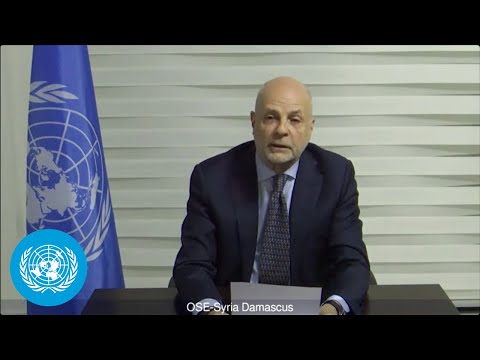
Claudio Cardone, speaking from Damascus at a United Nations Security Council session, urged Israel to cease incursions into southern Syria, detailed refugee flows and security incidents, and called for legislation on transitional justice alongside increased UN engagement and economic assistance.
Claudio Cardone, a United Nations official speaking from Damascus, told the Security Council that recent months have seen progress toward stabilization in Syria but that the country still faces economic strain, social tensions and localized insecurity that threaten political transition.
Cardone accused Israeli forces of repeated violations of Syrian sovereignty and international agreements, saying in the briefing that Israeli airstrikes on 19 March targeted Syrian military infrastructure and that incursions continued, including an operation on 29 March launched from Jebel Al Sheik/Mount Hermon. "I reiterate a strong call on Israel to cease violations, respect Syria's sovereignty and territorial integrity, adhere to the 1974 disengagement-of-forces agreement, and prevent incidents such as the one today," he said, and he urged Israel to return Syrians detained in violation of international law.
The briefing also described humanitarian and security developments across Syria. Cardone said that as of 19 April nearly 300,000 people fleeing fighting in Lebanon had crossed into Syria and that about 51,000 of those were Syrian nationals; he reported that the Syrian Ministry of Interior announced arrests of Hezbollah-affiliated cells, the destruction of cross-border smuggling tunnels and the confiscation of weapons. He said drone attacks in late March from Iraqi territory struck military installations in the northeast but that bilateral efforts and a regional ceasefire had helped restore calm in some areas.
On the political front, Cardone reported incremental progress implementing the 29 January agreement between the Syrian government and the Syrian Democratic Forces, including government deployments, handovers of sites and releases of detainees, while flagging unresolved issues over education, military and administrative integration and public appointments. He said there had been "no progress on advancing elements of the SWEDA roadmap" and cited protests—including on 11 April—calling for self-determination, better living conditions and the release of detainees.
Cardone summarized findings from the Independent International Commission of Inquiry and the Syrian National Commission of Investigation, saying both bodies documented "widespread and serious violations of international human rights and humanitarian law"—including unlawful killings, torture, arbitrary detention, sexual and gender-based violence, and large-scale destruction and displacement—and he welcomed government statements committing to implement recommendations to strengthen accountability and security-sector reform.
Noting trends in the fighting, Cardone said March 2026 recorded the lowest level of direct conflict-related violence in 15 years but cautioned that civilians continue to be killed by remnants of war. He emphasized the need for mine clearance and removal of unexploded ordnance and said that OMAS had offered support for those efforts. He also described joint operations with neighboring countries to counter smuggling and highlighted recent drug seizures.
Cardone linked economic hardship to rising social unrest, describing demonstrations and counter-demonstrations in Damascus that produced injuries and calling for a poverty-reduction strategy and transparency in economic reforms. He welcomed engagement between Syrian authorities and international financial institutions, saying the government has engaged with the World Bank and the IMF and urging continued action on sanctions relief to address the legacy of sanctions.
Cardone urged the swift establishment of a functioning, representative legislature, noting preparations for indirect elections to fill nine vacant seats in the People’s Assembly and the pending announcement of 70 presidential appointees. He called for a law on transitional justice in coordination with the National Commission on Transitional Justice and for a legislative framework for the National Commission on Missing Persons, and he encouraged full use of international impartial mechanisms.
Turning to the United Nations' role, Cardone described strengthened coordination across UN leadership in country, including a joint visit by the emergency relief coordinator and the UNDP administrator, and he previewed upcoming briefings from the under-secretary-general and the special representative for children and armed conflict. He said progress is underway preparing a Sustainable Development Cooperation Framework for 2027–2030 and that discussions are ongoing about relocating the UN mission to Damascus "at the earliest feasible date," pending government feedback.
In closing, Cardone praised the Security Council's "unity of purpose" and cited press and presidential statements and Security Council Resolution 2799 as endorsements of the UN's political role in supporting a credible transition in Syria.