Get Full Government Meeting Transcripts, Videos, & Alerts Forever!
Get email alerts on the Regional Transportation Economic Development topic
No spam. Unsubscribe anytime.
Walla Walla region urges completion of Highway 12 and expanded transit support as port and cities outline growth projects
Summary
Presentations to the commission from the Walla Walla MPO, the Port of Walla Walla, local chambers and cities stressed the economic dependence on US‑12 improvements, highlighted major private projects tied to transportation upgrades and asked for funding and partnership to expand transit, last‑mile connections and flood mitigation.
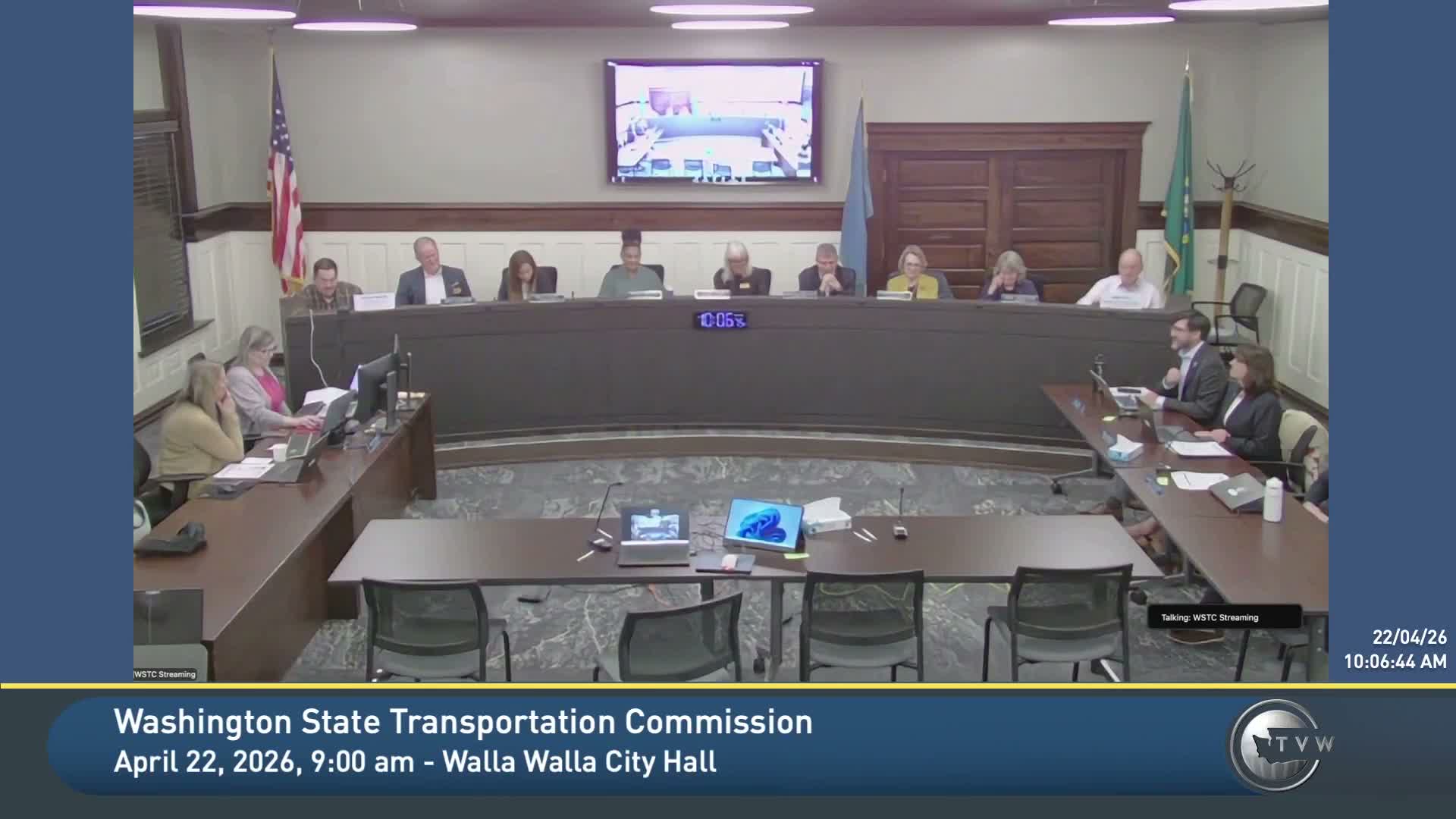
Regional leaders told the Washington State Transportation Commission that completing major roadway projects and aligning transit with workforce needs are critical to economic growth in the Walla Walla Valley.
Andy Gomez, executive director of the Walla Walla Valley Metropolitan Planning Organization, summarized the MPO’s updated Metropolitan Transportation Plan and a project prioritization process that points to US‑12 Phase 8 and the Clinton interchange as top investments. Gomez highlighted demographic shifts — a growing 65+ cohort and falling preschool enrollment — and said the MPO plans a mix of investments (pedestrian, cycling and roadway) totaling tens of millions through 2045.
Pat (Port leadership) described the Port of Walla Walla’s intermodal work, airport operations and a slate of large private projects that depend on transportation capacity. The port cited several major investments in or near the industrial park: a Rockwool insulation plant (phase 1 estimated in the transcript at roughly $300 million and about 125 jobs), a Sky Energy sustainable aviation fuel project (about $2 billion), and a proposed Amazon data center (discussed as roughly a $5 billion investment). Port leadership said those projects make completion of US‑12 Phase 8 essential for freight mobility, safety and regional economic development.
Arlene, president and CEO of the Walla Walla Valley Chamber of Commerce, said the region’s immediate workforce and small‑business challenges center on ‘‘last mile’’ connectivity: employees cannot reliably get to many industrial jobs when shifts start or end because transit schedules and frequencies are misaligned with employer hours. She urged state support on funding tools and service coordination to help businesses hire and retain workers.
City officials from College Place described recent sidewalk, lighting and roundabout projects and outlined persistent local funding gaps: small residential streets and utility‑driven transportation needs are often underfunded even as larger projects advance.
Valley Transit Director Angie Peters explained the agency’s pulse system, fixed‑route and dial‑a‑ride services and a zero‑fare policy supported by Move Ahead Washington funds. Peters said the system has transitioned much of its peak fleet to electric vehicles but is balancing electric procurement against price and resiliency concerns; the agency is piloting electric vehicles for paratransit and expanding demand‑response and job access services to reach areas not served by fixed routes.
Across presentations, speakers repeatedly framed transportation as both economic and workforce infrastructure: large industrial investments require roadway and rail capacity, while local businesses need reliable transit to recruit and retain employees. Several presenters called for continued state and federal grant support and better coordination among partners to move projects from planning to construction.