Get Full Government Meeting Transcripts, Videos, & Alerts Forever!
Get email alerts on the Land Use Zoning topic
No spam. Unsubscribe anytime.
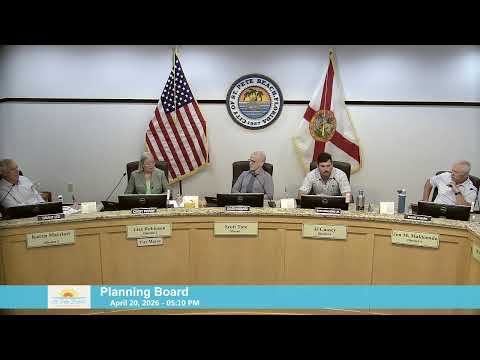
Planning board recommends city amend TC2 Coquina West rules to allow standalone multifamily on small lots
Summary
The St. Pete Beach Planning Board voted to recommend two companion ordinances that would allow standalone multifamily housing on lots smaller than a full block in the TC2 Coquina West District, imposing limits meant to preserve the district’s horizontal mixed‑use character while offering incentives for parcel assembly.
The St. Pete Beach Planning Board on April 20 recommended two companion ordinances (2026‑06 and 2026‑05) that would let developers build standalone multifamily housing on parcels smaller than a full block in the TC2 Coquina West District, a roughly three‑block area on the city’s west downtown between 76th and 73rd avenues.
Brandon Berry, planning staff, told the board the change stems from city commission direction and public meetings held last year. He said the proposal is intended to preserve the area’s existing horizontal mix of commercial, office, residential and lodging uses while making smaller‑scale multifamily developments feasible under modern floodplain, parking and landscaping standards.
"If this were to be accepted by the planning board as a recommendation and adopted by the commission, this would allow for standalone multifamily residential developments within the TC2 Coquina West District," Berry said, describing the policy alignment between the comprehensive plan and the proposed land‑development code changes.
Under the proposal, small‑lot standalone multifamily would generally be limited to about 18 units per acre and three stories in height; assembling half a block and providing mixed use would be incentivized with higher density (up to 24 units per acre) and additional height allowances. Berry said the staff’s basic feasibility gap analysis — which did not factor land‑value — suggested small‑scale mixed use may be most viable from a narrow development returns perspective, but that the comprehensive plan and community input support a range of housing options.
Board members pressed staff on whether these changes would primarily benefit multifamily developers or preserve mixed use. One member said he was unsure the area would ever develop into the type of town center seen on the east side because a major highway divides the two sides of Corey Avenue. Another asked whether the revisions would enable new condominium proposals; Berry said those projects may be in different zoning districts and would not necessarily need this change.
The board moved to find Ordinance 2026‑06 and Ordinance 2026‑05 consistent with the comprehensive plan and recommended both to the city commission. Both motions passed on roll call.
Next steps include transmission of the ordinances to the county and state agencies for review, staff adjustments as needed, and a first city commission reading in May or June, with possible adoption in late summer if reviews are resolved.
Votes at a glance: The planning board took roll‑call votes to recommend Ordinance 2026‑06 and Ordinance 2026‑05 to the city commission; both motions carried.
The planning board’s recommendation will move to the city commission for hearings and final action; state and county review is required for comprehensive plan amendments.