Get Full Government Meeting Transcripts, Videos, & Alerts Forever!
Get email alerts on the Short Term Rentals Policy topic
No spam. Unsubscribe anytime.
Columbus committee hears staff plan for new short-term rental code, online registration and tougher enforcement tools
Summary
City staff proposed a new short-term rental chapter, fully online registration with a simplified renewal affidavit, graduated fines, trespass authorization for police, occupancy limits and a 25% hotel/motel threshold for buildings that function like hotels. Councilors and residents urged stronger enforcement and better platform reporting before possible legislation this summer.
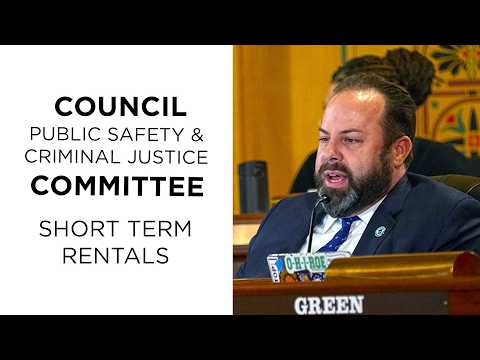
Chair Council Member Emmanuel Remi convened a follow-up hearing of the Columbus City Council's Public Safety and Criminal Justice Committee to review staff recommendations for updating the city's short-term rental rules and to collect public feedback ahead of possible legislation before the July recess. No bills were before the committee.
Legislative analyst Dr. Tanisha Pruitt summarized the committee's earlier hearing and presented current counts and trends: roughly 1,535 permits had been issued, and staff reported about 1,600 short-term rental accounts with roughly 1,200 active. Pruitt said peer cities use neighbor-notification programs and that the department is exploring whether platforms should remit the city's 5.1% lodging excise tax directly.
Tony Celebrizi, deputy director of the Department of Building and Zoning Services, outlined a package of suggested code and policy changes intended to modernize enforcement while easing compliance for responsible hosts. Celebrizi said staff wants a single new chapter in the municipal code to centralize requirements, "implement a fully online registration renewal system" and consider a simplified renewal affidavit so timely renewals cost less to process.
On enforcement, staff proposed graduated fines for repeat or willful noncompliance, and said the department prefers to work cooperatively with owners before seeking court action. Celebrizi described the department's proposed trespass authorization, a form owners would sign so police can remove non-overnight guests who are not part of the registered overnight party, calling it "a strong tool" to stop repeated disturbances without requiring officers to find the owner first.
Staff also recommended rules to address specific safety and nuisance risks: inspections for bedrooms claimed in basements to confirm egress and compliance with the Ohio building and fire codes; an overnight occupancy guideline (proposed roughly two people per bedroom plus an additional two guests); limits on non-overnight occupants; and a possible policy to require hotel/motel licensing when a threshold share of a building's units (staff mentioned 25% as a working concept) operate as short-term rentals and the property functions like a transient lodging facility.
Council members queried the department about details: how fingerprints and background checks would fit into a more automated workflow, how fees for initial review and issuance differ from renewal fees, whether fines should scale by the severity of incidents, and whether licensing records can be integrated with the recently adopted rental-registry system. Celebrizi said fingerprint-based background checks would remain in-person but that multiple locations exist and that moving the rest of the workflow online would free staff time for enforcement and problem properties. He also said staff is discussing technology integrations with platforms and the county auditor to improve proactive detection of unregistered units.
Chair Remi and members emphasized the hearing's goal: preserve the economic value of short-term rentals while giving the city better, clearer and more enforceable tools to address repeat nuisance and safety problems. Staff and council committed to reviewing testimony and continuing to refine proposals before drafting legislation.