Lifetime Citizen Portal Access — AI Briefings, Alerts & Unlimited Follows
Pitkin County planning commission continues Phillips Mobile Home Park review after hours of technical briefings and public opposition
Loading...
Summary
Pitkin County planners and asset staff presented a county‑led plan to modernize water and sewer and add 40 new affordable homes at the Phillips Mobile Home Park. Staff found the proposal conflicts with the Woody Creek master plan but aligns with parts of the Down Valley comprehensive plan; commissioners voted to continue the hearing to May 5 after extensive public comment on flood hazards, wildlife and relocation.
Pitkin County’s Planning & Zoning Commission on April 21 continued a public hearing on a county‑initiated proposal to upgrade utilities at the Phillips Mobile Home Park and add roughly 40 new affordable homes, directing staff to draft a resolution that captures the panel’s concerns and returning the item on May 5 for final action.
Planner Nicole and county asset manager Kevin Warner gave a technical presentation that described the 74½‑acre county parcel, a long‑standing legal nonconforming mobile‑home park, and outlined the county’s plan: two new water wells, a roughly 900‑square‑foot water‑treatment building, a mostly buried 280,000‑gallon concrete storage tank (about 210,000 gallons dedicated to fire flows), a permitted wastewater treatment facility using bio‑clear units, asphalt road improvements and clustering of 40 new stick‑built units (a mix of fourplexes, duplexes and single‑family homes) on about 22 acres of the site.
Kevin Warner told the commission the water tank "will meet the required fire flows" and described sanitation and conveyance improvements intended to replace aging wells and septic systems. Staff also summarized referral comments: Colorado Geological Survey noted debris‑flow hazards and requested additional analysis, and regional transit/corridor reviewers raised concerns about encroachments into the Rio Grande rail corridor and potential deed exchanges.
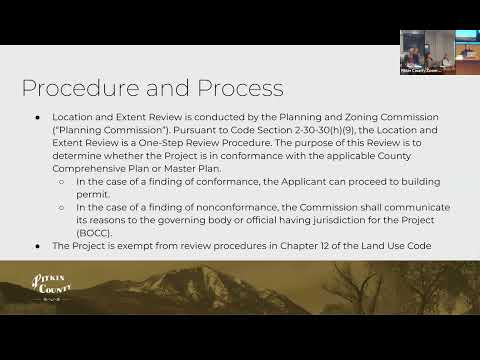
Nicole said staff’s analysis finds the proposal increases dwelling units and therefore is not in conformance with the Woody Creek master plan while concluding it does conform with some elements of the Down Valley comprehensive plan. Staff recommended adoption of the draft resolution in the packet that records those findings.
The meeting then moved to public comment, where many residents and community representatives opposed the application. Kathy Wallagus, a Lower River Road resident, said, "I am here tonight to oppose the Philip Trailer Court project as presented, and it is noncompliant with the Woody Creek Caucus." Public speakers raised a consistent set of concerns: the site’s proximity to debris‑flow channels and floodplain; potential wildlife impacts and loss of open habitat; added vehicle trips and safety at Rio Grande Trail crossings; long‑term operating and replacement costs for water/waste systems; uncertainty about relocation guarantees for Riverside residents whose homes and septic are partly within the floodplain; and the project’s apparent tension with long‑standing neighborhood master‑plan goals.
Staff answered detailed questions about technical elements: Warner said the new water system would include two new wells, treatment and distribution piping and that the wastewater treatment would be permitted by the Colorado Department of Public Health and Environment and would discharge treated effluent to the river via a conveyance that must cross a limited portion of the floodplain. On debris‑flow mitigation, Warner said engineers are iterating designs with geologists and hydrologists and proposed measures such as larger catchment basins, channelization and low‑water crossings in place of culverts.
Commissioners debated the planning findings, the limits of the commission’s authority versus the Board of County Commissioners, and the need to give the BOCC a clear, specific record if P&Z were to deny the application. Multiple commissioners said they view the proposal as inconsistent with the Woody Creek master plan. Rather than vote on final action, a commissioner moved — and colleagues seconded — to continue the public hearing to May 5 and ask staff to draft a revised resolution enumerating the commission’s concerns. The motion passed by voice vote.
The commission’s next steps are to review the staff‑drafted resolution at the continued hearing and decide whether to adopt findings of nonconformance, send a different recommendation to the Board of County Commissioners, or approve the application with conditions. The hearing record includes staff analyses, CGS comments requesting further geotechnical and hydrologic work, the traffic and debris‑flow technical materials, and more than a dozen public comments opposing the project.