Get Full Government Meeting Transcripts, Videos, & Alerts Forever!
Get email alerts on the Health Workforce topic
No spam. Unsubscribe anytime.
UAA tells committee it needs $2M to study a $30M academic medical center, cites workforce shortages
Summary
University of Alaska Anchorage officials told the House Health and Social Services Committee they are seeking $2 million in year-one funding as part of a $30 million rural health transformation effort to study and plan an Alaska academic medical center, expand residencies and retain more graduates in-state.
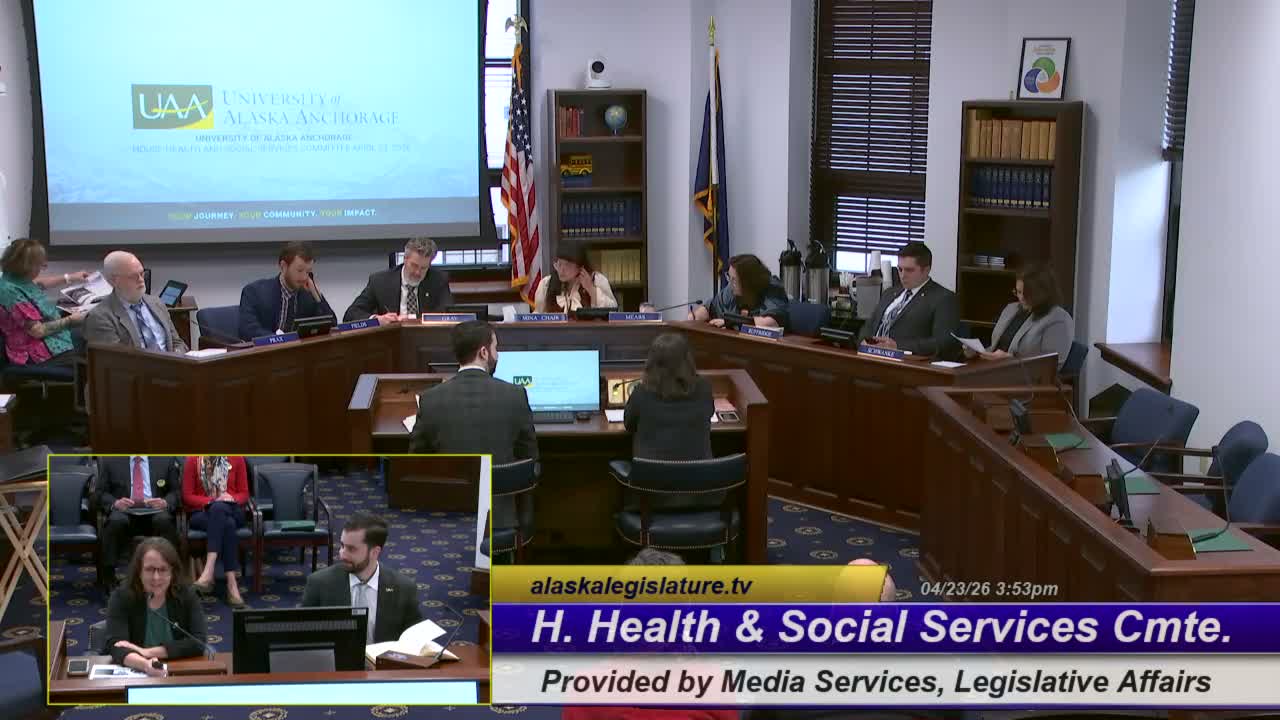
University of Alaska Anchorage leaders told the Alaska House Health and Social Services Committee on April 23 that the College of Health is expanding programs to address statewide workforce shortages and is seeking initial state funding to study an academic medical center and broader rural health transformation.
Chancellor Cheryl Siemers told committee members that UAA is the system's designated College of Health and emphasized a "dual mission"—providing short pathways into the workforce while also offering advanced degrees. "We are committed to workforce development... and applied research efforts solve practical problems for our state," she said.
In a prerecorded address, Dean Jay Butler said, "In Alaska, access to care isn't just a policy catchphrase. It's a geographic challenge," and urged support for expanded rural and tribal clinical placements. Butler and UAA presenters argued that training more Alaskans increases the likelihood they will stay to practice in-state.
Andre Rose and Dr. Carrie Moore described specific programs and capacity constraints: population health, social work, allied health and nursing programs, existing partnerships with the University of Washington (WWAMI) and Idaho State University, and workforce-training initiatives such as PATH Academy for entry-level certifications. Moore reported program metrics including roughly 60 certified nursing assistant graduates per year and high in-state retention rates for many programs.
UAA outlined a proposal for a state-supported rural health transformation and an academic medical center described as a partnership model linking university training with an operating clinical facility. UAA said the overall proposal is for $30,000,000, with a first-year request of $2,000,000 to fund a feasibility study, consulting support, legal counsel and memoranda of agreement. "Our first year proposal was for 2,000,000, and that would allow us to recruit and vet a consulting firm," UAA said.
Officials said that residency capacity in Alaska is limited (currently about 12 to 14 residency slots per year) while the WWAMI undergraduate expansion will bring 30 medical students annually beginning in 2029, creating a need for more in-state residency training to retain graduates. UAA said a multi-year plan would include a feasibility year, development of a business plan and steps to operationalize residencies and rural rotations over five years.
Committee members pressed for more metrics and specifics on sustainability and return on investment, asking UAA to provide detailed numbers on traveler nurse spending, employer-funded scholarships, job placements by program and exact wage data for specialized roles such as public guardians. UAA committed to share metrics and to follow up with the committee.
The committee recessed to sign the report on the earlier confirmation and adjourned the hearing at 4:50 p.m.; no committee funding decision was made at the April 23 meeting.