Lifetime Citizen Portal Access — AI Briefings, Alerts & Unlimited Follows
Mayors and city managers tell Alaska Senate committee SB 280 must ensure earlier, direct pipeline impact funding
Loading...
Summary
Mayors and city managers told the Senate Resources Committee that the committee substitute to SB 280 (version G) improves revenue sharing but still risks leaving communities without timely funding for immediate construction impacts; speakers urged direct municipal payments, clearer eligibility for indirect-impact hubs and predictable pre-construction aid.
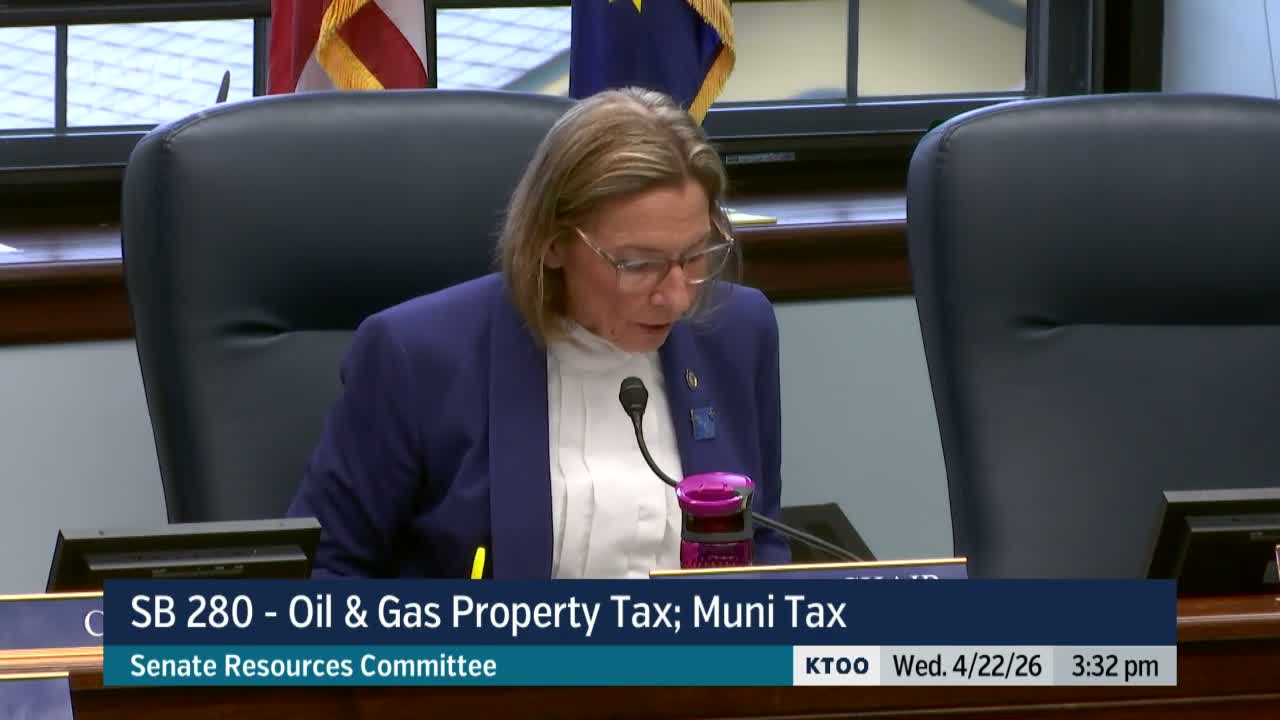
Chair Giesel opened the Senate Resources Committee hearing on SB 280 on April 22, where municipal leaders outlined how the proposed alternate volumetric tax and community impact programs would affect local services during construction of a proposed gas pipeline. Several mayors and city managers said version G includes important improvements — but warned the timing and routing of funds could leave host and adjacent communities underfunded when impacts arrive.
Mayors from Denali, Matanuska-Susitna and Fairbanks, and the city manager of Kenai, all described immediate service demands the project would create. "This legislation would fundamentally alter our abilities as local governments to collect revenue to meet our current and future needs," said Mayor Chris Noel of the Denali Borough, who noted Denali has no current property tax and asked that community impact payments flow directly to municipalities rather than through legislative appropriation. Mayor Mindy O'Neil of Fairbanks said version G's community impact fee and statewide per-capita sharing are helpful but cautioned that impact funding "may not arrive when you need it" and recommended a portion of the impact funding be made formula-based and available pre-construction.
City Manager Terry Eubank of Kenai described a range of near-term pressures — airport traffic, increased calls for police and EMS, road wear, water and sewer demand and housing shortages — and said the original bill lacked mechanisms to pay for those immediate needs; he told senators that version G "improves that framework" by adding statutory revenue sharing and construction impact payments. Eubank also cited a Kenai survey finding that 74% of residents reported housing availability and affordability challenges.
Committee members pressed witnesses on allocation mechanics. Senate majority legal counsel Sunny Kawasaki explained version G's design: revenue flows to municipalities from a per-mile allocation and through a per-capita distribution under the Community Assistance Program, and DCCED (Department of Commerce, Community and Economic Development) would clarify how per-capita shares are handled for cities located inside boroughs. Several officials warned that routing significant funds through boroughs without a clear pass-through mechanism could delay or complicate distribution to affected cities.
Municipal leaders repeatedly raised the timing problem: impacts (construction camps, laydown yards and road improvements) begin during mobilization and ramp-up, but payments tied to miles of pipeline constructed would lag and could arrive only after communities have already incurred costs. Noel suggested requiring the developer to implement community impact-fee payments "prior to construction" or to negotiate direct mitigation. Mayor O'Neil said Fairbanks needs eligibility language that explicitly covers communities that will experience significant indirect impacts even if the pipeline does not cross their municipal boundaries.
The committee heard consistent support for retaining revenue certainty and avoiding broad preemption of local revenue sources; several speakers urged that alternative volumetric taxes be used "in lieu exclusively of property taxes" so municipalities retain clarity over their long-term tax base. Senators indicated they would welcome concrete drafting ideas about front‑loaded impact payments and local eligibility for the impact funding.
The hearing closed with the committee noting further testimony would come from industry at the next meeting on April 23, and that staff would work to provide maps and clarifications about municipal boundaries and program implementation.