Get Full Government Meeting Transcripts, Videos, & Alerts Forever!
Get email alerts on the Energy Regulation topic
No spam. Unsubscribe anytime.
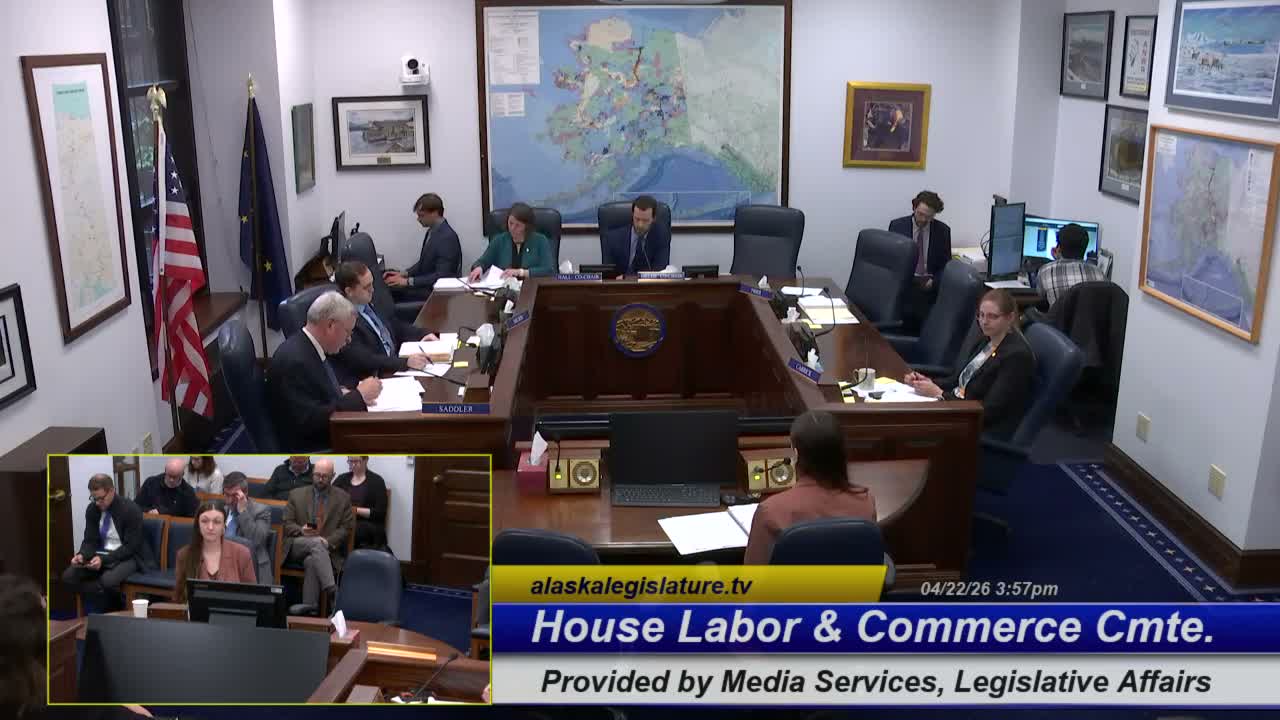
Committee debates SB 180’s intent to clarify RCA jurisdiction over LNG imports; short timeline amendment adopted
Summary
Lawmakers exchanged sharply over sponsor language about Regulatory Commission of Alaska authority and adopted an amendment shortening RCA adjudication timelines (6‑1) while holding larger policy changes on LNG facility regulation for further work.
Senate Bill 180, which aims to clarify how the Regulatory Commission of Alaska (RCA) treats liquefied natural gas import facilities, prompted a pointed exchange about the sponsor statement’s framing and what authority the RCA currently holds.
Paige Brown (staff to the Senate Resources Committee) told the House Labor and Commerce Committee the bill was intended to "clear confusion" created by language in a prior bill (House Bill 50) and to confirm that RCA authority covers gas‑sales contracts involving LNG imports while not expanding commission authority to regulate the import facility itself. Representative Sadler disputed parts of the sponsor statement and said the sponsor language misstated historical RCA authority; he argued the statement could create more confusion than clarity.
Separately, the committee considered two amendments. Amendment I.2 would shorten certain RCA adjudication timelines: for tariff filings that do not change a utility's revenue requirement or rate design, decision time would move from 270 days to 180 days; for filings that do change revenue requirement, the timeline would move from 450 days to 270 days. Utilities and Golden Valley Electric Association urged the committee to adopt the amendment, arguing it would reduce regulatory lag and investment risk. Representative Sadler urged the committee to hear directly from the RCA; the chair said the amendment was developed with RCA input and governor’s office support. The roll call on I.2 was 6 yeas, 1 nay and the amendment was adopted.
A separate amendment copied compromise language from SB 32 that would deregulate facilities under a megawatt threshold (discussed as 8,000 kilowatts/8 MW, with sponsor staff preferring 5 MW in line with power‑pooling agreements) produced more substantive policy pushback. Several members said the change was a significant policy shift that had not been fully vetted in Senate Resources; the committee agreed to hold the bill and its amendments for further discussion.
The hearing underscored a narrow, technical change moving forward on regulatory timelines while broader policy questions about facility jurisdiction and deregulation were deferred for more information and stakeholder input.