Get Full Government Meeting Transcripts, Videos, & Alerts Forever!
Get email alerts on the SB 167 PFD Eligibility topic
No spam. Unsubscribe anytime.
Committee adopts substitute to restore PFD eligibility for people with vacated convictions
Summary
The Alaska House Judiciary Committee adopted a committee substitute for SB 167 on April 22, 2026, restoring Permanent Fund Dividend (PFD) eligibility to individuals whose criminal convictions were vacated or reversed and outlining procedures to claim past PFDs; the committee reported the bill out with individual recommendations and an attached fiscal note.
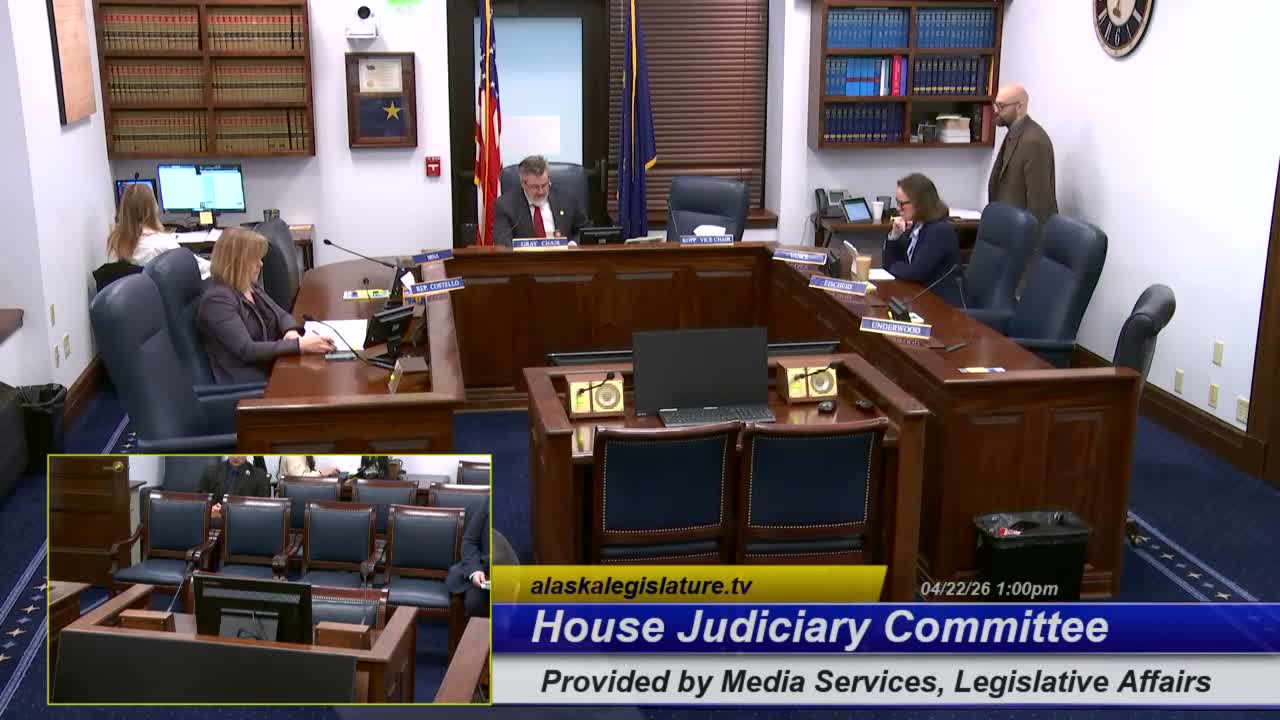
The Alaska House Judiciary Committee on April 22 adopted a committee substitute for Senate Bill 167 to restore Permanent Fund Dividend eligibility to people whose criminal convictions have been vacated or reversed. Chair Representative Gray presided; Representative Mena moved the substitute and, seeing no objections after discussion, the committee adopted it as its working document and later voted to report the bill out with individual recommendations and an attached fiscal note.
The substitute, explained to the committee by Dylan Hitchcock Lopez, committee aide, conforms the senate bill to the house companion and "restores PFD eligibility for individuals whose convictions were vacated or reversed." It also establishes procedures for applying to claim past PFDs and clarifies that a prior transfer of a past PFD amount to the restorative justice account does not disqualify an otherwise eligible individual from receiving those past PFDs.
Members asked how that language interacts with existing law governing the restorative justice account. Representative Costello pressed whether the statute explicitly earmarks transferred dividends for the Victims Compensation Board and domestic violence/sexual-assault programs, and whether putting the funds into a general restorative justice account would change the statutory purposes. Dylan Hitchcock Lopez replied that the committee substitute does not amend the restorative justice account statutes and cited AS 43.23.048 (restorative justice account), noting the statute creates a separate account in the dividend fund and lists priority appropriations by percentage. He read the statutory allocation ranges, which include 10–13% to the victims compensation fund, 2–6% to the Office of Victims' Rights, 1–3% to nonprofits for domestic violence/sexual-assault grants, 1–3% for nonprofit mental health/substance-abuse services for offenders, and 79–88% to the Department of Corrections for incarceration or probation costs.
Representative Costello said she wanted to ensure the substitute did not unintentionally expand how those transferred amounts are used; staff reiterated the substitute's purpose is limited to eligibility for past PFDs and does not restructure the restorative justice account. After discussion the chair removed his objection, and the committee adopted the substitute as the working document. Representative Mena then moved that SB 167 be reported out of the committee with individual recommendations and an attached fiscal note; hearing no objections, the motion carried and Legislative Legal Services was authorized to make technical and conforming changes.
The committee approved the substitute and reported SB 167 out for further consideration with a fiscal note. The bill's changes are intended to provide a path for people whose convictions were overturned to reclaim dividends they did not receive while incarcerated; the substitute also preserves the prior transfers to the restorative justice account and clarifies eligibility independently of those transfers. The committee briefly recessed to sign paperwork and adjourned at 1:33 PM.