Get Full Government Meeting Transcripts, Videos, & Alerts Forever!
Get email alerts on the Budget Reform Impact topic
No spam. Unsubscribe anytime.
Okaloosa County warns proposed homestead exemption could cut about $35 million from county budget
Summary
County staff told commissioners that House Joint Resolution 203 or similar property‑tax changes could eliminate non‑school property taxes for homesteads and reduce Okaloosa County’s general‑fund revenue by roughly $35 million, forcing deep cuts to nonmandated services unless alternative revenue sources are adopted.
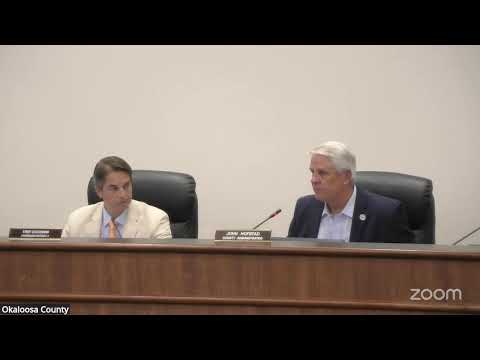
County Administrator Hofstead warned the Okaloosa County Board of County Commissioners on April 21 that proposed state reforms to property‑tax rules could sharply reduce the county’s property‑tax revenue and force substantial reductions in nonmandated services.
"We would have to reduce our general fund budget by 35,000,000," Hofstead said, summarizing staff modeling of a scenario in which an additional $25,000 homestead exemption (or broader House Joint Resolution 203 language eliminating non‑school property tax for homesteads) takes effect. He said that an additional $25,000 exemption across homesteaded parcels would reduce county revenue by about $4,200,000 per increment and that the version discussed in the Legislature could reduce Okaloosa’s revenue by roughly $35 million.
That loss would come against an all‑funds county budget of roughly $687 million and an estimated general‑fund budget near $180–182 million, Hofstead said. Staff told commissioners that about 57 percent of property‑tax dollars primarily support local and state school levies, while the county’s portion and a small MSTU account for the remainder. Hofstead emphasized that much of the county’s general‑fund spending covers statutory and constitutional obligations—public safety, courts, corrections and other mandates—which he estimated at about $85 million when aggregated, leaving roughly $27 million for discretionary, nonmandated services.
Because mandated public‑safety and constitutional costs are difficult or impossible for the county to cut, Hofstead said any multi‑million‑dollar revenue loss would be concentrated on parks, libraries, economic development, capital projects and general‑fund positions. "Even if you eliminate all of the nonmandatory services, ... we'd still have a balance of about $8,000,000 we would need to find to offset that," he said.
Staff outlined potential responses, including a 10 percent reduction exercise across funds (described as an analytic exercise required under a pending transparency bill), deferring or canceling capital projects, eliminating nonessential services, consolidating programs, cutting positions, increasing user fees, imposing franchise or stormwater fees, or raising millage. Hofstead told the board that most revenue options would be modest and that a millage adjustment remains the only likely source of significant new revenue in the near term.
Several commissioners urged caution in forecasting and stressed public education if drastic changes reach the ballot. One commissioner said the public often does not appreciate the services paid for locally and urged colleagues to inform residents about potential program losses.
Hofstead and staff said the county is monitoring multiple legislative items (including sovereign‑immunity proposals and a proposed state audit function) and expects clearer revenue estimates after the governor signs bills and the state’s revenue‑estimating conference meets in June. Staff will present more refined budget scenarios and department requests during one‑on‑one reviews in May and board workshops in July; the tentative millage discussion is scheduled for the July 21 workshop, with final hearings in September.
Next procedural steps: staff will continue modeling scenarios and return with draft budgets and options in July once property‑value certifications and state revenue estimates are available.