Get AI Briefings, Transcripts & Alerts on Local & National Government Meetings — Forever.
Parker council approves license‑plate‑reader grant application over one councilmember's privacy objections
Loading...
Summary
Council voted 4–1 to authorize applying for a TxDOT/MVCPA grant to install automated license‑plate readers at city entry points, with a local match capped at $5,000; supporters cited crime‑fighting benefits and interoperability, while the dissenting councilmember warned of surveillance and community trust concerns.
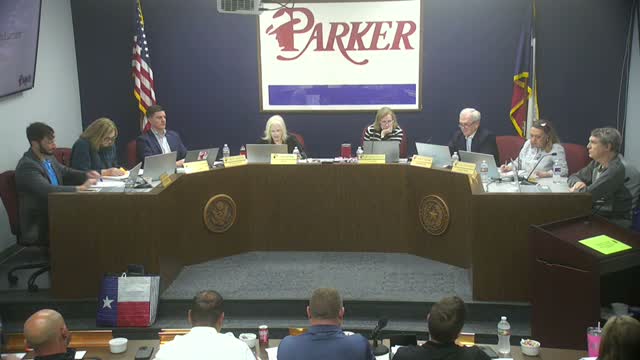
The Parker City Council voted April 21 to apply for a Motor Vehicle Crime Prevention Authority (MVCPA) grant to install automated license‑plate readers (ALPRs) at four entry points to the city, approving a resolution that authorizes up to $5,000 in local matching funds and directs staff to prepare policy and contract details.
Mayor Pro Tem Pilgrim (S8) moved to submit the grant application for four cameras and the required match, and Councilmember Sharp (S6) seconded. The motion passed 4–1; Councilmember Halbert (S7) voted against the measure, citing privacy and community‑trust concerns.
Police and vendor presenters described the system as an investigative tool that captures a point‑in‑time image of a vehicle plate and checks it against national hot lists (stolen vehicles, NCIC alerts) and said it does not perform facial recognition. Ian Leslie, regional public affairs manager for vendor Flock (S9), said the vendor’s policy defaults to 30‑day retention and that the platform provides a transparency portal so agencies can publish data retention, prohibited uses and camera locations.
“We are looking for people that have a hit on their car, people that maybe are involved in a crime,” the police presenter said, describing past local uses to locate suspects. Leslie added, “It’s not tracking somebody throughout the day. It’s a point in time image of the back of the license plate.”
Council members asked detailed questions about data flow, CJIS/Texas data access, early‑termination liability in vendor contracts, what audits and access controls would look like and how costs would be provided in the budget. Staff said the grant covers equipment and that the city would be responsible for a local match and ongoing subscription costs; the first‑year estimated local expense presented ranged roughly $40,070 with subsequent annual subscription costs in the low thousands, and staff said they could seek a one‑year contract term.
Councilmember Halbert said she worried about perception and civil‑liberties risks: “I don't ever want our residents to think that we are surveilling them,” she said, noting transparency and careful policy would be required if the city adopts the technology.
Council directed staff to prepare a policy for council review, get contract details from the vendor, and return with a grant application and budget amendment if the grant is awarded.
Votes: Motion passed 4–1 (Halbert opposed).