Get Full Government Meeting Transcripts, Videos, & Alerts Forever!
Get email alerts on the Subdivision Preliminary Plat topic
No spam. Unsubscribe anytime.
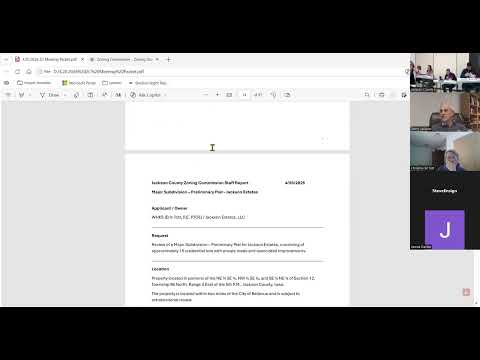
Jackson County Zoning Commission recommends preliminary plat for Jackson State subdivision with 18% road grade and recorded fence agreement
Summary
The Jackson County Zoning Commission voted to recommend supervisors approve the preliminary plat for the Jackson State subdivision, accepting the submitted 18% private roadway grade and requiring a recorded fence agreement assigning boundary‑fence maintenance to adjoining landowners and the homeowners association.
The Jackson County Zoning Commission voted unanimously to recommend that the Board of Supervisors approve the preliminary plat for the Jackson State subdivision, forwarding conditions that accept the 18% maximum roadway grade shown in the applicant's plan and require a recorded fence agreement assigning fence maintenance to adjoining landowners and the homeowners association.
Planning staff opened the hearing by saying notices were published and 38 property owners within 500 feet received mailed notice; staff reported four responses by phone or email prior to the meeting. The preliminary review focused on lot layout and buildability, drainage and stormwater, private road design and maintenance, wells and septic (to be verified at permitting), and final covenants.
Eric Todd, identified at the hearing as the applicant/agent, described the proposal as about 50 acres on the north side of Bellevue adjacent to Highway 52 and Jackson Park Drive. The plan would add 14 new lots plus an existing house (15 lots total), create four private roads terminating in 85‑foot cul‑de‑sacs and provide six on‑site detention basins to meet stormwater requirements. Todd said each lot will have individual wells and septic systems unless neighbors later opt to share systems, and that eastern lots are served by the city while the western half uses county/other utilities that staff and the applicant are still coordinating.
Neighbors raised multiple concerns. Dwayne Van Heemer, who said his property backs up to the proposed development, urged the commission to address drainage, saying “the drainage is horrendous there” and noting recent heavy flows, a filled pond and visible bank erosion. Other residents described potential erosion, the need for recorded fence agreements because of livestock, and loss of hunting areas if lots are developed. Several speakers asked for a neighborhood meeting and for the county engineer and supervisors to verify downstream impacts.
The applicant and the engineer responded with technical clarifications: the subdivision’s drainage plan includes multiple detention basins and intercepting ditches intended to hold the 100‑year storm volume and release only at a reduced (5‑year) rate; they also pointed to specific basin locations and described berms and pipes intended to slow runoff. The applicant said some steep local private roads and an existing driveway near the site have grades in the mid‑teens and that the site’s topography limited feasible alternatives.
Commission discussion centered on two primary issues: the requested modification to the county’s standard roadway gradient and fencing/maintenance responsibility. The county or city engineer had recommended a lower maximum grade (12%) but the applicant requested relief to allow steeper private drives because the roads are private, serve only the subdivision, and the topography is constrained. Commissioners acknowledged the engineer’s preference for a lower grade but noted existing local examples with steep grades and the private‑road context.
To address neighbors’ fencing and livestock concerns, commissioners favored recording a fence agreement and shifting maintenance responsibility to the HOA and adjoining landowners rather than leaving it to individual lot owners. Planning staff confirmed the subdivision ordinance requires covenant language and recording of any required boundary fence arrangements.
A commission member moved to approve the preliminary plat recommendation as presented, including the 18% grade shown on the plan and a recorded fence agreement assigning maintenance to the HOA and adjoining landowners; a second was recorded. On roll call the commission recorded unanimous yes votes from the six members present. The commission’s recommendation — including those conditions and the record of the public comments — will be forwarded to the Board of Supervisors, which has the final approval authority for the final plat.
What happens next: the commission’s recommendation, staff summary and the conditions discussed (drainage items, fence recording, and the grade modification) will be included in the packet sent to the Board of Supervisors for their review and final decision. The county engineer and supervisors will examine the technical stormwater and grading concerns during that review; no final building permits or well/septic approvals will be issued until lot‑level permitting and environmental health reviews are completed.
Sources: Planning staff presentation and packet; applicant remarks; public comments during the Jackson County Zoning Commission public hearing.