Get Full Government Meeting Transcripts, Videos, & Alerts Forever!
Get email alerts on the Workforce Development topic
No spam. Unsubscribe anytime.
Delta Regional Authority opens 2026 Delta Workforce Program grant cycle; $4M available, $50k–$300k awards
Summary
The Delta Regional Authority (DRA) detailed application rules, scoring criteria and deadlines for the 2026 Delta Workforce Program (DWP), highlighting a May 15, 2026 portal deadline, required employer letters, a $300,000 award ceiling, a 24-month performance period, and a new apprenticeship scoring element tied to the Department of Labor’s America's Talent Strategy.
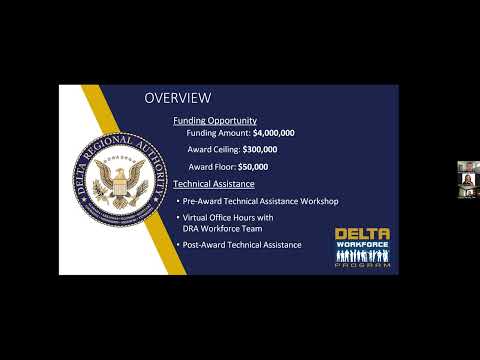
Daniel Musgrave, workforce program manager at the Delta Regional Authority (DRA), outlined application rules and scoring guidance for the 2026 Delta Workforce Program during a technical-assistance briefing for prospective applicants. He said the DWP has at least $4,000,000 available, individual awards range from $50,000 to $300,000, and the application portal closes on May 15, 2026, at 11:59 p.m. Central.
Musgrave stressed that submissions must be uploaded through DRA’s grant management system and that late or emailed/hard-copy applications will not be reviewed. "The application deadline is Friday, May 15, 2026, at 11:59 p.m. Central," Musgrave said, and he urged applicants to complete uploads several days early to avoid avoidable disqualification.
Jayden Penley, workforce program analyst at DRA, reviewed the scoring rubric and point structure applicants will face. The rubric emphasizes five evaluation areas including project description and rationale, local and regional collaboration, anticipated outcomes and work plan, project team, and funding information. Penley noted the project description and rationale portion comprises a substantial portion of the score and that applicants should include demographic and labor-market data (median household income, unemployment rate, labor force participation) to receive full points.
Penley also described a new apprenticeship training-model section for 2026 tied to the U.S. Department of Labor’s America's Talent Strategy (pillar 1). Applicants that demonstrate industry-driven apprenticeship or registered-apprenticeship models aligned with that pillar can score highly. Penley explained that measurable, SMART outcomes (for example, number trained, jobs created or retained, industry-recognized credentials earned) should be listed with supporting evidence.
A firm employer-engagement requirement was emphasized. "Applicants that do not include at least 1 letter from an employer partner will not be considered. This is a requirement," Penley said. Applicants must document where trainees will be hired, specify employer roles in curriculum development or on-the-job training, and attach detailed letters that describe the partner's commitment and any leverage (cash or in-kind).
Eligibility and allowable uses: DRA said eligible applicants include local governments, nonprofits (including 501(c)(3) organizations), regional economic development organizations, workforce boards, unions, community and faith-based organizations, institutions of higher education, trade and technical schools, and federally recognized tribes; for-profit entities are not eligible. Eligible participant groups include new entrants to the workforce (including youth and formerly incarcerated individuals), dislocated workers and incumbent workers who need upskilling. Training must be cost-free to participants.
Budget and cost rules: Penley instructed applicants to provide a categorical budget narrative that ties every line item to proposed activities. The total requested from DRA cannot exceed $300,000 per award. Cost sharing of at least 10% is required for most applicants (cash or in-kind), though projects located in or serving DRA-designated distressed counties or isolated areas of distress do not need to demonstrate a match. Equipment purchases with a per-unit acquisition cost of $10,000 or more must be listed under equipment; items below $10,000 should be classified as supplies. Construction is not allowable, but renovations tied to training delivery may be eligible under the contractual line item.
Indirect costs and federal compliance: Penley said organizations with a negotiated indirect cost rate agreement (NICRA) should explain the calculation and attach documents; organizations without a NICRA may claim the 15% de minimis indirect cost rate applied to modified total direct costs, if they meet the requirements in 2 CFR part 200.
Performance period and technical assistance: DRA said the period of performance for awarded projects is 24 months, beginning on the notice to proceed; activities occurring before the notice are not reimbursable. Musgrave noted DRA will offer pre-award technical-assistance workshops, virtual office hours with the workforce team, and a post-award workshop for recipients.
Application review process and contact information: Penley said all applications will be pre-screened for eligibility and completeness and scored against FOA criteria; awards will depend on competitiveness and proposed request amounts, and DRA may negotiate budgets or request revisions. Musgrave closed the briefing by encouraging applicants to use DRA’s resources, keep SAM registrations active (SAM registration is free), and to address portal or FOA questions to workforce@dra.gov.
What applicants should check now: confirm an active SAM registration, ensure at least one detailed employer letter is included, prepare a 24-month work plan with SMART outcomes, assemble resumes or job descriptions for key team members, and prepare a categorical budget narrative that does not exceed the $300,000 ceiling. The application portal and the full FOA are available at dra.gov (Delta Workforce Program page).