Get Full Government Meeting Transcripts, Videos, & Alerts Forever!
Get email alerts on the Broadband Tax topic
No spam. Unsubscribe anytime.
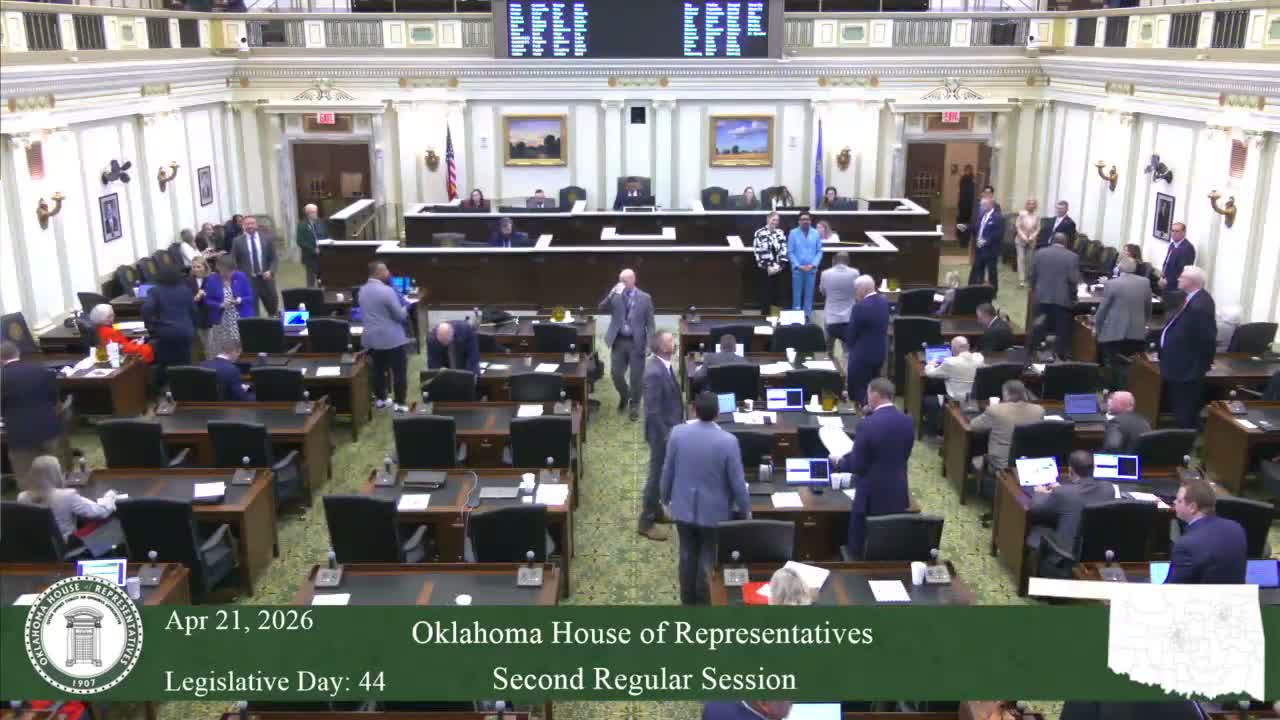
House debates SB 1122 to align ad valorem tax treatment for broadband infrastructure
Summary
Lawmakers spent an extended floor session debating SB 1122, which would carve certain broadband infrastructure out of utility property-tax treatment and equalize rates between legacy utilities and newer broadband providers; questions focused on whether the change favors business, lowers consumer prices and how it affects incumbents. A roll call on third reading recorded 56 ayes and 38 nays; the clerk said it had not received a majority at that point.
Representative Trey Caldwell brought SB 1122 to the floor as a measure aimed at "promot[ing] equality in broadband expansion," saying the bill would treat non-utility broadband infrastructure at the same property-tax rate as other broadband providers rather than at legacy utility rates.
Caldwell told colleagues the proposal addresses a current disparity in tax treatment that he said disadvantages some providers and communities. "When we're pushing broadband out into rural areas of Oklahoma," he said, "this merely promotes equality in broadband expansion." He described greater broadband access as "the rural electrification of our time."
Members pressed Caldwell with detailed questions. Representative Banning asked whether the bill was "pro-business," and Caldwell replied that it was "not only pro-business, but it's equal treatment under the law for businesses that do the same type and kind of work." Representative Boles raised a concrete example from south-central Oklahoma, noting two providers offering the same service but taxed at different rates; Caldwell agreed the bill would correct that imbalance.
Representative Timmons questioned whether the state should instead raise the tax on out-of-state providers to match the higher rate and whether the state was operating with a revenue deficit; Caldwell disputed the characterization of a revenue decline and argued that Oklahoma's tax environment supports economic growth. Representative Fugate probed the policy's broader need and implications for taxpayers and the structure of local taxation.
On third reading, a recorded roll call on the bill showed 56 members voting "aye" and 38 voting "nay." The clerk announced that the tally had not yet produced a majority at that point. (The transcript records that roll-call numbers were called and that, at the time recorded in the transcript, the clerk said it had not received a majority.)
What happens next: The debate focused on technical tax distinctions and competitive impacts on incumbent firms and newer providers. Sponsors framed SB 1122 as leveling a playing field for investment in broadband expansion; opponents warned the change could have distributional effects that merit further review. The bill's immediate floor disposition is recorded in the roll call noted above.