Get AI Briefings, Transcripts & Alerts on Local & National Government Meetings — Forever.
Advisory panel urges Howard County to bank one‑time gains, limit recurring spending to 4%
Loading...
Summary
A Spending Affordability Advisory Committee briefing to the Howard County delegation projected a strong but volatile FY27 revenue uptick and recommended capping recurring expenditure growth at 4%, directing roughly $35 million of temporary gains to reserves, and focusing $75 million in new bond issuances on deferred maintenance.
The Howard County delegation heard recommendations March 25 from the Spending Affordability Advisory Committee (SAC), which warned that temporary revenue gains for fiscal 2027 mask longer‑term risks and urged caution in setting recurring budgets.
"We are suggesting that we build our budget around a 4% growth," a SAC committee member told the delegation, adding that the panel would place the roughly 2.3 percentage‑point difference (about $35,000,000) between the committee’s 4% prudent baseline and the staff‑projected 6.3% increase into reserves.
Why it matters: The committee described three primary revenue drivers—county residents who work and pay income taxes, local job growth, and real estate values—that together account for roughly 80–90% of county revenues. Presenters said two of the three (population/workforce and employment) are under stress from slow growth and declines in federal employment, while real estate valuations remain relatively strong but are shifting toward more multifamily development that typically yields less tax revenue per unit.
Richard Clinch, an economist who said he has worked with the county for more than 20 years on revenue forecasting, told the delegation that Maryland and Howard County have experienced weak population and employment growth in recent years and that recent federal cutbacks have exacerbated that trend. "The revenues that we're seeing right now are kind of this lagged impact of things that have occurred before," Clinch said.
The SAC’s fiscal recommendations included limiting new general obligation bond issuances to $75,000,000 and targeting that borrowing to projects that address deferred maintenance in county agencies and the Howard County Public School System (HCPSS). The committee cited approximately $190,000,000 in deferred maintenance needs within HCPSS and warned that adding new capital assets can create ongoing operations and maintenance obligations.
SAC also reported a projected FY27 fiscal gap of about $67,000,000, driven in part by large collective expenditure requests (the presentation cited nearly $84,000,000 in new school-related cost requests) and the need to replenish about $14,500,000 of one‑time funding used last year to support ongoing expenses. Presenters warned of additional pressures from pension liabilities and shifts of certain pre‑K and other costs from state to county budgets.
Delegates pressed presenters on implications for economic development and housing policy. Delegate Hill asked what types of businesses Howard County should pursue to attract younger, working‑age residents. A committee member said the SAC’s responsibilities are forecasting and fiscal guidance, and recommended officials review the county’s economic task‑force report and ensure the county has the planning and zoning tools needed to implement any master plan changes.
Delegate Taraza asked whether the county strategy of increasing housing supply—rather than imposing mandatory affordable‑unit requirements—was incorporated into the SAC calculations. The committee speaker distinguished between government‑subsidized affordable housing and market‑based housing affordability, noting that increasing unit counts affects revenue via the number of taxable units as well as changes in assessed values.
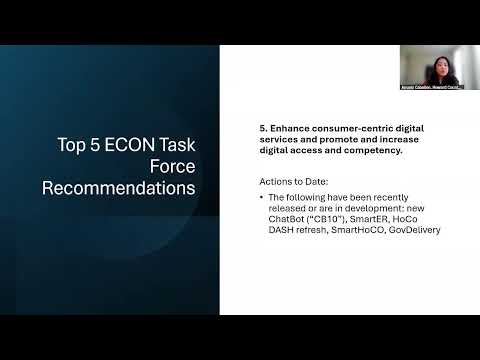
Angela Cabellan, who presented the county’s short‑term competitiveness actions, described immediate interventions and investments to offset federal employment losses and to support future growth. Cabellan listed programs and expenditures already underway, including a $2,500,000 PAYGo deployment for FY26 federal impacts, an estimated $5,600,000 investment to relocate and modernize the American Job Center (including co‑located childcare), and an $11,000,000 county investment in Howard Community College workforce trades programs. Cabellan also outlined process modernization steps—permitting streamlining, pilot use of AI for internal reviews and customer service, a chatbot for the county website, a smart ER platform to reduce emergency room use, and GovDelivery notifications for resident outreach.
The chair closed the briefing noting time constraints and asked staff and delegates to schedule a follow‑up interim meeting to continue questions and to address a pending bill; no votes or formal decisions were taken at the March 25 session.
Sources in this article are presenters and delegates from the March 25 SAC briefing to the Howard County delegation.