Get Full Government Meeting Transcripts, Videos, & Alerts Forever!
Get email alerts on the Instructional Practice topic
No spam. Unsubscribe anytime.
Maricopa High spotlights 'thinking classroom' using vertical whiteboards to boost math engagement
Summary
Maricopa High School presented a 'thinking classroom' model using vertical whiteboards and peer-led discourse; principals and teachers say early data and video lessons show rising IXL diagnostic scores and increased student engagement, with a school-wide rollout planned next year.
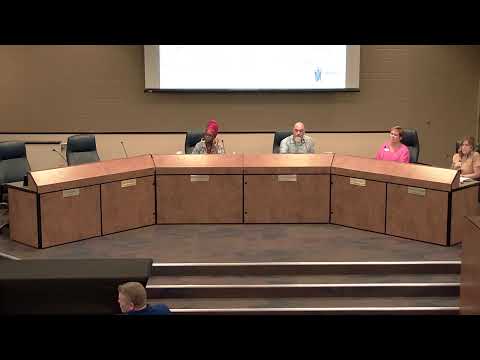
Maricopa High School framed a classroom redesign Tuesday that officials say is improving student engagement and measurable math outcomes.
Principal Sotomayor introduced the district’s classroom-innovation pilot, and Kevin Struble, Maricopa High’s math department chair, demonstrated how vertical whiteboards and Kagan strategies shift students from passive receivers to active problem-solvers. "When a student stands at a whiteboard, they become the owner of that space," Struble said, describing more peer discussion and risk-taking in class.
The presenters showed longitudinal IXL diagnostic data they said tracks student growth from August to April. Struble described a clear upward trajectory: "Whether a student started in the 600 or 1,200 range, the trajectory moves in the same direction upward," and he said some gains equate to "nearly 2 years worth of scale score growth compressed into a single academic year." He also showed a classroom video in which students solved an AP calculus integration problem on vertical surfaces, then used peer feedback to reteach concepts.
School leaders said the model produces immediate formative data because teachers can scan whiteboards and intervene in real time. Sotomayor outlined next steps including a digital "repository of excellence" with recorded lessons, targeted one-on-one coaching for teachers, and reflective professional learning teams to study student work: "We will be beginning to video master lessons... so this isn't just a one-off initiative," she said.
Board members asked about scaling and effect on testing. Struble said the practice scales to pairs or trios and that classroom work transfers to individual assessments: "If they've got it here, then we're good once we get by ourselves and on paper." Members and staff emphasized teacher coaching and a measured rollout next year.
The presentation closed with the board praising the low-cost pilot model and informal peer-driven origin: staff noted the idea started with a coach, Josie Nichols, and was inexpensive to implement in Struble's classroom. Staff emphasized the district will iterate on the model using classroom video and student-growth data rather than adopting it wholesale without evidence.
The board took no formal action on the spotlight; questions and discussion concluded and the meeting moved to budget items.