Get AI Briefings, Transcripts & Alerts on Local & National Government Meetings — Forever.
Baltimore County staff warn data centers could strain public water supply, urge early coordination
Loading...
Summary
DPW&T staff told the County that hyperscale and some wholesale data centers can consume large volumes of water and concentrate contaminants in wastewater, and that Baltimore County lacks reclaimed-water infrastructure like other jurisdictions; staff recommended early, site-specific review, pretreatment requirements and consideration of on-site storage or infrastructure funding.
Baltimore County Department of Public Works & Transportation staff told a county work session that data centers can use large amounts of municipal water and that the county lacks reclaimed-water infrastructure and permitting mechanisms other jurisdictions use to control that demand.
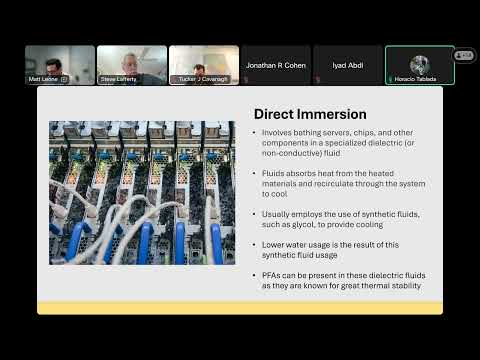
"We're gonna talk about data center and its water usage, today," said the DPW&T presenter, who described four cooling systems and the county work plan produced under a council resolution. Jonathan Cohen, identified in the presentation as an Engineer 3, gave an overview of the shared Baltimore City–County water system and pressure zones used for siting analysis.
The presenters said data-center water demand varies by business model and cooling method. The presentation cited two benchmark types: retail/wholesale sites (one example noted at about 88,000 gallons per day) and hyperscale sites, which the presenter described as using "about half 1000000 gallons per day" in examples from Northern Virginia. The presenter also said Loudoun Water reports data centers currently account for roughly 10% of its potable supply and that Loudoun uses a planning rule-of-thumb of about "1 gallon per day per square foot." (Reported numbers were presented by staff from outside jurisdictions and the county flagged differences in how figures were calculated.)
Staff warned that cooling systems introduce additives (biocides, corrosion inhibitors) and pick up minerals and metals during circulation; as water is lost to evaporation, those contaminants concentrate. "Those are not being lost to evaporation," the presenter said, noting that pretreatment and permits are used in other jurisdictions to limit discharges to sanitary sewers.
DPW&T also described options other counties use to reduce potable demand: reclaimed water tapped near treatment plants (Frederick County) or reclaimed systems built by a water authority that data centers then locate around (Loudoun County). In Loudoun, staff said reclaimed water use has been heavily taken up by data centers; the presentation reported that "95% of [Loudoun] reclaimed water is used by data centers." By contrast, Baltimore County's sole wastewater treatment facility within county boundaries is Back River (operated by Baltimore City), and staff said any reclaimed-water solution would require coordination with Baltimore City and assessment of the Back River effluent line's steady flow.
The DPW&T presenters urged early, front‑loaded engagement with data-center developers to set expectations, identify infrastructure improvements, and consider funding models — for example, a reclaimed-water system funded in part by a data-center developer. They also recommended site-specific approvals rather than treating data-center development as a by-right use in every zoned location because "each center is unique," the presenter said.
Council members pressed for quantitative capacity analyses: how many times current baseline use a pressure zone could handle, whether the county can set per-zone limits, and whether minimum acreage requirements for hyperscale centers (presenter suggested 15–25 acres as a typical recommended minimum for hyperscalers) should be adopted. Staff said water-supply review is handled case-by-case and emphasized the importance of learning early what a proposed operator needs so the county does not face costly retrofits or stranded investments.
The work session closed with staff agreeing to follow up (including sharing the slide deck and recording) and with the Chair noting upcoming presentations, a public input meeting and additional technical speakers for the report.