Get Full Government Meeting Transcripts, Videos, & Alerts Forever!
Get email alerts on the Aquifer Protection topic
No spam. Unsubscribe anytime.
Parks staff report 188,900 acres protected under Edwards Aquifer program; program remains voluntary and science‑driven
Summary
Grant Ellis told the committee the Edwards Aquifer Protection Program has secured about 188,900 acres—mostly via conservation easements—and described funding history including earlier propositions and a $100 million municipal facilities allocation spanning 10 years.
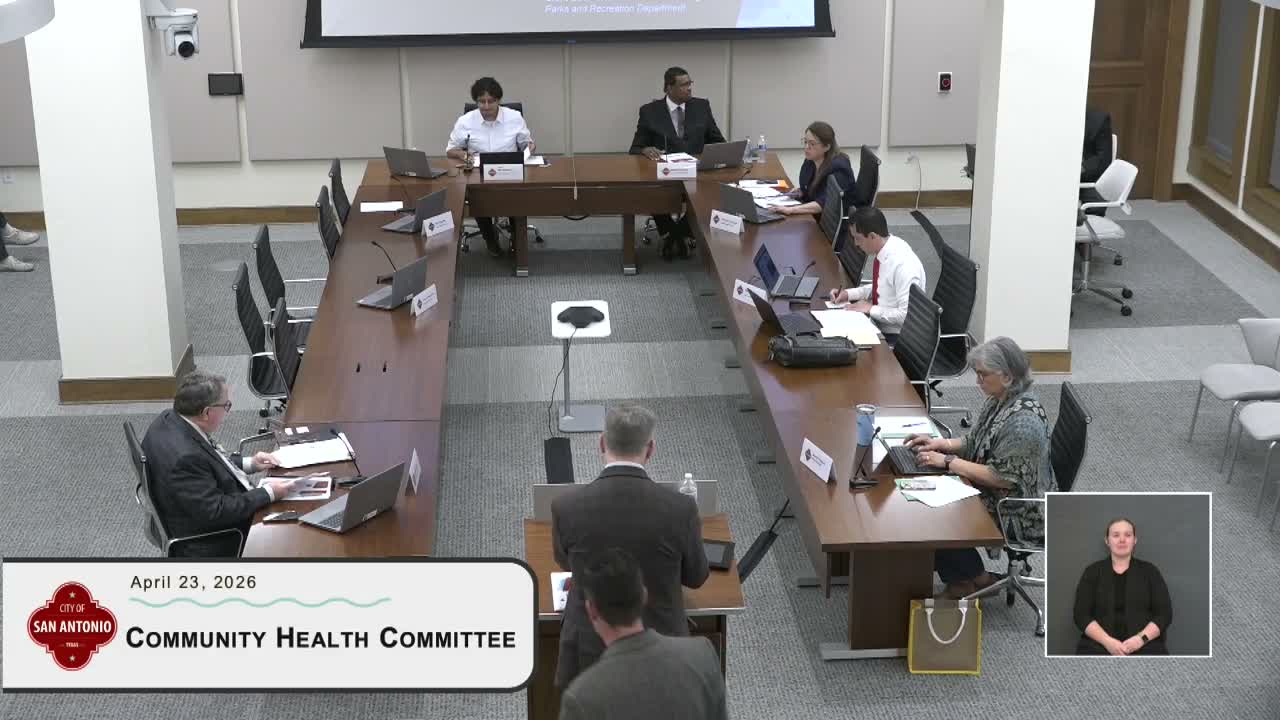
The Community Health Committee heard an update on April 23 from Grant Ellis, natural-resources manager in the Parks and Recreation Department, on the Edwards Aquifer Protection Program and recent acquisitions and funding.
Ellis traced the program’s origins back to local advocacy in the 1970s and summarized voter-approved funding rounds and council actions that have supported land protection. He said the program protected roughly 188,900 acres to date, with more than 95% of property interests acquired via conservation easements and about 8,000 acres in fee acquisitions. Acquisitions typically take nine months to a year to negotiate and complete, Ellis said.
Ellis reviewed past funding: Proposition 3 (initial voter-approved funding), subsequent Proposition 1 rounds, and a San Antonio Municipal Facilities Corporation funding mechanism approved by council that covers $100,000,000 over 10 years; that municipal funding began in 2022, making the program three years into the 10-year period. He also said the program has leveraged over $34,000,000 from federal, state and local partners and that the San Antonio Development Services Department’s Southern Edwards Plateau Habitat Conservation Plan has been an important local partner.
The program is voluntary: staff work with willing landowners—often ranchers or farmers—in Medina, Uvalde and Bexar counties to purchase future development rights (conservation easements) that run with the land in perpetuity. Ellis described a science-based property-ranking process and a periodic convening of a scientific evaluation team that reviews candidate properties and weighting matrices used for selection. He said the program’s Conservation Advisory Board is a nine-member council-appointed body that includes technical experts and representatives from agencies such as Texas Parks and Wildlife, San Antonio Water System and the San Antonio River Authority.
Ellis also noted $10,000,000 of the municipal-facilities funding was set aside for water-quality projects, and that 11 such projects were approved; all are complete except one final report that staff expect in the next month or two.
Council members expressed support and asked about mapping and program pacing; staff pointed to program maps showing parcels acquired under different propositions and the municipal facilities funding and said all acquisition and project reports are available on the program website. The committee did not take formal action during the briefing.