Get AI Briefings, Transcripts & Alerts on Local & National Government Meetings — Forever.
House passes broad property-tax reform after heated debate
Loading...
Summary
The Iowa House passed Senate File 2472, a wide-ranging property-tax reform bill that caps local revenue growth at 2% and makes other changes including reserve-account limits and a new homebuyer program. The final vote was 64-23 after hours of debate and multiple amendment votes.
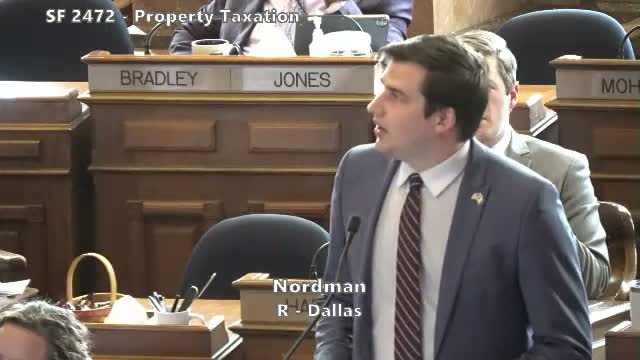
The Iowa House on Thursday approved Senate File 2472, a comprehensive property-tax reform package that sponsors said will provide predictability and relief to taxpayers while critics warned it could shift costs and strip local flexibility.
Representative Nordman, the bill’s floor sponsor, told colleagues the strike-everything amendment HA394 "is the House's comprehensive property tax reform package designed to provide relief and predictability to Iowans while ensuring long term fiscal discipline at the local level." He outlined provisions that include capping local tax revenue growth at 2 percent (plus new-construction revenue), limiting local reserve accounts to 35 percent of budgets with a new restricted reserve for large capital projects, prohibiting use of property-tax bonds for general operations, retaining the business property exemption at $150,000 while ending the state backfill, converting the homestead credit into a larger exemption (sponsor cited an increase from $4,850 to $15,000), a $10,000,000 appropriation for an efficiency grant program administered through IEDA, limits on TIF districts, and a program for first-time homebuyers.
Opponents said the bill is unlikely to produce immediate tax-bill reductions and warned of downstream effects. Representative Jacoby, a frequent critic of the majority plan, urged an alternate approach and contrasted the package with a Democratic proposal that would triple the homestead credit and provide direct rebates. Representative Johnson argued the bill amounts to a fiscal shift that "is not tax relief. This is a cost shift," saying local hospitals and emergency services could face cuts if local budgets are constrained. Representative Brown Powers said the measure "will not lower property tax" and cautioned it would hurt community colleges. Several Democrats urged a commission or independent study to assess long-term fiscal impacts before enacting the cap.
Supporters said the package restores accountability and offers large-scale savings. In floor remarks, Representative Nordman said the plan would "provide $435,000,000 in savings just next year, and $4,000,000,000 in relief over the next 6 years." Proponents repeatedly characterized the bill as restoring budget discipline and transparency, including requirements for parcel-level data submission and clearer TIF limits.
The bill drew a number of amendment votes during floor consideration. A proposed amendment by Representative Jacoby (H 8,397) that would have advanced an alternative Democratic plan failed on a suspension-of-rules roll-call (26 yes, 61 no, 13 absent). A later amendment by Representative Nordman (H 8,398), which placed several extension levies under the 2 percent cap, was adopted by voice vote.
On final passage the House approved Senate File 2,472 as amended. The clerk recorded 64 votes in favor, 23 opposed and 13 members absent or not voting. The House instructed the Speaker to message the bill to the Senate. No further immediate procedural actions were recorded in the transcript.
Next steps: the measure was sent to the Senate for its consideration. The transcript does not record Senate action or the governor’s position.