Get Full Government Meeting Transcripts, Videos, & Alerts Forever!
Get email alerts on the Police Compensation topic
No spam. Unsubscribe anytime.
Weslaco negotiators offer 3.5% annual raises, propose converting incentives to broader 'stability' pay; cadet rules flagged for legal review
Summary
City negotiators proposed 3.5% base pay increases each year for three years and moving roughly $68,000 in targeted incentives into a larger stability pay pool (totaling about $125,817) so every officer receives pay increases; parties agreed to reconvene to translate percentages into dollar costs and to refine cadet/probationary language that may affect civil‑service rules.
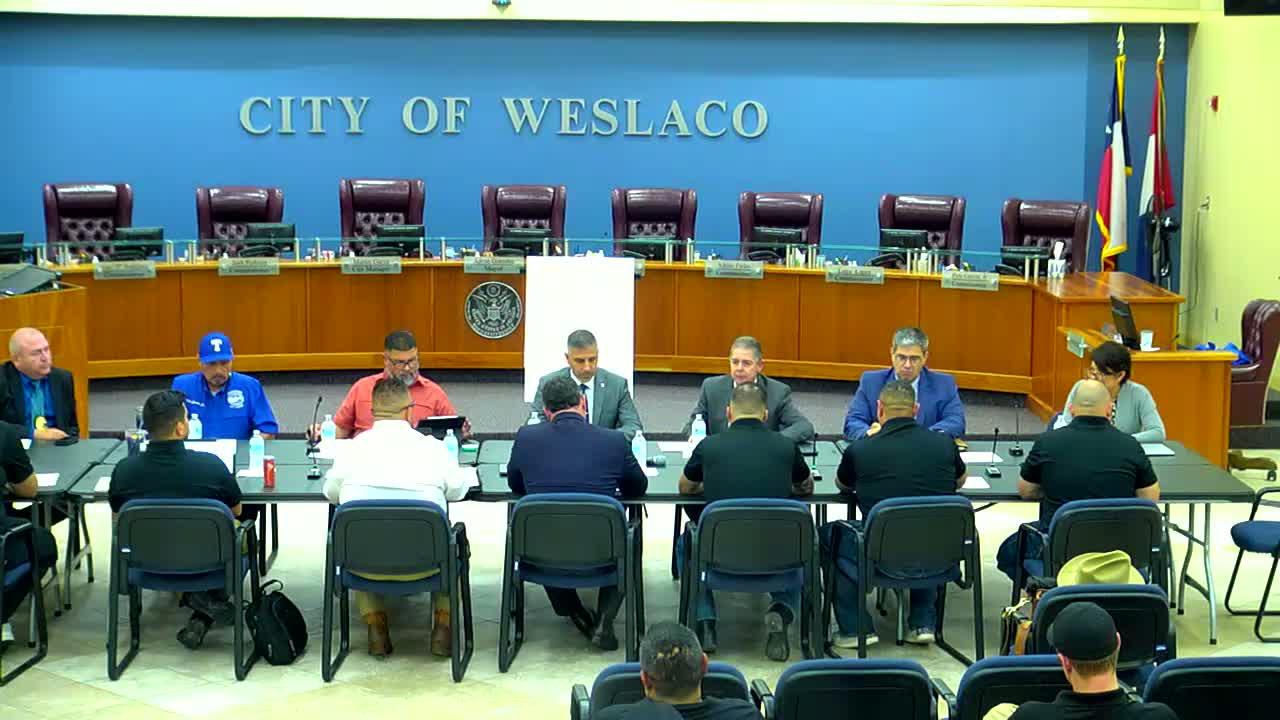
Presenter (speaker 1) opened the session by restating the city’s counteroffer for the police collective bargaining agreement: 3.5% base pay increases for each of the next three years, retention and certification incentives, a uniform allowance, and a 32‑hour sick‑leave buyback. Presenter said those items yield a first‑year incentive package of 6.8% and produce a starting officer salary of $54,027 for fiscal 2025–26, rising to $55,918 in year two and $57,875 in year three.
The nut‑graf: negotiators are close on structure but not on total cost. The bargaining association had sought a 15.5% increase over three years; the city’s counteroffer totals 13.8% over the same period. Rather than concentrate additional money into a few certification or assignment incentives, Presenter proposed shifting about $68,017 from targeted incentive lines into a larger “stability” pay pool so that every officer would receive some portion of the raise. “Everybody’s getting a piece of the pie,” Presenter said, describing the change as a retention measure.
Questioners pressed staff for precise dollar impacts. Several attendees asked staff to convert the percentage increases (6.8% first‑year total) into a hard dollar figure against the adopted police budget; staff said those calculations require reworking the compensation chart and that budget hearings in June and the police chief’s submissions will provide further detail. Presenter said the city’s public‑safety budget numbers are separate from the specific CBA pay figures and that the chief will present academy and cadet cost details to the budget process.
Negotiators also discussed adding a paid cadet classification and an interlocal agreement for a city‑run or regional academy. Speaker 8 warned that parts of the proposed article on cadet conversion and probationary status would “depart from civil service law,” describing those sections as civil‑service modifications that lengthen probation and alter procedural protections. Questioners sought clarity on whether cadets included in the bargaining unit would be entitled to full due‑process rights or whether probationary exceptions would apply; staff said cadets would be treated as probationary officers for many purposes but that the exact language needs refinement.
Participants reviewed a proposal to roll $68,017 into the existing stability pay of approximately $57,800, creating a combined pool Presenter cited at about $125,817. Negotiators read a draft distribution plan aloud and estimated the immediate budget increase at about $105,000 (salary) and $126,796 including benefits; staff said they were roughly $1,000 away from their target number and asked both sides to reconvene after running precise figures. Questioner suggested considering a four‑year plan that would reach a higher recruitment target (one negotiator put a four‑year projection near $62,200), but the group left that as a longer‑term consideration.
Several meeting participants and an elected official who identified themself as mayor spoke in support of officers and thanked negotiators for reaching common ground while noting other departments’ needs. No formal motion or vote occurred; the group agreed to caucus briefly, recalculate the compensation chart in dollar terms, and return with a reconfigured table and the chief’s budget details.
Next steps: staff and negotiators will reconvene with updated dollar conversions, the police chief will provide academy and cadet cost estimates during the city’s June budget hearings, and parties will refine cadet/probationary language to address civil‑service concerns.