Get Full Government Meeting Transcripts, Videos, & Alerts Forever!
Get email alerts on the Middle Housing topic
No spam. Unsubscribe anytime.
San Antonio committee backs program to incentivize 'middle housing' to expand affordable options
Summary
A San Antonio governance committee endorsed staff recommendations to create a program offering predevelopment help, fee and tax incentives, design templates and a single city point of contact to support development of duplexes, triplexes, small multifamily and casitas aimed at lower-income households; the committee voted to advance the plan.
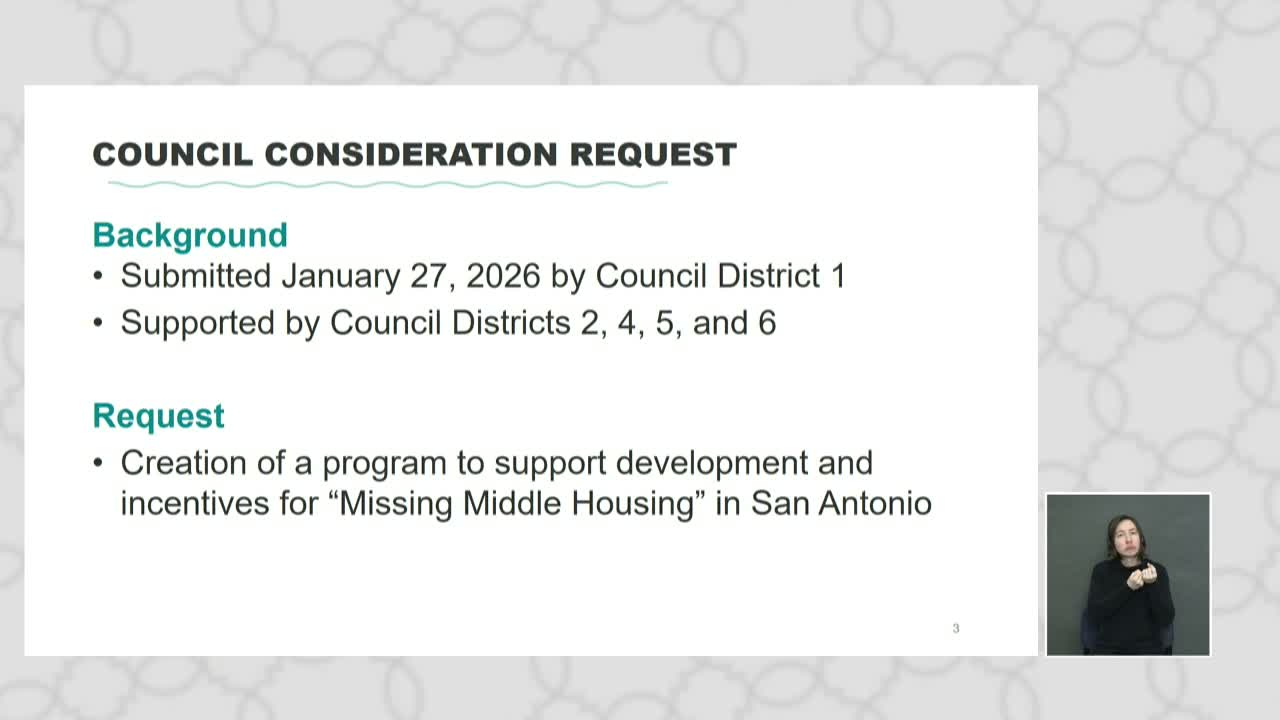
San Antonio’s Committee on Governance voted Wednesday to advance a proposal to create a city-backed program aimed at encouraging so-called “middle housing” — duplexes, triplexes, fourplexes, small apartment buildings and casitas — as a way to expand affordable housing options.
Councilmember Verónica, who introduced the item, told the committee the request (filed Jan. 27) would fund predevelopment assistance to identify sites suitable for the housing types, provide a single city contact for developers navigating logistics and permitting, supply pre-approved design templates and offer incentives such as property tax and fee relief and targeted financing or grants. “Estamos trabajando muy de cerca con el departamento de vivienda y estar haciendo un trabajo increíble de lo que es la brecha entre viviendas,” she said during the presentation.
Staff recommended coordinating the program with the housing commission and incorporating potential amendments to the Unified Development Code that staff said are expected to begin in 2027. The presentation noted the program would aim to prioritize walkable neighborhoods with transit access and to create more housing choices near existing services.
During discussion, councilmembers pressed staff on how the program would be funded and where it would best be tried. One member warned that incentives such as property tax exemptions could reduce general-fund revenue and asked staff to quantify the fiscal impacts; another emphasized that limited available acres mean the program should target corridors and rings around central areas rather than neighborhoods dominated by large single-family subdivisions. A member also raised construction-quality concerns, noting that smaller, lower-cost units sometimes suffer from poor maintenance and that achieving durable, marketable product will be important to long-term success.
The presentation said consultants are already working to identify development barriers — including financing access, risk, and loan repayment terms — and to recommend zoning or permitting reforms that could make middle-housing projects feasible. The presenter also referenced a pilot casita program that helps homeowners build small accessory units.
Committee members voted to approve the staff recommendation to advance the program; the motion passed on a voice vote. The committee asked staff to return with cost estimates, specific site recommendations and proposed code amendments for future consideration. The committee adjourned at 10:28 a.m.
Next steps: staff will prepare implementation costs and proposed code changes and coordinate with the housing commission for follow-up review.