Get Full Government Meeting Transcripts, Videos, & Alerts Forever!
Get email alerts on the Stateboard Accountability Hearings topic
No spam. Unsubscribe anytime.
State Board subcommittee recommends corrective action plans after day of accountability hearings across Tennessee districts and charters
Summary
A State Board of Education subcommittee heard testimony from Jackson Madison County, Haywood County, Memphis Shelby County Schools and several charter operators and recommended corrective action plans, focusing on attendance, teacher licensure and leadership stability as priorities for getting underperforming schools off the state list.
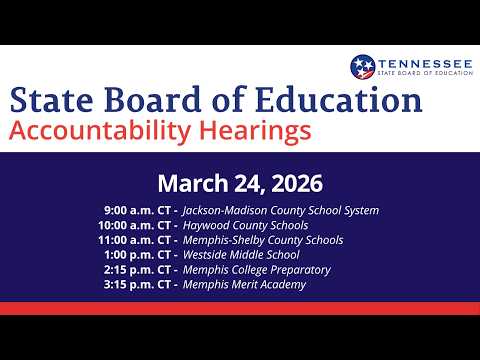
A State Board of Education accountability subcommittee convened a series of public hearings April 27 to review underperforming schools and district turnaround plans, and it recommended corrective action plans for multiple districts and charter operators.
Daryl Cobins, the committee chair and vice chair of the State Board, opened the proceedings by saying the hearings are meant to be constructive and noted the panel has spent months reviewing prehearing materials and data. “A corrective action plan is not a punitive measure,” Cobins told district and school leaders, adding the plan would codify steps already under way and align district efforts with state supports.
Jackson Madison County Superintendent Marlon King and his leadership team told the panel three schools named for accountability review face overlapping challenges: out-of-school barriers for students, difficulty recruiting and retaining qualified teachers, and leadership disruptions tied to recent grade-band restructuring. King described a multi-pronged response that includes embedded professional development and job‑embedded coaching, a recruitment/retention bonus that pays $10,000 over three years for teachers who commit to high‑need campuses, and a staffing structure that adds deans for academics, operations and student engagement. King also told the committee the district has hired truancy counselors and is partnering with local juvenile court and the district attorney to enforce attendance expectations.
Haywood County Superintendent Amy Marsh described steps to support Haywood Middle, including use of CSI/STAR funds for intensive coaching, technology upgrades and teacher bonuses tied to evaluations. Marsh said the district is considering consolidation of grade bands (for example, moving to 3–5 and 6–8 configurations) to reduce student transitions and improve instructional continuity; she stressed the board will engage the public before any closures or major reconfigurations are finalized. Board members raised fiscal questions about how capital and federal turnaround funds would follow students, and the committee asked Haywood to formalize a corrective action plan.
Memphis Shelby County Schools Superintendent Richmond acknowledged systemic problems across 14 flagged schools — inconsistent Tier 1 instruction, a high share of permitted teachers rather than fully licensed teachers, and chronic absenteeism — and described a districtwide 2025–2030 academic plan to address them. The district said it has moved to a differentiated, tiered system of supports that includes weekly regional walkthroughs, a seven‑day rapid response window for instructional adjustments, student‑based budgeting that aligns resources to need, and plans to engage external turnaround providers for CSI schools. Richmond and the district indicated they will be naming metrics and scorecards to track progress; the subcommittee voted to recommend a corrective action plan for the district to the full board.
Westside Middle operator Representatives for the charter operator of Westside Middle, including principal Dr. Lawanda Clark, described leadership instability that followed consolidation of multiple campuses into a single school. The operator said it has returned to a traditional leadership model with a single principal, added an RTI (response to intervention) lead, and instituted deliberate weekly coaching and observation cycles. Clark said the school’s average daily attendance has improved and chronic absenteeism is down after targeted outreach, transportation supports and incentives; the committee recommended a corrective action plan for continued oversight and codified monitoring.
Memphis College Prep Leaders at Memphis College Prep described a steep drop in math outcomes last year and said chronic absenteeism was a primary driver of low performance. The school cited transportation contracts, a 21‑day attendance challenge, student incentives and resource fairs that connect families with social services as reasons for a recent sharp improvement in attendance. Memphis College Prep also described retraining for interventionists, new lesson‑plan fidelity checks and redeployment of coaches into classrooms.
Memphis Merit Academy The charter school acknowledged consecutive F letter grades in recent years tied to leadership turnover and the adoption of new, state‑approved curricula. Founder Lakena Booker and newly hired instructional leader Jacqueline Brown Lewis outlined a stabilization plan: more content coaching, partnerships (literacy and math providers), expanded high‑dosage tutoring and investments in facilities and health services. The school reported measurable growth on interim assessments and said it has a significant community waiting list despite the accountability designation; the subcommittee recommended a corrective action plan to be formalized with the state.
What happens next The subcommittee’s recommendations will go to the full State Board of Education at its May meeting. If approved, districts and schools will work with the State Department of Education to convert the committee’s findings and the districts’ stated strategies into a corrective action plan that sets timelines, monitoring milestones and supports.
Why it matters Committee members repeatedly told district and charter leaders that the State’s primary concern is keeping students in classrooms and ensuring consistent, high‑quality Tier 1 instruction. Attendance, teacher licensure and leadership capacity emerged as crosscutting priorities: the districts and operators that showed the most progress combined curriculum alignment and frequent classroom‑level coaching with pragmatic supports that remove barriers to attendance (transportation, partnerships and court involvement in truancy cases). As the committee framed it, the corrective action plan process is intended to codify those approaches and provide a structure for state‑level partnership and accountability.
The committee emphasized that the corrective action plan is not intended as punishment but as a tool to marshal state and local resources and to track short‑ and medium‑term milestones that will be reviewed publicly.
Notable direct quotes “‘A corrective action plan is not a punitive measure,’” Cobins told attendees as he opened the hearings. “We’re all in this together.”
“‘We are clear‑eyed about where we stand, transparent about the factors that brought us here, and unwavering in our commitment…’” Dr. Richmond said in describing the district’s new academic plan for Memphis Shelby County Schools.
Next procedural steps If the full State Board approves the committee’s recommendations in May, districts and schools will work with the department on written corrective action plans. Those plans typically include measurable benchmarks, reporting cadences and a defined monitoring relationship between the LEA and the state.