District faces falling overall enrollment while special programs drive space needs
Summary
Dr. Russell presented 10‑year enrollment declines (from ~5,600 to ~4,500) and said growth in program classes—autistic support, emotional support—and service providers make facility planning urgent; the board agreed to a small working group to explore options.
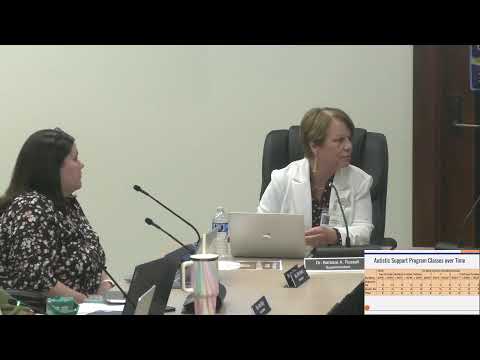
Dr. Russell told the Education Committee that district October enrollment has fallen over the past decade from roughly 5,600 to about 4,500 — a loss of more than 1,000 students — but administrators still project space needs because of program‑class growth and service‑provider demands.
“We've lost over 1000 students,” Dr. Russell said, noting the paradox that program classes (for example, autistic support and emotional support) require dedicated rooms and additional service spaces even when overall enrollment declines. He said some buildings that were once kindergarten spaces were repurposed to host program classrooms because they included single‑use bathrooms and other features that programs need.
Russell said the district now has multiple autistic support classes (up to six in the examples discussed) and that state guidelines cap autistic support classroom size at eight students, so projected increases in program‑eligible students mean the district likely needs at least one more autistic support classroom next year. “Eight is the maximum number of students,” Russell said. “It looks like we'll need at least 1 more class to be able to deliver the service in the ways that uphold the law and serve students effectively.”
Board members raised building‑layout constraints (bathrooms in classrooms, limited art/tech/gym spaces), transportation implications and possible remedies such as adding a wing at Schwenksville (administration said that building was roughed in for a future 10‑class expansion but that construction costs would be substantial). The board discussed short‑term operational approaches — routing, cadet buses and a possible three‑tiered busing system — and longer‑term facility planning.
Next steps: administration will return in April with staffing and program projections tied to early‑retirement incentive outcomes and will convene a small ad hoc safety/operations working group to evaluate options and develop recommendations for board consideration.
AI generated
The text on this page is AI generated. Summaries, highlights, analysis, and video transcripts are all produced from the original source material.
AI can make mistakes, so if you spot one, and we will fix it for everyone.
Note: the source content is unaltered by us. Any content source we link to, be it a video, an audio recording, or a document, is presented exactly as its publisher released it. That publisher is usually a government body, sometimes an individual official or another organisation.