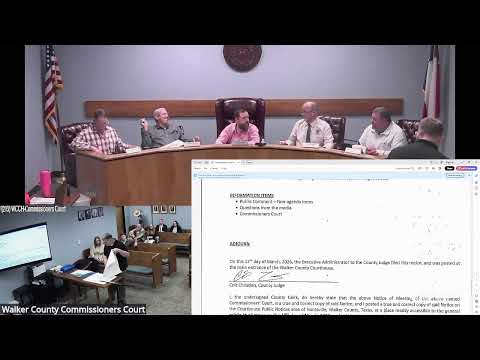
Commissioners ask High Meadow developer to fix paving and density issues; variance request tabled
Summary
Testing of asphalt cores in the High Meadow subdivision found multiple locations below county density standards. Commissioners declined to grant a pavement‑thickness and density variance and instructed the developer to return with corrective proposals and additional testing results.
Commissioners declined to approve a requested variance for pavement thickness and asphalt compaction in the High Meadow subdivision and directed the developer to return with a remediation plan.
County staff presented core‑test results showing multiple locations below Walker County’s usual density thresholds. Engineers and a third‑party laboratory jointly tested 70 locations; several cores were reported below the county’s referenced thresholds and some streets had multiple failing samples. The project team said they had targeted a 2.25‑inch asphalt lift and that overall averages were near 2.4 inches, but that spot cores revealed localized density shortfalls.
Thomas Yager, representing the developer, told the court the intention had been to “request that it's laid at 2 and a quarter inches” and that the average thickness across the subdivision was above the minimum design depth. Commissioners expressed reluctance to accept a variance on thickness and density without a robust corrective plan; one commissioner said extending a warranty is not an adequate substitute for meeting construction standards.
The court voted to table the variance request and asked the developer and testing firms to present a corrective plan — whether that means paving repairs, milling and replacing specific segments, or agreed extended warranties and guarantees backed by a remediation schedule — at a future court session. Staff recommended the developer provide all third‑party testing results and a clear mitigation proposal.
What happens next: Developer to return with a concrete remediation plan and supporting lab reports; county staff will review options including requiring replacement or negotiating acceptable corrective measures.
AI generated
The text on this page is AI generated. Summaries, highlights, analysis, and video transcripts are all produced from the original source material.
AI can make mistakes, so if you spot one, and we will fix it for everyone.
Note: the source content is unaltered by us. Any content source we link to, be it a video, an audio recording, or a document, is presented exactly as its publisher released it. That publisher is usually a government body, sometimes an individual official or another organisation.