Get Full Government Meeting Transcripts, Videos, & Alerts Forever!
Get email alerts on the Land Use topic
No spam. Unsubscribe anytime.
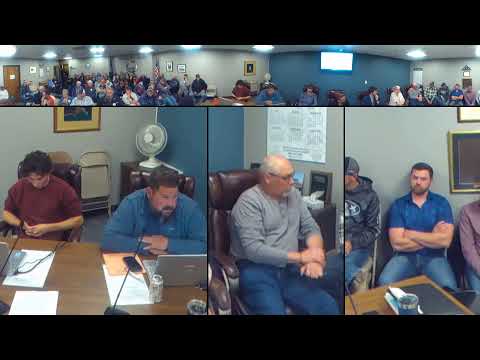
York County public hearing: residents press for half‑mile setbacks as utility warns rules could 'effectively ban' solar
Summary
At a public hearing on proposed solar zoning rules, dozens of York County residents urged half‑mile setbacks or an outright ban on utility‑scale solar to protect farmland, water and cemeteries. A representative for OPPD said the draft regulations and uncertainty prompted termination of a project interconnect agreement and cited large, company‑estimated local revenue losses.
Dozens of York County residents urged county commissioners to adopt half‑mile setbacks for Class 4 (utility‑scale) solar or ban industrial solar, while a utility representative warned the draft rules would “effectively ban” projects and cited large projected economic losses.
"Growing up on a farm in York County, I was able to walk down the road and smell the freshly tilled dirt," said Diana Johnson Henderson, a resident who urged the board to protect farmland and to follow the zoning board’s setback recommendations. "We were privileged to have farm ground growing crops, not an industrial solar field."
Caleb Jackson, who said he plans to be a seventh‑generation landowner, urged commissioners to adopt the proposed half‑mile setback for nonparticipating dwellings and argued agriculture provides the county’s tax base and supports local businesses and schools.
At the same hearing Dustin Marble, speaking for OPPD, said the utility recently terminated its generator interconnect agreement for the K Junction solar project because the proposed regulations and uncertainty make development impossible. "Due to the proposed regulations and ongoing uncertainty, OPPD has recently terminated our generator interconnect agreement for the K Junction solar project," Marble said, and he presented OPPD's estimate that York County could lose "$610,000,000 in net economic activity and more than $30,000,000 in local tax revenues." These figures were presented as OPPD's estimate and were not independently verified in the hearing record.
Speakers opposing industrial solar cited multiple concerns: potential long‑term soil damage after panel installation and storm events, unknown chemical runoff and effects on aquifers and village wells, and loss of productive farmland. Sandra Browett, chairman of the Village of McCool board, said protecting wellhead areas was her top priority and asked the board to require stronger decommissioning and runoff protections.
Supporters of strict setbacks said developers and outside organizations were pressuring the county and urged commissioners to follow the zoning board’s recommendations. Several commenters pointed to language in the draft allowing waiver of setback requirements by written agreement between adjoining landowners and asked whether that provision would undermine protections for nonparticipating dwellings.
Commissioners and zoning board members discussed several technical and drafting issues raised during public comment. They identified potential ambiguity in the noise standard — the draft references a 55‑decibel 10‑minute LEQ in one place and 40 dB (day)/37 dB (night) elsewhere — and sought clearer wording about storm exceptions. Board members suggested adding a recycling or disposal requirement for end‑of‑life solar panels and clarifying battery‑storage cooling language to prohibit open‑loop water cooling while allowing closed‑loop or air cooling as appropriate.
On bonding and decommissioning, speakers recommended that performance bonds be held by project owners rather than by the county. Commissioners discussed whether some conditional‑use approvals could be delegated to the zoning committee to reduce repeated public hearings while preserving an appeals process.
The public hearing was closed at about 8:12 p.m., and commissioners told the zoning board they would discuss the draft and possibly vote on adoption the following day. The transcript does not record a formal vote at this session.
What happens next: the board planned to consider the zoning text at its next meeting; commissioners indicated they would weigh public input, technical clarifications and legal advice before any final action.