Get Full Government Meeting Transcripts, Videos, & Alerts Forever!
Get email alerts on the Mobile Food Vendors topic
No spam. Unsubscribe anytime.
Lynnwood staff propose single mobile food vendor permit; council hears questions about fees and enforcement
Summary
Staff presented a proposed mobile food vendor permit to replace tangled licensing code: one permit with site-specific and non-site-specific tracks, a possible fee in the ~$100–$200 range, and plans to coordinate health and fire inspections. Council and public asked about recurring fees, enforcement and on-street vending. Council will consider the ordinance May 11; SmartGov permitting expected May 18.
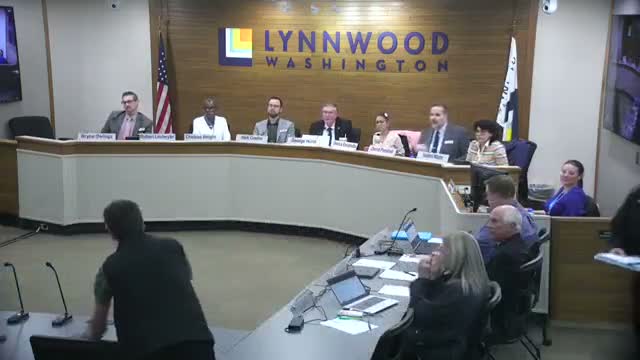
City staff outlined a proposed overhaul to Lynnwood's mobile food vendor rules at a public hearing on April 27, presenting a single mobile food vendor permit with two paths — site-specific (for a location over 90 days) and non-site specific (mobile operation up to 90 days) — plus an option for site amendments and coordinated inspections.
Planner Brian Kirk summarized the change as moving mobile-vendor rules from the licensing section into the land-use code and creating a single, clearer permit. "We're going to create a permit, instead of a license, which will help us review things like a mobile food vendor pod," he said, describing simplified submittal materials and an intent to accept inspection checklists from Snohomish County Health when available.
Why it matters: Staff framed the rewrite as removing "loops and dead ends" in the old code that prevented vendors from getting permitted. The policy could expand access for food trucks and support vendor pods, while council members and the public pushed staff to balance simplicity with enforceability.
Key details presented by staff: - Two permit tracks: site-specific (operators on a single site more than 90 days) and non-site-specific (operators who move among permitted lots up to 90 days). (Brian Kirk) - A "site amendment" process to allow a permitted vendor to change locations without full reapplication. (Brian Kirk) - Survey results recorded in the presentation (transcribed in the packet as 4,141 respondents) showing broad public support for more food trucks and for food truck pods. (Brian Kirk) - Fee options: Planning Manager Carl Algren said the staff used other municipalities as comparators and cited a fee near a $200 staff-cost rate; a one-time or recurring fee structure is under consideration. "Our 2 hour available rate is near that $200 mark," he said.
Council members asked for clarifications on fee structure and enforcement. Vice President Escamilla and other council members suggested an annual check-in or renewal to keep vendor databases accurate over time. Council asked whether a one-time fee or a recurring fee was planned; staff said the current draft treats the mobile food vending permit as a one-time permit while the limited business license remains an ongoing requirement, but acknowledged some cities use recurring fees for tracking.
On enforcement, staff said current practice is to seek voluntary compliance and that code enforcement will process complaints; more persistent violations can prompt notices and orders or other legal remedies. Planning Manager Algren and Planner Kirk said the proposal accepts equivalent county health or fire checklists when valid; Deputy Fire Marshal Alex Janis noted a standardized fire-safety checklist used by jurisdictions across the state and said his office will accept prior completed checklists where appropriate.
Public commenters suggested practical enforcement measures and voluntary reporting. Ted Heichel proposed a volunteer reporting program to document noncompliant vendors on weekends; staff noted residents can submit complaints through the city website to start a code-enforcement case.
Next steps: Staff asked the council to consider the ordinance on May 11 and said the SmartGov permitting portal is expected to go live for the public on May 18. No ordinance vote was taken April 27; the public hearing was closed and the council will deliberate at the scheduled date.
Ending note: The proposal aims to make permitting more accessible for vendors while addressing council concerns about fees, database maintenance and enforcement; those trade-offs will be central to deliberations before any ordinance adoption.