Get email alerts on the Planning And Zoning topic
No spam. Unsubscribe anytime.
Consultants outline 30‑month plan to rewrite Cedar Hill's development code, seek more public input
Summary
City consultants presented a 30‑month plan to rewrite Cedar Hill's unified development code, aiming to preserve 25% of land as open space, streamline permits and modernize regulations; council asked about community input, tree rules and legislative changes.
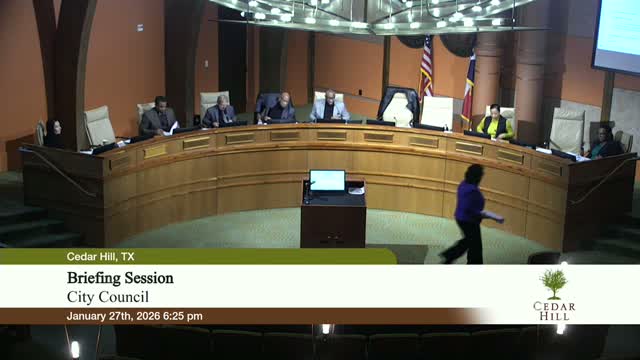
Consultants from Friesen Nichols presented a 30‑month plan to rewrite Cedar Hill's unified development code at the Jan. 27 city council briefing, describing a phased process of public engagement, diagnostic work and drafting aimed at consolidating scattered regulations and making zoning and subdivision rules easier to use.
David Jones, the consultant presenting for Friesen Nichols, told the council the rewrite is meant to "consolidate existing development regulations" and to make the code usable rather than "driving on ice," adding the project will include stakeholder interviews, developer roundtables and public open houses over the next two-plus years.
Director Self framed the effort as council‑led and aligned with the city's comprehensive plan. Jones said the draft process will be broken into modules: Module 1 (zoning districts and allowed uses), Module 2 (zoning procedures, variances and the board of adjustment), and Module 3 (planning and construction standards such as sidewalks, landscaping and infrastructure). The team expects to return to the Planning & Zoning Commission on Feb. 3 and back to council on Feb. 24, with an anticipated adoption window in winter 2028.
The consultant highlighted public engagement tools already in use: a project website with an interactive map and QR code, stakeholder interviews (about 22 completed), a developer roundtable (scheduled for Jan. 29) and at least one module‑level open house. Jones noted a statutory requirement that property owners whose uses might become nonconforming receive mailed notice when a development code is adopted.
Councilmembers focused questions on process and safeguards. Councilmember Catherine Sims asked whether the aggressive schedule would allow the team to "infuse more community feedback" if council wanted to pivot; Director Self replied the project is council‑led and the consultants would accommodate additional engagement at council direction. Councilor Verheyen asked how active development projects would be handled during a rewrite; consultants said interim steps and close coordination with staff could prevent conflicts.
Several technical issues raised by stakeholders surfaced in the discussion: lengthy permitting and confusing approval sequencing, frequent reliance on planned developments (PDs) to obtain flexibility, a tree ordinance that some developers find hard to interpret, and inflexible parking requirements that disadvantage downtown businesses. Jones said those issues would be prioritized in the diagnostic and drafting phases and that the team would survey peer cities to craft clearer, administrable language.
The city manager reminded council that a communications plan has been prepared to support outreach for major projects including the code rewrite. The agenda also listed several consent‑calendar items for future action or approval, including a proposed purchase of Cedar Hill Independent School District properties for $1,200,000 for economic development purposes and a $154,625 contract with Alliance Geotechnical Group for construction materials testing (paid by Balcones Ranch/Meritage); no formal council votes on those consent items were recorded during the briefing.
Next steps spelled out by staff and consultants include the developer roundtable on Jan. 29, a Planning & Zoning presentation Feb. 3, a special council briefing on project costs Feb. 17, and a council review of Module 1 materials on Feb. 24. Consultants reiterated the intention to allow substantial public review of discussion drafts before any adoption vote.
The briefing ended with routine business and a motion to adjourn; the council adjourned the session at 7:17 p.m.
AI generated
The text on this page is AI generated. Summaries, highlights, analysis, and video transcripts are all produced from the original source material.
AI can make mistakes, so if you spot one, and we will fix it for everyone.
Note: the source content is unaltered by us. Any content source we link to, be it a video, an audio recording, or a document, is presented exactly as its publisher released it. That publisher is usually a government body, sometimes an individual official or another organisation.