Get AI Briefings, Transcripts & Alerts on Local & National Government Meetings — Forever.
Nantucket launches community workshop on strategic retreat and relocation to address coastal risks
Loading...
Summary
Town officials and consultants held a virtual workshop to begin community engagement on a proposed strategic retreat and relocation program, outlining goals, hazards, past work and next steps; presenters said the voluntary planning effort aims to clarify a currently reactive process and prioritize equitable, implementable options.
Leah Hill, the town's coastal resilience coordinator and project manager, said Tuesday that the Town of Nantucket is starting a proactive planning process to help residents, property owners and the town adapt where erosion, sea‑level rise and storms make traditional protections infeasible.
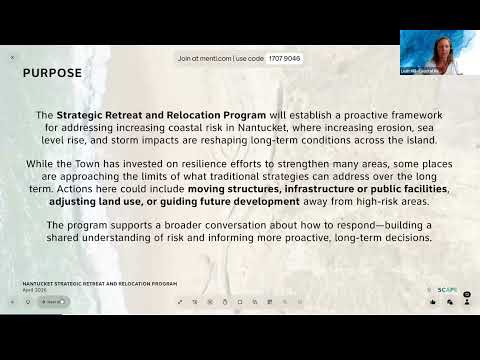
"The purpose of the strategic retreat and relocation program is to establish a proactive framework for addressing increasing coastal risk in Nantucket," Hill said, outlining five core goals including identifying areas facing extreme risk and crafting equitable, legally viable actions supported by community input and partner agencies.
The workshop, led by Scape consultants with subconsultants including Arcadis, HRNA and Noble, Wickersham & Hart, introduced the program's phases: initial research and analysis now, summer in‑person public workshops for deeper discussion, and a fall package of recommendations and a roadmap for first actions. The session used live polling to gather participants' reactions to terminology and priorities.
Hill cited the town's risk assessment and history of resilience planning, saying the 2020 island‑wide estimate of damages and losses if no action is taken is about $3,400,000,000 in 2020 dollars and that adjusting for inflation to 2026 would add roughly $1,000,000,000. "That assessment helped show where adaptation will be most urgent," she said.
Arcadis consultant Devin McKay described the coastal hazards that underlie the program: tidal flooding, storm surge and shoreline erosion. "Portions of the island shoreline, particularly along our South Shore, have eroded more than 100 feet inland in just the past decade," McKay said, and he warned that higher sea levels and stronger storms make both episodic and long‑term erosion more likely.
Presenters emphasized that the program is voluntary: it is a planning tool to support informed community decision‑making and is not intended to force property owners to move or to remove property rights. Hill said the town has already used retreat and relocation strategies for critical infrastructure in places such as Madaket and along Sheep Pond Road, and that the town received a state grant through the Office of Coastal Zone Management to begin planning for Surfside Wastewater Treatment Facility discharge beds after dune erosion exposed a bed.
Hill also highlighted Nantucket's history of moving structures as context for the proposed program, citing a time‑lapse example showing Sankaty Lighthouse moved roughly 400 feet away from an eroding coastal bank and noting that fundraising around that effort raised about $44,000,000.
Workshop facilitators asked participants about preferred language for the program (responses included "strategic retreat," "community‑driven relocation" and "proactive relocation") and planned four small‑group breakout discussions on terminology, personal experience of coastal impacts, adaptation decisions/triggers and barriers/resources. The breakout rooms were not recorded; the facilitators invited continued participation at in‑person summer workshops and a fall virtual open house and asked attendees to fill out a survey at nantucket.gov.
Next steps: the project team will use feedback from the workshop and upcoming sessions to refine priorities and develop implementable recommendations and procedures the town can follow to make retreat and relocation options clearer and more equitable.