Get AI Briefings, Transcripts & Alerts on Local & National Government Meetings — Forever.
Senator Womack’s SCR 24 would ‘reset’ CWD rules; task force tables recommendations pending legislative action
Summary
Senate Concurrent Resolution 24 would lower zone radii, set a 1.5% apparent-prevalence trigger and a 300-sample surveillance benchmark while allowing limited bait/feed from Sept. 1–March 31. The task force heard scientific and economic concerns and tabled its written recommendations pending the legislature’s action on SCR 24.
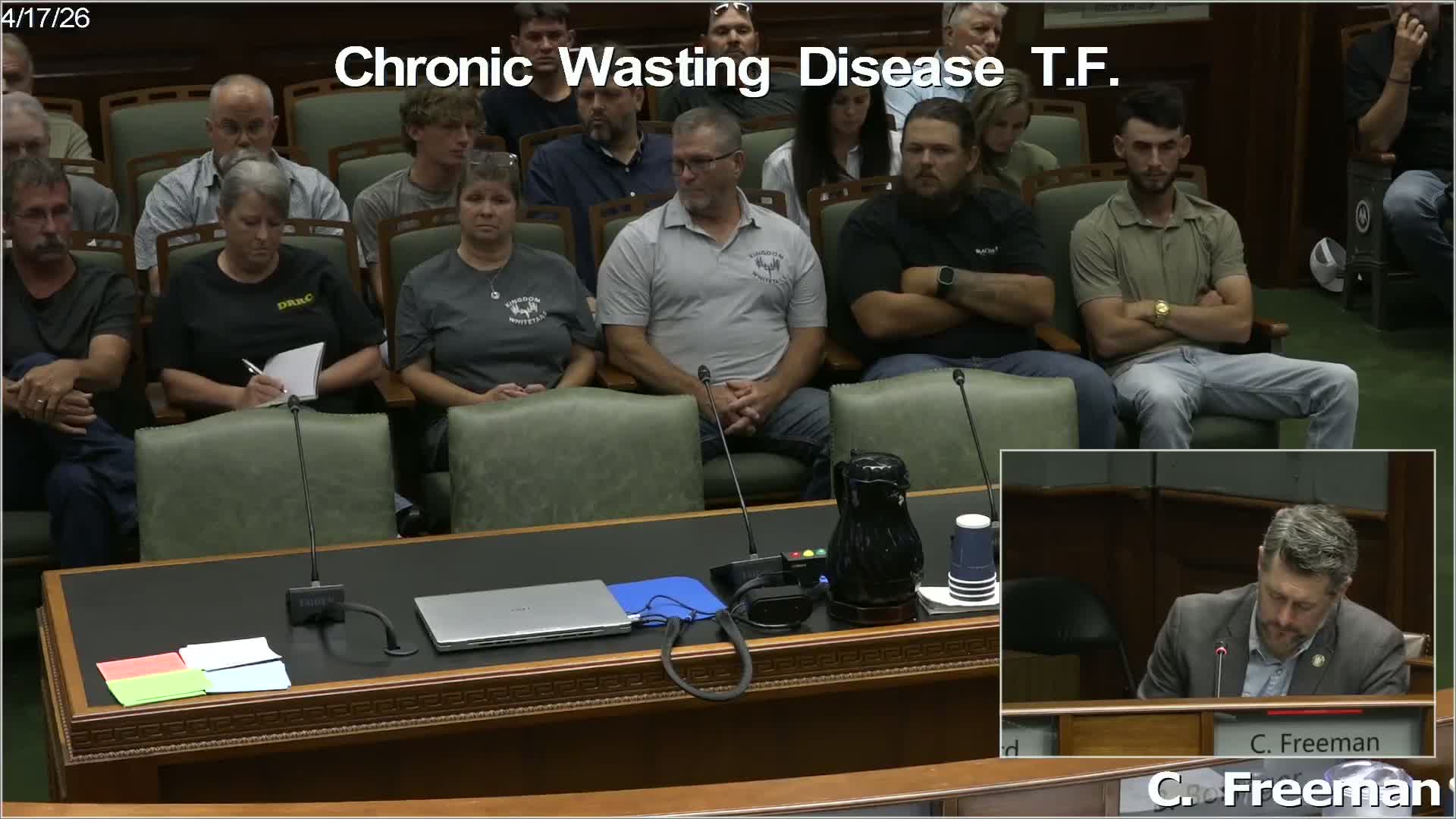
Senator Womack outlined Senate Concurrent Resolution 24 on April 17, telling the Chronic Wasting Disease task force that the proposal ‘‘puts a reset on the chronic wasting disease, as it stands today,’’ with key provisions meant to limit immediate regulatory impacts on hunters and businesses.
Womack said SCR 24 sets a surveillance goal of 1.5 percent apparent prevalence, ties that to a minimum sampling benchmark of 300 animals, shortens large management zones (from 25 miles to 15 miles, with a 5-mile radius around detected positives) and allows use of bait and supplemental feed from Sept. 1 through March 31. He described the package as intended to ‘‘go back to some kind of normalcy, for our youth hunters, for our deer management, for our real estate’’ and to reduce economic disruption.
The proposal prompted detailed technical and procedural questions. Jonathan Bordelon, DEER program manager for the Louisiana Department of Wildlife and Fisheries, clarified that ‘‘apparent prevalence’’ equals the percentage of samples that test positive and that most recent detections outside Tensas Parish are single positives, with apparent prevalence below 1.5 percent in those areas. Bordelon said Tensas Parish—where the state first confirmed CWD in 2022—shows an apparent prevalence roughly in the 2–4 percent range based on intensified sampling.
Legal counsel Cole Garrett explained rulemaking mechanics under the Louisiana Administrative Procedure Act: states can issue rules via a notice of intent (a longer four‑month process) or by a declaration of emergency to meet season timing. Garrett framed the ‘‘declaration of emergency’’ wording in SCR 24 as a procedural mechanism to publish rules in time for hunting seasons rather than a signal to the public that a catastrophe has occurred.
Stakeholders pressed for clarity on calculation and incentives. Andy Brown of the Louisiana Farm Bureau Federation said Farm Bureau ‘‘feels like SCR is working towards a solution’’ but asked the panel to define exactly how prevalence and the 300‑sample benchmark will be applied to avoid disincentivizing voluntary testing. Brown and other industry representatives urged that any emergency declaration not result in immediate, irreversible regulations that would strand inventory or contracts for feed suppliers.
Task‑force members also stressed the value of early mitigation. Jonathan Roberts, the state wildlife veterinary, said mitigation methods ‘‘work best when the prevalence rate’s really low,’’ arguing that emergency authority can be necessary to apply biologically effective measures before spread accelerates.
Members of the task force expressed continued concern about balancing scientific caution with economic impacts. A feed retailer who spoke during public comment described dramatic month‑to‑month declines in sales in affected areas—saying, for example, protein‑bag sales dropped from about 872 bags in February 2025 to 12 in February 2026—and urged predictability for small businesses.
Chairman Reiser said the commission would preserve the task force’s work in the record but temporarily defer formal recommendations while SCR 24 moves through the legislature. He moved to table the task force’s written recommendations; there was no objection and the motion carried. The task force adjourned after the vote.
What’s next: SCR 24 remains in the legislative process; the task force’s recommendations will stay on the record and the commission expects to reconvene or revisit implementation questions if needed after legislative action.