Get AI Briefings, Transcripts & Alerts on Local & National Government Meetings — Forever.
Sen. Bass’s bill to create a higher-education research security council advances after hours of testimony
Loading...
Summary
The House Education Committee on April 27 advanced Senate Bill 399, which would create a Louisiana Higher Education Research Security Council to review and report on research partnerships tied to federal foreign-adversary designations. Supporters cited national-security risks; university officials warned of duplicative state review that could delay federally funded research.
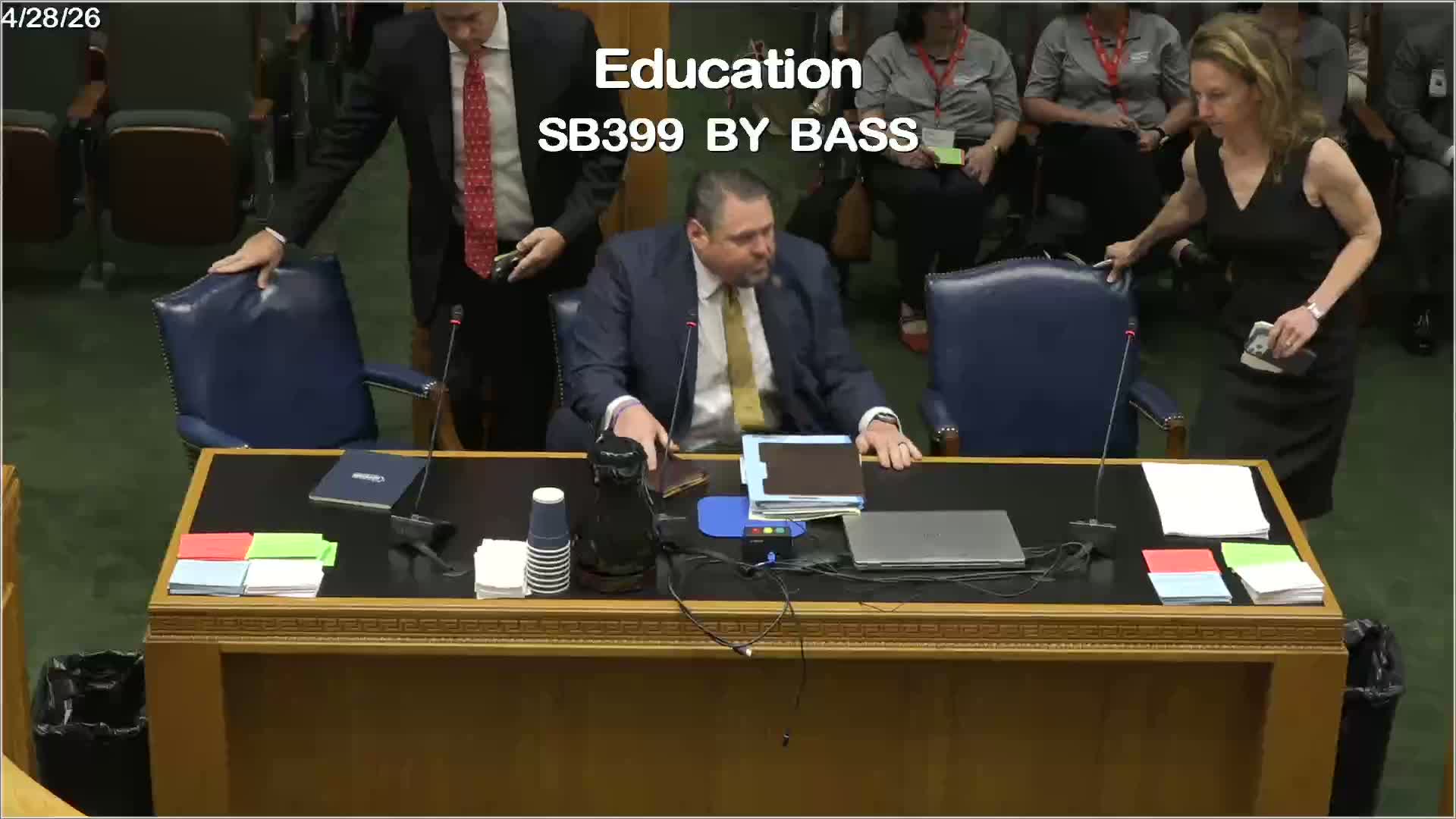
Senator Bass pressed the House Education Committee on Tuesday to move Senate Bill 399, which would create the Louisiana Higher Education Research Security Council to develop research-security policy, training, review procedures and public reporting of proposed foreign-adversary gifts, contracts and partnerships.
"Senate Bill 399 is all about protecting Louisiana's universities, research and intellectual property and students from foreign adversary influence and exploitation," Senator Bass said in his opening remarks.
The bill drew contrasting testimony. Michael Lucci, founder of State Armour, told the committee the Chinese Communist Party uses academic partnerships, scholarships and talent programs to extract U.S. research and influence campus activity. "They come bearing gifts," Lucci said, arguing those gifts can be used to "infiltrate" institutions and channel research back to foreign military programs.
Jackie Deal, a researcher advising State Armour, cited federal investigations and gave a state example, saying, "there was an institution here that shared grants worth over $7,600,000 from the Pentagon with China-based scholars," and urged a state mechanism to identify and limit risky partnerships.
University officials, including Chad Steele, Tulane's interim vice president for research, urged caution. Steele said Tulane already follows federal reporting and export-control rules and warned SB399 could add a state-level approval step that conflicts with federal requirements. "This bill could create a difficult, multilevel process that includes approval from a newly created state council before certain work can move forward," Steele said, noting Tulane's annual research spending exceeds $215,000,000 and warning that added delay could push projects — and investment — out of Louisiana.
Industry witnesses also raised concerns. Rodney Braxton of Lenovo told the committee the bill’s definition of "foreign source" could sweep in multinational firms with substantial U.S. operations and federal security vetting, increasing costs for universities that purchase technology.
Committee members pressed both sides on definitions and exceptions. Representative Landry proposed an amendment to carve out entities operating under national-security agreements reviewed by the Committee on Foreign Investment in the United States (CFIUS). Committee debate centered on whether such an exemption would create unintended loopholes; the amendment was placed on the roll call and failed, 4 yeas to 8 nays.
Senator Bass defended the measure as oversight intended to "check homework" on high-risk partnerships and said the council would be able to consider exceptions. After discussion and the sponsor’s closing remarks, Representative Tarver moved SB399 favorably; with no recorded opposition during that motion, the committee reported the bill favorably.
What happens next: SB399 was reported favorably by the House Education Committee and will proceed according to legislative procedure. The bill’s creation of a state-level council, its authority to review or potentially veto partnerships tied to federally designated foreign adversaries, and its mandate for a public Board of Regents portal were the main impacts noted in testimony.
Vote and procedural notes: An amendment offered by Representative Landry to add an explicit CF IUS-related exemption failed on a roll call, 4–8. The committee later moved SB399 favorably on the floor motion.
Sources: Committee hearing testimony from Senator Bass; Michael Lucci, founder of State Armour; Jackie Deal, researcher/advisor; Rodney Braxton, Lenovo; Chad Steele, Tulane University.