Get Full Government Meeting Transcripts, Videos, & Alerts Forever!
Get email alerts on the Budget Overview topic
No spam. Unsubscribe anytime.
Coconut Creek outlines conservative FY27 budget plan as state property tax reform looms
Summary
City finance officials told a town hall that taxable values rose 6.51% and property taxes provide roughly a third of general fund revenue; officials warned state tax reform could reduce city revenue and force service adjustments while pursuing grant funding and major capital projects.
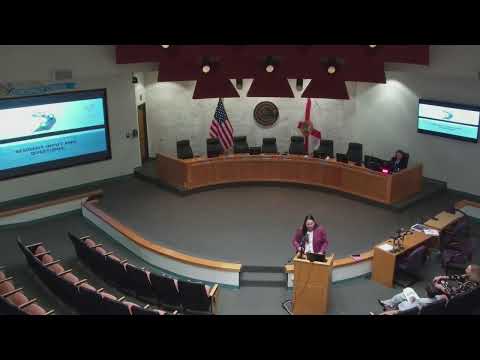
City finance officials told residents at a Coconut Creek FY27 budget town hall that the city will take a cautious approach to next year’s budget as uncertainty over state property tax reform could reduce local revenue.
“For this fiscal year, our values increased by 6.51%,” said Peter Gay Lake, the city’s finance director, summarizing recent reassessments and a small amount of new construction. He said property taxes make up about a third of the city’s general fund revenue and are a primary source for public safety, roads, parks and other services.
The finance presentation walked residents through the city’s revenue mix: property taxes at roughly 33% of general fund revenue, intergovernmental aid around 6%, charges for services about 20%, and an appropriated fund balance of about 24%. Using a sample bill and the city’s average taxable value of $283,000, officials illustrated that the city receives about 32% of the property tax bill in the example – a figure used to explain how tax changes translate to city services.
Peter Gay Lake said the city remains “financially solid” with adequate reserves to handle emergencies, but noted that any state property tax reform could reduce revenues and require the city to prioritize programs and possibly adjust fees. “We’re going to continue to monitor property tax reform and any changes there, and, of course, we’re going to plan to pivot as needed,” he said.
Officials emphasized grant-seeking to offset local costs. The presentation cited a roughly $1,000,000 federal earmark for fiber optics and approximately $7,900,000 from agreements with the Seminole Tribe to support capital projects and Main Street-area work.
Staff outlined the FY27 budget calendar: certification of taxable value on July 1, the proposed FY27 budget submission to the commission on Aug. 1, a budget workshop on Aug. 13, first and second public hearings in September, and the start of the new fiscal year Oct. 1.
At the end of the meeting, resident Nancy Fry asked how potential tax changes would affect nonprofit and community grants used for school safety and local programs. The moderator replied that staff’s expectation is to budget the same line-item amount for commission-allocated nonprofit grants and that staff may propose using a portion of CDBG funds to free up money for the community foundation; those proposals have not yet been formally presented to the commission.
The town hall provided a fiscal snapshot and public input opportunity; no formal votes were taken and next procedural steps are the staff budget submission and the commission’s workshops and hearings.